In a Zagreb laboratory in the early 1990s, a screening program worked through peptide fragments pulled from human gastric juice. Fragment number 157 survived stomach acid. Three decades on, it is one of the most published and least proven peptides in research supply.
What Is BPC-157?
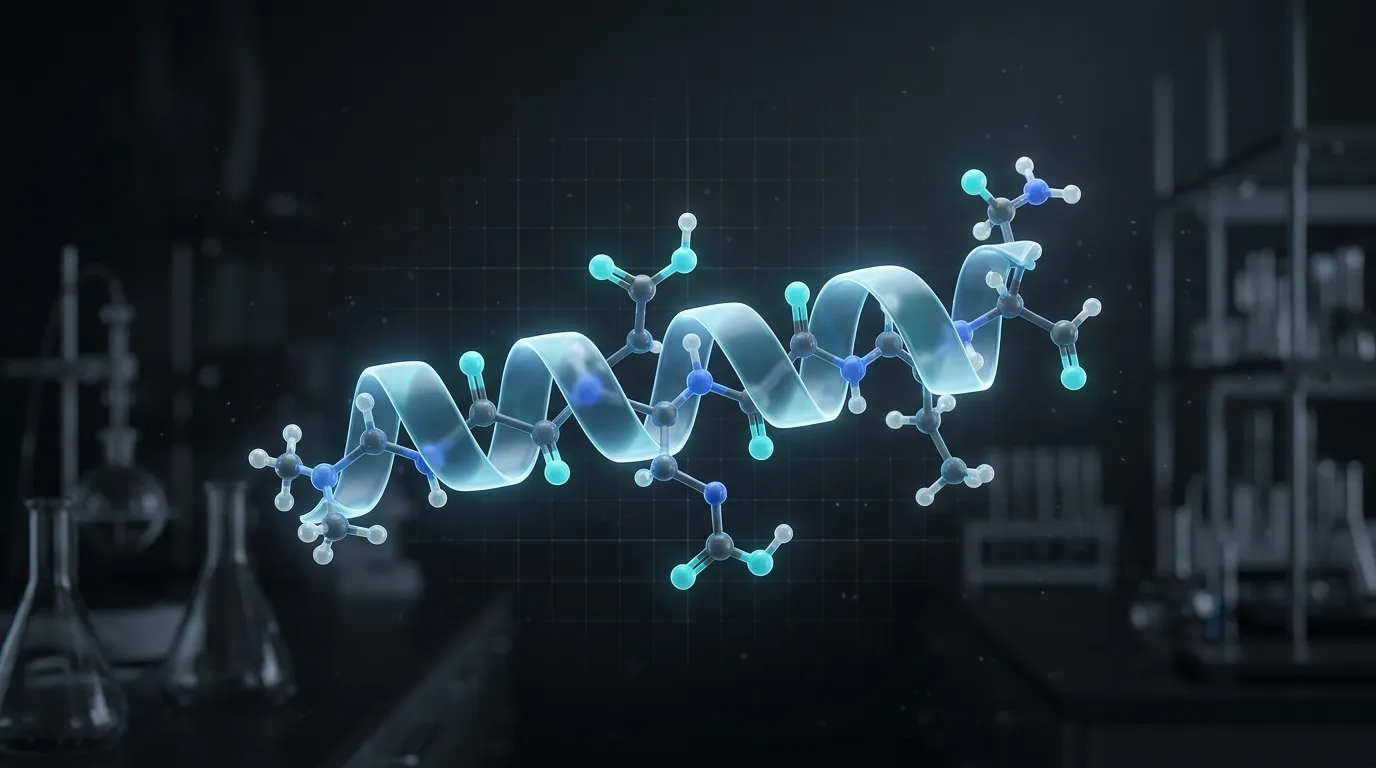
BPC-157 is a synthetic 15-amino-acid peptide, a pentadecapeptide, with the sequence GEPPPGKPADDAGLV and a molecular weight of roughly 1419 Da [1]. Those three letters stand for Body Protection Compound. The molecule is modeled on a fragment found in human gastric juice, and the synthetic version matches that natural sequence [1].
Fifteen residues is small for a peptide drug candidate. BPC-157 weighs about a quarter as much as a molecule of human insulin. That places it near the bottom of the size range for peptide drug candidates [1]. Three prolines sit consecutively at positions 3 to 5, and that rigid stretch is the structural reason the molecule resists pepsin (analytical evidence) [1].
In research, BPC-157 appears almost entirely in injury models. Rodent tissue-repair studies and gastrointestinal lesion studies account for the bulk of the literature [1,3]. Nothing in that record establishes a therapeutic use. Primetime Biolabs supplies BPC-157 for laboratory and in-vitro research only, not for human or animal consumption.
Why Is It Called BPC-157?
Predrag Sikiric and colleagues at the University of Zagreb ran a screening program on gastric-juice peptide fractions in the early 1990s. The numeral marks this sequence as the 157th candidate compound from that program [1]. Literature first described the peptide in 1993, calling it a possible free radical scavenger and organoprotection mediator [3].
The gastric-juice origin is not a piece of trivia. It explains the one property that separates BPC-157 from most peptides. The molecule stays intact in acid and pepsin, where comparable sequences are hydrolyzed within minutes [1]. Every argument later made for oral research routes traces back to that single observation.
That single origin also shaped the evidence base in a way any reader should weigh. More than 190 PubMed-indexed papers named BPC 157 as of May 2025 [4]. Over 80% carry Sikiric or Seiwerth as first or senior author [4]. Independent laboratories have contributed a handful of in-vitro and short-term rodent studies. A 2022 pharmacokinetic study from a group in Xi'an was the first full PK dataset generated outside that program [2].
How Does BPC-157 Work?
Nobody has identified a high-affinity receptor for BPC-157 after three decades of work [1]. The mechanisms below are proposed, not established, and each label marks the evidence behind it.
Upregulation of VEGF and its receptor VEGFR2 is the most cited pathway. In rodents it drives new blood vessel growth at injury sites (animal, in vitro) [1]. Egr-1 and its partner NAB2, both transcription regulators, also rise after exposure. That switches on downstream repair genes including PDGF and TGF-beta (in vitro, animal) [1]. Modulation of the nitric oxide system through eNOS, paired with heme oxygenase-1 upregulation, appears across gastroprotection studies (animal) [1]. Growth hormone receptor expression rose in cultured tendon fibroblasts (in vitro) [5]. Interaction with dopamine signaling shows up in rodent gastric protection and behavioral models (animal) [3].
One finding complicates all of this. Plasma half-life runs under 30 minutes in rats, dogs, and the two humans studied so far. Effects reported in injury models run for days or weeks [1]. The most parsimonious reading is that a brief exposure triggers repair processes. Their timing is then set by cell biology, not by how long the peptide lingers [1]. That reading is reasonable and widely shared. It is not proven.
Here is where the honest limit sits. A mechanism observed in a rat model is a mechanism in rats. Human tissue may respond differently, and no human study has measured any of these pathways after administration. Until a molecular target is defined, no mechanism claim about BPC-157 can be called settled.
What Has BPC-157 Been Studied For?
Nine tissue areas appear in the literature, with sharply different depth in each. The breakdown below grades what exists in every one.
Tendon and Ligament
Tendon work is the largest musculoskeletal body of research on any peptide of this class.
- What was studied: Achilles tendon transection and ligament injury models in rats.
- Evidence type: Animal, plus one small retrospective clinical analysis.
- Grade: Moderate in rodents, and nothing established in humans.
- Key limitation: A 2025 systematic review found 36 studies, of which 35 were preclinical [6].
Gut
Gut models are the home turf, which follows from where the molecule came from. Rodents given high-dose aspirin, indomethacin, or diclofenac showed lesion areas reduced by more than 75% (animal) [3].
- What was studied: NSAID lesions, colitis, anastomosis and colonic fistula healing.
- Evidence type: Animal, plus small and largely uncontrolled human enema studies.
- Grade: Deepest of the set, and still thin by clinical standards.
- Key limitation: The only controlled human trial survives as a 2005 meeting abstract [3].
Muscle
- What was studied: Transection, crush injury, and muscle-to-bone reattachment models.
- Evidence type: Animal only, across rat surgical models.
- Grade: Consistent in rodents, and untested in people.
- Key limitation: No dose-response curve has been established in any species [1].
Bone
- What was studied: Fracture healing and segmental bone defect models.
- Evidence type: Animal only, in rodent surgical models.
- Grade: Limited, resting on a small number of studies.
- Key limitation: No independent replication outside the original research program.
Nerve and Spinal Cord
- What was studied: Sciatic nerve transection and spinal cord compression models.
- Evidence type: Animal only, resting on histology-led endpoints.
- Grade: Limited, and a long way from any clinical claim.
- Key limitation: Functional outcome data in humans does not exist.
Brain
- What was studied: Dopaminergic disturbance, traumatic brain injury, and ischemia models.
- Evidence type: Animal only, reported mainly in rats.
- Grade: Limited, and complicated by the distribution data.
- Key limitation: Tracer studies put brain among the lowest-uptake tissues measured [1].
Skin and Eye
- What was studied: Burn wounds, alkali burns, and corneal injury models.
- Evidence type: Animal and in vitro, mostly under local application.
- Grade: Limited, and built on narrow structural endpoints.
- Key limitation: No human trial has tested either tissue.
Liver
- What was studied: Toxin-induced and NSAID-induced liver injury models [3].
- Evidence type: Animal only, in short-term rodent models.
- Grade: Limited, and heavily dependent on study design.
- Key limitation: Most designs treat before the injury, so post-injury effect is untested.
Heart
- What was studied: Arrhythmia and cardiac ischemia models in rodents.
- Evidence type: Animal only, in small study groups.
- Grade: Weak, and the thinnest area in the whole set.
- Key limitation: Every published study traces back to one research group.
Seven of those nine areas share a single shape. Effects are reported consistently, the endpoints are usually histological, and the studies rarely come from more than one laboratory. Volume of publication is not the same thing as independent confirmation.
What Don't the Studies Show Yet?
No completed Phase 1 trial of BPC-157 appears in a peer-reviewed journal as of September 2026. A Phase 1 study of oral tablets in healthy volunteers was registered as NCT02637284. Estimated enrollment was 42 subjects, and no results were ever posted [3].
The FDA's own literature search found five clinical studies using BPC-157 [3]. Two used rectal enemas, in 24 healthy subjects and in roughly 26 subjects with ulcerative colitis. One delivered intra-articular injections to 17 subjects with knee pain. Another treated 12 subjects with interstitial cystitis by intravesical injection, with no reported adverse events. The most recent gave intravenous infusions of 10 mg and 20 mg to 2 healthy adults, with no adverse effects observed [7].
Around 30 people total, across five uncontrolled or barely controlled studies, in three decades. Say that plainly before reading any benefit claim.
Four things would need to exist first. Start with a bioanalytical method validated to regulatory standards for human plasma. Add dose-response data from more than a single dose level, and independent replication outside the Zagreb program. An adequately powered randomized trial with a defined clinical endpoint would follow [1].
Is BPC-157 Safe?
Nobody has established a lethal dose in animals. Single-dose intramuscular no-observed-adverse-effect levels were set in both rats and dogs without histopathological damage (animal) [3]. Genotoxicity testing came back negative across Ames assays, chromosome aberration tests, and a mouse micronucleus assay (analytical) [3]. Pregnant rats dosed through organogenesis showed no effect on fetal weight, viability, or malformation rates (animal) [3]. No study has covered a full reproductive cycle.
The 28-day repeat-dose picture is not clean, and vendor summaries often say it is. FDA reviewers reading those studies flagged signals they called clinically relevant (animal) [3]. Activated partial thromboplastin time shortened in rats and lengthened in dogs, and serum ALT, glucose, and triglycerides rose. Altered clotting parameters in two species is a finding worth naming. No longer-duration study exists to say whether those signals persist.
Human reports are sparse and mixed. Enema trial participants most often reported headache and flatulence (human observational) [3]. FAERS holds three case reports tied to compounded injectable BPC-157 [3]. One described injection-site redness and swelling alongside concurrent thymosin use. Another described shortness of breath that prompted an emergency room visit. The third described diffuse hyperpigmentation and gum darkening, which recurred on rechallenge with a blended product. Nausea, dizziness, hot flashes, and blood pressure swings circulate in user communities as anecdotal reports with no published support.
Then there is cancer, where both sides deserve stating. A pro-angiogenic molecule is a plausible tumor-promotion hazard, because new vessel growth is how tumors feed. No in-vivo study in tumor-bearing hosts has ever tested it (theoretical) [4]. The counter-claim of anti-tumor activity rests on one 2004 melanoma cell-line experiment (in vitro) [4]. It was published as a conference abstract and never independently replicated. FDA found no carcinogenicity studies at all [3]. The science has not resolved this, and neither will this article.
What's BPC-157's Legal Status?
BPC-157 is not FDA-approved for any indication. No country lists an approved product containing it, and it has no monograph in the US, European, Japanese, or International Pharmacopeias [3].
On 23 July 2026, the FDA's Pharmacy Compounding Advisory Committee took up BPC-157 free base and BPC-157 acetate. Members voted 8 in favor and 6 against, with one abstention, to recommend both for the 503A bulks list [8]. FDA staff had recommended against it, citing poor physicochemical characterization, immunogenicity risk, and a lack of evidence for the proposed ulcerative colitis use [3]. Committee votes of this kind are advisory only. Formal rulemaking would still be required, and nothing about the vote makes BPC-157 an approved drug.
Two specifics from that briefing are worth carrying. FAERS holds three adverse event reports tied to compounded injectable product [3]. Suppliers also sell free base and acetate under the same common name. FDA called that a safety risk, because the two are different active pharmaceutical ingredients [3].
In sport, the position is unambiguous. WADA added BPC-157 by name to the 2022 Prohibited List under S0, non-approved substances [9]. No substance had ever been named as an example in that section before. The ban applies at all times, and no therapeutic use exemption is available. US service members face a parallel restriction, since the Department of Defense lists the peptide as prohibited.
Does Oral BPC-157 Work as Well as Injectable?
Gastric stability and oral absorption are two different questions, and the literature often blurs them. Surviving pepsin only clears the first of four barriers. Intestinal proteolysis, epithelial permeability, and first-pass liver metabolism remain entirely uncharacterized for this molecule [1].
Oral routes do have real evidence behind them in the gut. Rodent studies giving the peptide by gavage or in drinking water reported protection against NSAID lesions and healing of colonic fistulas (animal) [3]. A January 2025 rat study reported muscle-to-bone reattachment after per-oral treatment, which is the strongest oral musculoskeletal result published (animal) [10].
The numbers tell the harder part of the story. Absolute intramuscular bioavailability measured 14% to 19% in rats and 45% to 51% in dogs [2]. That gap is wide enough to make human prediction unreliable. Oral systemic bioavailability has never been measured in any species [1,2]. In the two human rectal studies that sampled blood, the peptide was not detected in plasma at all [3]. Gut-local activity and systemic delivery are not the same claim, and only the first has support.
What Should a BPC-157 COA Show?
A usable certificate of analysis names the full sequence and reports an HPLC purity figure with the method stated. It confirms identity by mass spectrometry and ties the result to a traceable batch number. Identity, purity, quantity, composition, traceability, and method are separate attributes, and a single percentage covers only one of them.
FDA reviewers looked at publicly posted BPC-157 certificates. Most contained purity testing and nothing else, with no impurity profile, no bioburden count, and no endotoxin result [3]. That gap is the practical reason to read a certificate closely.
A COA does not establish safety, efficacy, sterility, or net peptide content. Batch documents for our BPC-157 10 mg research vial are posted at /certificates. Our guide to reading a peptide certificate of analysis walks through each section line by line.
Key Moments in BPC-157 Research
- 1993: Sikiric's group publishes the first description of BPC-157 in Zagreb [3].
- 2005: A multicenter enema trial in ulcerative colitis reports as a meeting abstract, never as a full paper [3].
- 2022: WADA names BPC-157 in the S0 category, and the first independent pharmacokinetic study publishes [2,9].
- 2024 to 2025: Three small human pilots appear, covering knee pain, interstitial cystitis, and intravenous safety [3,7].
- July 2026: The FDA's compounding advisory committee votes 8 to 6 to recommend 503A listing, against staff advice [8].
The Bottom Line on BPC-157
Thirty-three years of research have produced a mature preclinical file and an almost empty clinical one. The rodent work is consistent and the mechanisms are plausible. Concentrating almost all of it in one laboratory is a limitation that volume alone cannot fix. Human evidence stands at roughly 30 subjects across five small studies.
For a methods section, what can be cited is narrow and specific. A described synthesis method, a stated sequence, and independently verified analytical results are the whole list. Purity is a measurement, not a safety finding. Everything beyond that remains a research question, and choosing a supplier is a separate exercise in documentation.
Primetime Biolabs products are supplied for laboratory and in-vitro research only. They are not for human or animal consumption.