Peptide Reconstitution Calculator
Peptide reconstitution is the process of dissolving a lyophilized peptide powder in a measured volume of diluent to produce a solution of known strength. This peptide reconstitution calculator takes two numbers, the peptide mass in your vial and the diluent volume you add. It returns the working concentration in mg/mL and mcg/mL.
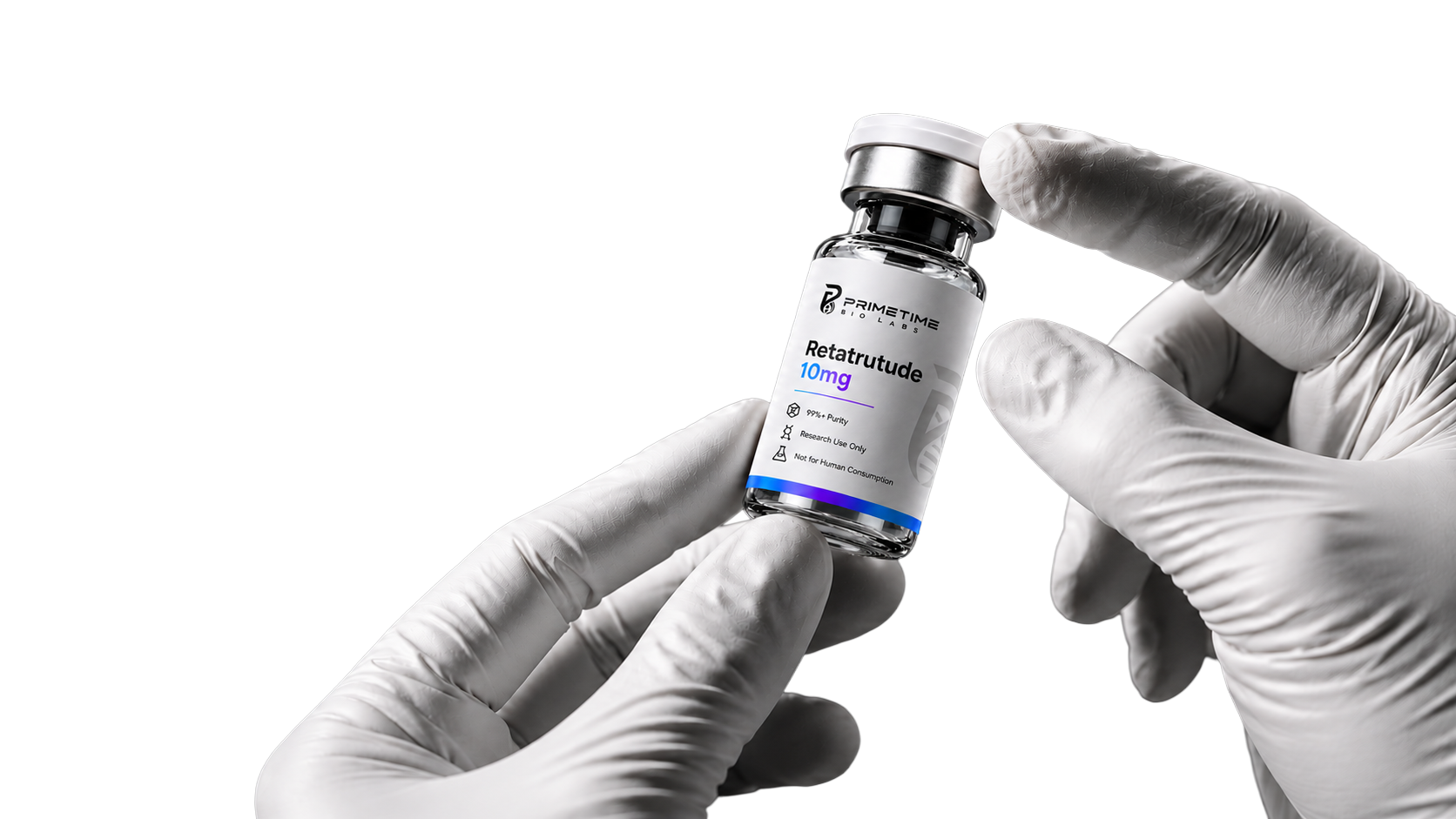
The scope here is deliberate: this tool does concentration math, nothing else. Vial mass in milligrams plus diluent volume in milliliters gives you mg/mL and mcg/mL. It produces no dose figures, no administration guidance and no protocol advice, by design.
Concentration Calculator
Enter the peptide mass printed on the vial and the volume of diluent you plan to add. The calculator returns the working concentration of the finished solution in mg/mL and mcg/mL. Volume is an input you choose, not a result. This calculator is for research use only.
One decimal decides every number that follows
Reconstitution is where a vial gets its number. Every measurement you take from that vial afterward inherits it.
Decimals Compound
A misplaced decimal does not stay in one place. Write 0.5 mL where you meant 5 mL and the concentration is ten times off, silently, for the life of the vial. Each sample you measure out carries that error forward. So does every dilution you prepare from it, and every figure you write in the log.
Unit Precision
Mixing up milligrams and micrograms is worse. That mistake is off by a factor of 1,000.
Good Practice
Good practice here is unglamorous. Read the vial label, not your memory of it. Measure the diluent volume with a calibrated device. Run the calculation, then check it against the batch Certificate of Analysis before anything goes on paper.
Step 1. Prep
01Let both the vial and the diluent sit until they reach room temperature. Wipe both stoppers with an alcohol swab and let them dry. Work on a clean, uncluttered surface with the calculation already done and written down. Knowing your target concentration before you open anything removes the guesswork later.
Step 2. Transfer
02Measure your chosen diluent volume accurately, then angle the vial and run the liquid slowly down the inside glass wall. A slow transfer matters, since a fast stream aimed straight at the powder drives shear and starts foaming, and both damage peptide structure. Keep the vial upright once the transfer is complete.
Step 3. Dissolve
03Swirl the vial gently, or roll it between your palms. Then wait for the powder to dissolve on its own. Most lyophilized peptides need only a few minutes, and some need longer. Shaking is the one thing to avoid completely. If the solution stays cloudy or leaves visible particles after it has had time to settle, treat the vial as compromised.
How to reconstitute peptides in three steps
TL;DR
Bring the vial and diluent to room temperature. Measure your chosen volume of bacteriostatic water into a sterile syringe or pipette. Transfer it slowly down the inside wall of the vial, letting it run onto the powder rather than jetting into it. Swirl gently, never shake, and leave it to dissolve on its own. Label the vial with the concentration and date, then store it cold.
Choosing your water volume
Your diluent volume is a measuring decision. The vial mass is fixed, so volume is the only lever you have over concentration.
More diluent gives a lower concentration. Each portion you measure out is physically larger, which makes it easier to measure accurately with ordinary lab equipment. Less diluent gives a higher concentration and smaller sample volumes, which saves space but demands finer measuring precision.
Neither option is correct in isolation. Pick the one that matches the measuring equipment you actually have and the volumes it reads reliably.
Milligrams, micrograms and milliliters are not interchangeable
Three units do the work on this page, and two of them measure the same thing.
Milligram (mg)
Milligram (mg) measures mass, the amount of peptide sitting in the vial. It is the number printed on the label.
Microgram (mcg)
Microgram (mcg) also measures mass, just on a smaller scale. One milligram equals 1,000 micrograms. A 5 mg vial holds 5,000 mcg of peptide.
Milliliter (mL)
Milliliter (mL) measures volume, the amount of liquid. It describes the diluent you add and the solution you end up with. Volume tells you nothing about how much peptide is present on its own.
The Factor of 1,000
The mg and mcg confusion is the expensive one. Both measure mass, both start with the letter m, and they differ by a factor of 1,000. A number written as 250 is meaningless without its unit attached. Write the unit every time, on every label and in every log line, and the error has nowhere to hide.
The math behind every result on this page
Define the terms first, then the formula reads itself.
The milligram figure printed on the vial (mg).
The liquid volume you add (mL).
Peptide mass divided by diluent volume.
Form One
Form Two
Worked example
A 10 mg vial reconstituted with 3 mL of bacteriostatic water:
The canonical case
A 5 mg vial reconstituted with 2 mL:
Verify it yourself
Both forms are one operation each, so you can check any result the calculator gives you on paper in about ten seconds. Divide the label mass by the volume you added. Multiply by 1,000 for micrograms. If your figure and the tool's figure disagree, one of the two inputs was entered wrong.
A note on rounding: some divisions do not resolve cleanly, and 10 ÷ 3 is one of them. Values here are rounded to two decimal places for mg/mL and to the nearest whole number for mcg/mL.
Every concentration figure on this page — all 18 table rows, the worked examples, and the calculator output — is computed from the two formulas above. Milligram values are rounded to two decimals, microgram values to whole numbers. The worked examples are cross-checked against the table.
Common vial sizes and what each diluent volume gives you
Use this reconstitution chart to look up the concentration for common vial sizes and diluent combinations.
How to read this table: Find your vial size in the first column, then the diluent volume you plan to add. The third column is the concentration of the finished solution. These are calculated figures for the stated inputs, not recommendations.
| Vial size | Diluent volume | Concentration |
|---|---|---|
| 2 mg | 1 mL | 2 mg/mL (2,000 mcg/mL) |
| 2 mg | 2 mL | 1 mg/mL (1,000 mcg/mL) |
| 2 mg | 3 mL | 0.67 mg/mL (667 mcg/mL) |
| 3 mg | 1 mL | 3 mg/mL (3,000 mcg/mL) |
| 3 mg | 2 mL | 1.5 mg/mL (1,500 mcg/mL) |
| 3 mg | 3 mL | 1 mg/mL (1,000 mcg/mL) |
| 5 mg | 1 mL | 5 mg/mL (5,000 mcg/mL) |
| 5 mg | 2 mL | 2.5 mg/mL (2,500 mcg/mL) |
| 5 mg | 3 mL | 1.67 mg/mL (1,667 mcg/mL) |
| 10 mg | 1 mL | 10 mg/mL (10,000 mcg/mL) |
| 10 mg | 2 mL | 5 mg/mL (5,000 mcg/mL) |
| 10 mg | 3 mL | 3.33 mg/mL (3,333 mcg/mL) |
| 15 mg | 1 mL | 15 mg/mL (15,000 mcg/mL) |
| 15 mg | 2 mL | 7.5 mg/mL (7,500 mcg/mL) |
| 15 mg | 3 mL | 5 mg/mL (5,000 mcg/mL) |
| 30 mg | 1 mL | 30 mg/mL (30,000 mcg/mL) |
| 30 mg | 2 mL | 15 mg/mL (15,000 mcg/mL) |
| 30 mg | 3 mL | 10 mg/mL (10,000 mcg/mL) |
Three values are rounded from repeating decimals: 0.67, 1.67 and 3.33 mg/mL. The calculator carries the full precision.
Cold, dark and dated, before and after mixing
Lyophilized powder (unopened)
- Store sealed vials at 2 °C to 8 °C for routine holding. For long-term storage, keep them at -20 °C or colder.
- Keep vials in their original carton or another opaque container. Light and moisture both degrade dry peptide, and a dry cake will pull water out of humid air through a punctured stopper.
- Dry peptide is far more stable than peptide in solution. A properly stored, sealed lyophilized vial holds its integrity for months to years, where the same material in water is measured in weeks.
Reconstituted solution
- Store at 2 °C to 8 °C immediately after mixing. Return the vial to the refrigerator between every use.
- Label the vial at the moment you reconstitute it, with the concentration and the date. An unlabeled vial in a shared fridge is an unusable vial.
- Keep it out of light and away from the refrigerator door, where the temperature swings most.
Side by side
| Property | Lyophilized (dry) | Reconstituted (in solution) |
|---|---|---|
| Storage temperature | 2 °C to 8 °C routine, -20 °C or below long term | 2 °C to 8 °C |
| Typical stability window | Months to years, sealed and dry | Around 28 days at 2 °C to 8 °C in bacteriostatic water |
| Light exposure | Keep dark | Keep dark |
| Freezing | Suitable, and standard for long holding | Avoid for bacteriostatic water solutions |
| Main risk | Moisture ingress through the stopper | Microbial growth, aggregation, freeze-thaw damage |
Stability windows vary by peptide sequence, diluent and handling. Treat the 28-day figure as a working reference for bacteriostatic water at refrigeration temperature, not a guarantee for every compound.
Five mistakes that ruin a vial
Shaking it
Vigorous shaking forces peptide against the air-water interface and drives foaming. Both unfold peptide structure and push it toward aggregation. Swirl gently, then let time do the rest.
Jetting the diluent onto the powder
A fast stream aimed straight at the cake applies shear exactly where the material is most fragile. Run the liquid down the vial wall so it reaches the powder gently.
Topping up a vial that has already been reconstituted
Adding more diluent later changes the concentration of everything left in the vial. Your original figure is now wrong, and so is every record derived from it. If you need a lower concentration, prepare it as a separate dilution and label it separately.
Leaving it on the bench
Room temperature is the enemy of a reconstituted vial. Warmth accelerates hydrolysis and oxidation, and every hour out of the fridge is subtracted from the vial's usable life.
Skipping the label
The concentration lives in your head for about a day. Write the mg/mL figure and the date on the vial before it goes anywhere. An unlabeled solution cannot be verified, so it should not be used.
What mg/mL actually tells you
Concentration expressed as mg/mL is the mass of peptide contained in each milliliter of finished solution. A vial at 2.5 mg/mL holds 2.5 milligrams of peptide in every milliliter present. The figure describes the solution itself, so it holds true for any portion you measure out.
One property surprises people: concentration does not change when you remove solution from the vial. Take out half and the remaining liquid is still 2.5 mg/mL, because mass and volume fall together. Concentration only moves when you alter the mass or the volume, and after reconstitution the only realistic way to move it is adding more diluent.
Visual Difference
Notice how the same 5 mg vial reads 5 mg/mL at 1 mL, but only 1.67 mg/mL at 3 mL.
Switching to mcg/mL
Small concentrations are awkward to read in milligrams, so micrograms are often clearer. The conversion is one multiplication:
Worked micro-example
A 2 mg vial in 3 mL of diluent gives 0.67 mg/mL once rounded. Carry the unrounded figure through the multiplication and it becomes 667 mcg/mL. Same solution, same measurement, different unit. Reading 667 is less error-prone than reading 0.67, which is the whole reason the second unit exists.
Going the other way, divide by 1,000. So 200 mcg/mL is 0.2 mg/mL.
What actually breaks a peptide down
Peptides degrade through chemistry, not through age alone. Five factors drive nearly all of it.
Temperature
Heat accelerates hydrolysis, the reaction that cleaves the peptide bond. Every degree above refrigeration shortens the usable life of a solution, and the effect compounds with time at temperature.
Freeze-thaw cycling
Ice crystal formation concentrates solutes and creates new interfaces, both of which unfold and aggregate peptide. One freeze and one thaw is survivable for many sequences. Repeated cycling is not, which is why single-use aliquots exist.
Light
Ultraviolet and visible light excite aromatic residues, tryptophan and tyrosine in particular, and set off photo-oxidation. Clear glass on an open shelf is the worst case.
Oxidation
Methionine and cysteine residues react readily with dissolved oxygen and trace metals. Headspace air in a part-used vial is a continuous oxygen supply, and each entry replenishes it.
Sequence itself
Some peptides are simply more fragile. Asparagine and glutamine deamidate, aspartate-glycine pairs undergo isomerization, and free cysteines form unwanted disulfide bridges. Two compounds stored side by side under identical conditions can hold up very differently.
Glossary
Reconstitution
Reconstitution is the process of dissolving a lyophilized peptide powder in a liquid diluent to form a solution. The peptide mass in the vial does not change. The volume of diluent you add sets the concentration. Once dissolved, the material is handled and recorded as a solution with a known mass per milliliter.
Lyophilized
Lyophilized means freeze dried: the material is frozen, then water is drawn off under vacuum, leaving a dry cake or powder in the vial. Removing water slows the reactions that break peptides apart. A sealed lyophilized vial therefore stays stable far longer than the same peptide sitting in solution.
Diluent
A diluent is the liquid added to a lyophilized vial to dissolve its contents, usually bacteriostatic water or sterile water in peptide work. The diluent contributes volume, not peptide mass. Its measured volume is the denominator in every concentration calculation you run on that vial, which makes measuring it accurately essential.
Concentration
Concentration is the amount of peptide present per unit volume of solution, written as mass over volume in mg/mL or mcg/mL. It is a ratio, so it stays constant across the vial. Concentration changes only when the peptide mass or the liquid volume changes, not when solution is removed.
Bacteriostatic water
Bacteriostatic water is sterile water containing 0.9 percent benzyl alcohol, a preservative that suppresses bacterial growth. The preservative allows a sealed vial to be entered more than once without the contamination risk of plain water. Laboratories choose it when a reconstituted peptide will be sampled repeatedly across days or weeks.
Sterile water
Sterile water is purified water with no preservative added. Because it carries no bacteriostatic agent, a vial reconstituted with it has no defense against microbial growth once the stopper has been entered. It suits single-use preparations and peptides known to be incompatible with benzyl alcohol.
Aliquot
An aliquot is a measured portion taken from a larger volume of solution and stored separately. Splitting a reconstituted vial into aliquots lets you work from one small portion while the rest stays sealed. That limits how often the main stock is opened, warmed, or exposed to light and oxygen.
Working concentration
Working concentration is the mg/mL figure a vial holds after reconstitution, the number every later measurement from that vial depends on. It is fixed at the moment you add the diluent. Recording it on the vial label, alongside the date, is what makes the solution traceable afterward.
Peptide Reconstitution FAQs
Answers to the questions researchers actually ask about reconstitution, storage and measurement.
Peptide reconstitution is dissolving a lyophilized peptide powder in a measured volume of diluent to make a solution of known concentration. The vial's peptide mass is fixed by the manufacturer. You choose the volume of liquid you add, and those two numbers together determine the strength of the finished solution in mg/mL.
Divide the peptide mass printed on the vial by the diluent volume you added. A 10 mg vial in 2 mL of bacteriostatic water gives 10 ÷ 2, which is 5 mg/mL. To express the same result in micrograms, multiply by 1,000, giving 5,000 mcg/mL. The calculator on this page runs both steps.
There is no single correct volume, because the volume you choose is what sets the concentration. Adding 1 mL to a 5 mg vial gives 5 mg/mL. Adding 2 mL gives 2.5 mg/mL. Adding 3 mL gives roughly 1.67 mg/mL. Larger volumes produce lower concentrations and physically larger sample volumes to measure.
Again, the volume is your decision and it determines the result. One milliliter gives 10 mg/mL, two milliliters give 5 mg/mL, and three milliliters give 3.33 mg/mL. Choose based on the measuring equipment you have. Lower concentrations mean bigger volumes, which most pipettes and graduated devices read more reliably.
Yes, and this catches people out. The peptide mass in the vial never changes, so adding diluent spreads that same mass across more liquid and lowers the concentration. A 5 mg vial at 2 mL sits at 2.5 mg/mL. Add another milliliter and it drops to roughly 1.67 mg/mL, so any earlier calculation is void.
Around 28 days at 2 °C to 8 °C is the working reference for a peptide reconstituted in bacteriostatic water. Sterile water gives a shorter window, since it has no preservative. Actual stability depends on the peptide sequence, how often the vial is opened, and how consistently it stays cold between uses.
Generally avoid it for solutions made with bacteriostatic water. Freezing and thawing forms ice crystals that unfold and aggregate peptide, and repeated cycles compound the damage. If a solution must be held beyond its refrigerated window, split it into single-use aliquots first and thaw each one only once.
Bacteriostatic water suits any vial that will be entered more than once. Its 0.9 percent benzyl alcohol suppresses bacterial growth between uses. Sterile water contains no preservative, so it fits single-use preparations and peptides known to react badly with benzyl alcohol. For most multi-day laboratory work, bacteriostatic water is the standard choice.
Shaking forces the solution against the air-water interface and creates foam. Peptides unfold at that interface, then clump together, and aggregated peptide does not return to its original state. Swirl the vial gently or roll it between your palms and leave it to dissolve on its own; patience costs nothing here.
Milligrams per milliliter states how much peptide mass sits in each milliliter of solution. A vial at 2.5 mg/mL contains 2.5 milligrams of peptide in every milliliter of liquid present. Because it is a ratio describing the whole solution, the figure holds for any portion you measure out of the vial.
Divide by 1,000, so 200 mcg equals 0.2 mg. Going the other direction, multiply milligrams by 1,000 to get micrograms, which makes 0.2 mg equal to 200 mcg. Mixing these two units is a thousand-fold error, so write the unit alongside every number you record.
No, and that is intentional: this tool performs concentration math only, converting a vial mass and a diluent volume into mg/mL and mcg/mL. It produces no dose figures, volumes to measure out for any purpose, or usage guidance. All products and calculations here are for laboratory research use only.
Every peptide in our catalogue arrives as lyophilised powder with the Certificate of Analysis for its batch. Shop research peptides or view Certificates of Analysis.