
What Is a Certificate of Analysis?
A Certificate of Analysis, or COA, is a batch-specific document recording a research peptide's measured purity, confirmed identity and physical characteristics. It exists so a purity claim is checkable rather than stated — the number on the label is only as good as the document that backs it.
Every legitimate COA is tied to one production batch, identified by a batch or lot number that also appears on the vial label. A COA that isn't batch-specific is not evidence of anything — it's a template.
The Five Things Every COA Must Show
Regardless of format, a COA worth trusting records the same five pieces of information:
- HPLC purity result, with the chromatogram attached
- Mass spectrometry identity result, with the observed mass
- The batch or lot number
- The name of the testing laboratory
- The date the analysis was performed
How to Read the HPLC Purity Result
High-performance liquid chromatography separates the target peptide from synthesis by-products, truncated sequences and residual reagents. The output is a chromatogram — a chart of peaks, each representing a compound present in the sample. The purity figure on the COA is the area of the main peak as a percentage of total peak area.
A purity number without the chromatogram attached is a claim you can't inspect. The chromatogram is what lets you see the impurity profile behind the number, not just take it on faith.
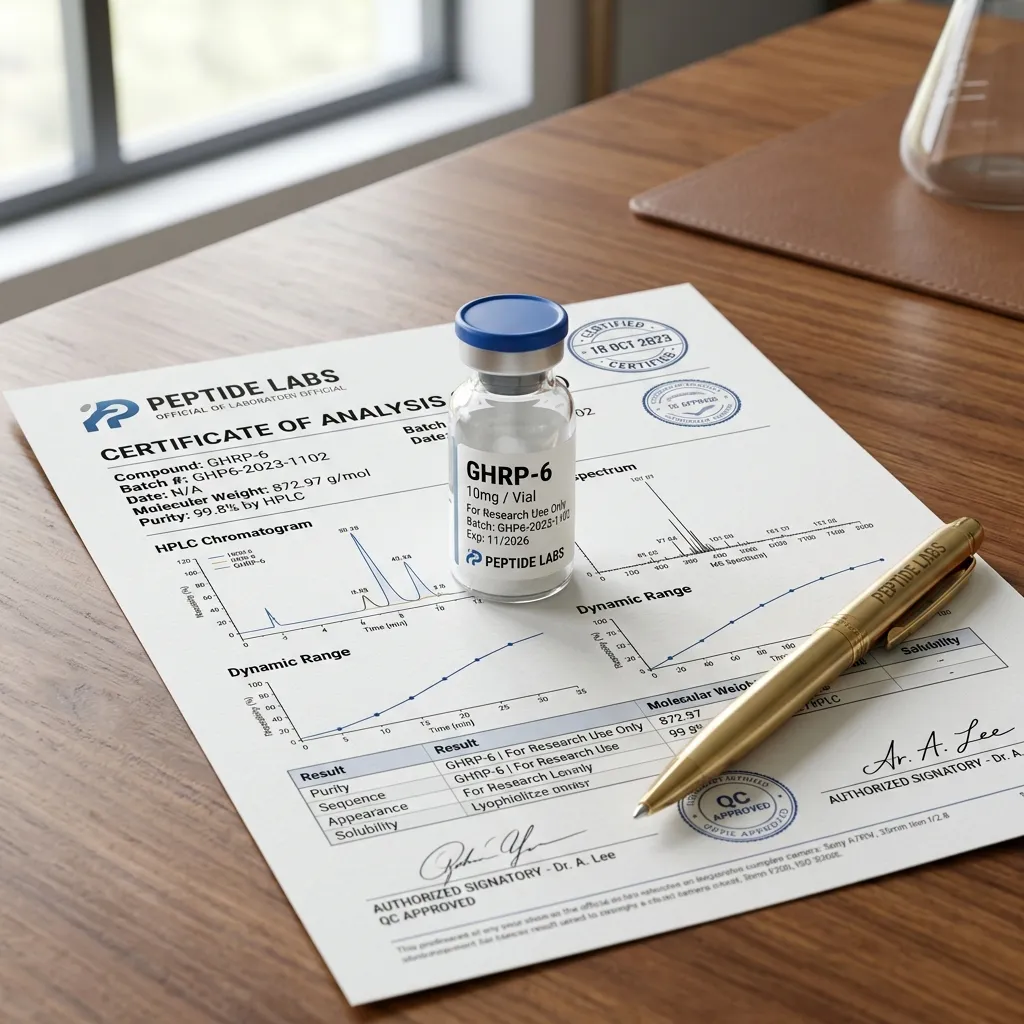
What a Chromatogram Actually Looks Like
A chromatogram plots detector response against retention time — how long each compound took to travel through the column. A clean batch produces one tall, narrow peak that dominates the chart, with the baseline flat everywhere else. That dominant peak is the target peptide.
A batch with problems looks different: smaller secondary peaks appear before or after the main one, representing truncated sequences left over from an incomplete synthesis cycle, or by-products that survived purification. The purity percentage on the COA is simply the main peak's share of the total area under every peak on the chart — which is exactly why the chart itself matters more than the number alone.
How to Read the Mass Spectrometry Identity Result
HPLC tells you how pure the sample is. Mass spectrometry tells you what it actually is. The instrument measures the molecular mass of the compound and compares it against the theoretical mass calculated from the sequence. When the observed and theoretical masses agree within tolerance, identity holds.
A batch that clears both tests carries documented purity and documented identity — not one or the other. A COA that reports a purity percentage but no mass spectrometry result is incomplete.
Most peptide identity testing uses electrospray ionisation (ESI-MS) or matrix-assisted laser desorption/ionisation (MALDI-MS). Either method should return an observed mass close enough to the theoretical mass that the difference is explainable by normal instrument tolerance — typically a fraction of a percent, not a rounding error large enough to describe a different molecule.
Matching the Batch Number to Your Vial
The batch number is what connects the document to the physical vial in front of you. It should appear in three places: the vial label, the packing documentation, and the COA itself. If those three don't agree, the COA you're holding may not actually describe the material you received.

If you find a mismatch, don't proceed with the material. Contact the supplier, quote all three numbers you found, and ask them to confirm which COA actually corresponds to your vial before you use it in any protocol.
Common COA Mistakes Buyers Miss
- The same COA PDF reused across multiple, unrelated order confirmations
- A purity figure given without units or without stating it's a percentage of peak area
- No analyst name or laboratory signature anywhere on the document
- A testing date that predates the batch's stated synthesis date
- A chromatogram image that's clearly a stock graphic rather than an actual instrument printout
Red Flags: When a COA Should Make You Pause
- No batch number, or a batch number that doesn't match the vial
- A purity figure with no chromatogram to support it
- The testing laboratory isn't named, or is the seller's own facility
- The same COA is reused across multiple, unrelated orders
- No mass spectrometry identity result at all
How Often Should You Request a Fresh COA?
Every time you order, even if you've bought the exact same product before. A COA describes one batch, not one product — a new production run means new raw material, a new synthesis run, and a new independent test, all of which produce a new document. Treating an old COA as valid for a new order defeats the entire purpose of batch-specific testing.
How to Verify a COA With PrimeTime BioLabs
Every batch we release is tested by an independent laboratory, and the COA travels with the order — chromatogram, mass spectrometry result, batch number and analysis date included. We archive every COA we issue, so you can retrieve the original document again later by batch number, and our team can answer specific questions about any result.