
What Is Solid-Phase Peptide Synthesis?
Solid-phase peptide synthesis, or SPPS, builds a peptide chain one amino acid at a time on a solid resin support. The method anchors the first amino acid to an insoluble resin bead, then adds each subsequent residue in a controlled coupling cycle. Because the growing chain stays bound to the resin throughout, excess reagents and by-products wash away between cycles rather than contaminating the product.
This is why SPPS became the dominant method for research-grade peptide production: it is reproducible, scalable to a laboratory bench, and well suited to the short-to-medium chain lengths most research peptides fall into.
The SPPS Cycle, Step by Step
Step 1 — Anchoring the First Amino Acid
The first amino acid in the target sequence is attached, or anchored, to an insoluble resin bead through its carboxyl end. That anchor point is what allows every later washing step to work — the growing chain simply cannot be washed away with the reagents.
Step 2 — Deprotection
Each amino acid arrives with a temporary protecting group on its reactive amine end, preventing it from reacting with itself or coupling in the wrong order. Deprotection removes that group, exposing the site where the next amino acid will attach.
Step 3 — Coupling
The next amino acid in the sequence, itself protected, is introduced along with a coupling reagent that activates its carboxyl group. It bonds to the exposed site from the deprotection step, extending the chain by one residue.
Step 4 — Repeat Until Complete
Deprotection and coupling repeat, one amino acid at a time, until the full target sequence is assembled on the resin. Between every cycle, the resin is washed to clear excess reagent — this is the step that solution-phase synthesis cannot do as cleanly, and it's the core reason SPPS scales.
Step 5 — Cleavage and Purification
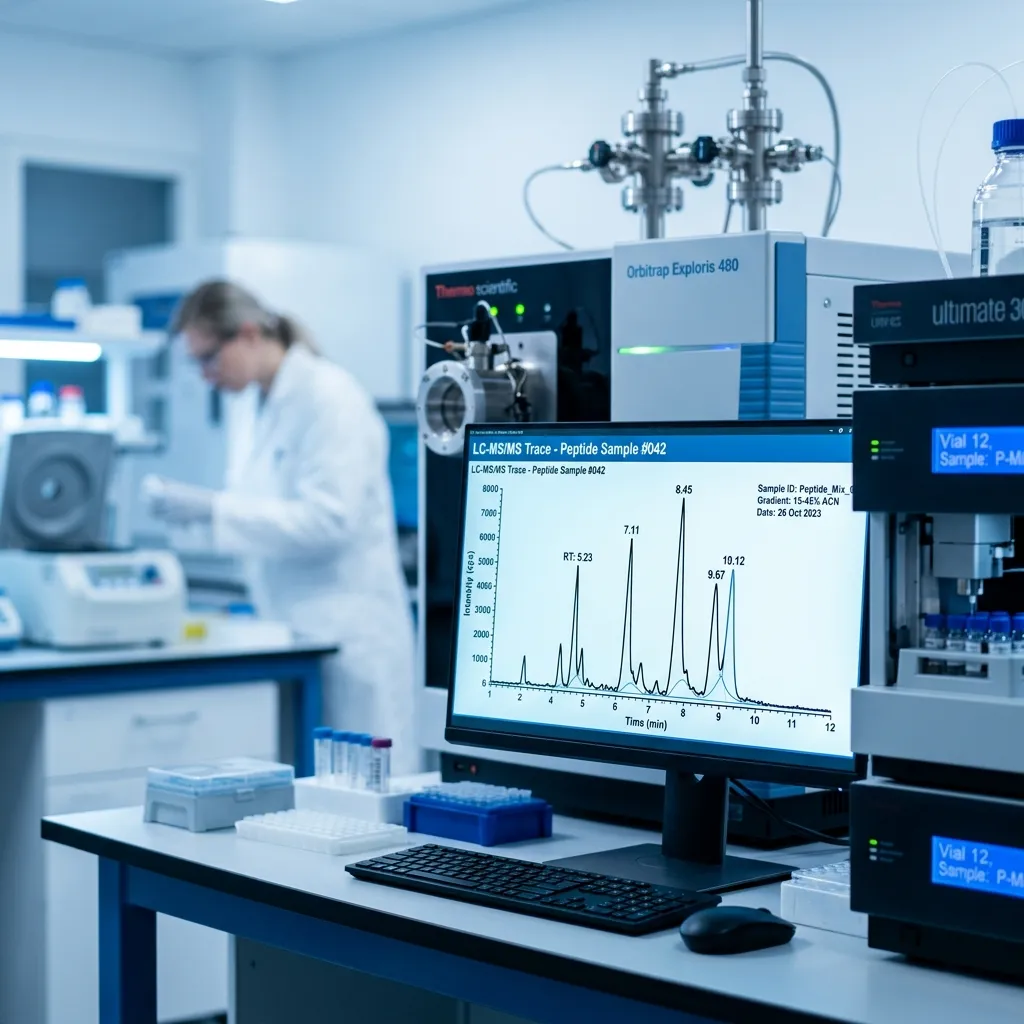
Once the sequence is complete, the finished chain is cleaved from the resin and its remaining protecting groups are removed. The crude peptide then goes through preparative chromatography to separate the target sequence from truncated chains and synthesis by-products, before independent analytical testing confirms purity and identity.
Common Errors in the SPPS Process
Every coupling cycle is a chance for something to go slightly wrong, and a documented process exists specifically to catch these before a batch is released:
- Incomplete coupling, which leaves a shorter “deletion sequence” missing one or more residues
- Aggregation of difficult sequences, where the growing chain folds on itself and blocks the next coupling step
- Side-chain protecting groups reacting unintentionally during synthesis
- Resin swelling problems that prevent reagents from reaching the full length of the chain evenly
How Chain Length Affects Difficulty
Every coupling cycle in SPPS runs at less than 100% efficiency — typically in the high nineties for a well-optimised step. That sounds close enough to perfect, but the effect compounds: at 99% yield per step, a 20-residue chain finishes around 82% theoretical yield, and a 50-residue chain drops below 60%. This is exactly why SPPS is the more direct route for short-to-medium peptides, and why very long chains increasingly favour other production methods.
Quality Checkpoints During Synthesis
A well-run synthesis doesn't wait until the final product to check quality. Analytical HPLC checks at key points during the build — particularly after difficult couplings — let a lab catch a failing synthesis early, before it consumes the remaining cycles on a chain that's already compromised.
Fmoc vs Boc Chemistry

SPPS is usually described by which protecting-group chemistry it uses. Fmoc (fluorenylmethyloxycarbonyl) chemistry is removed under mild basic conditions and is now the standard for research peptide production. Boc (tert-butyloxycarbonyl) chemistry requires stronger acid conditions to remove and was more common in earlier synthesis work. Fmoc's milder deprotection conditions make it easier to work with sensitive sequences, which is why most research peptide suppliers use it today.
SPPS vs Recombinant Peptide Production
SPPS is not the only way to produce a peptide. Recombinant production inserts the coding sequence into a host organism, such as bacteria or yeast, and lets the organism's own machinery produce the chain. Recombinant methods suit large proteins and long chains poorly served by stepwise chemical synthesis, but they add biological production overhead that SPPS doesn't need.
When Recombinant Production Makes More Sense
As chain length grows, chemical synthesis's compounding yield loss makes recombinant production increasingly attractive. Large therapeutic proteins are commercially produced this way for exactly that reason — the biological host builds the chain in one continuous process rather than hundreds of discrete coupling cycles. For the short-to-medium chain lengths that make up most research peptides, chemical SPPS remains the more direct and more common route.
Why Synthesis Alone Doesn't Prove Purity
Building a chain correctly and confirming that it was built correctly are two different things. Synthesis by itself never guarantees purity — analysis establishes it. That's why every reputable supplier follows SPPS with independent HPLC purity testing and mass spectrometry identity confirmation, and why both results belong on the Certificate of Analysis that accompanies the batch.
What This Means When You're Comparing Suppliers
A supplier that can describe its synthesis process in this level of detail, and backs it with independent testing on every batch, is operating a documented process rather than repackaging unknown material. That combination — a described method plus verified results — is what a methods section can actually cite.
The Bottom Line on How Research Peptides Are Made
SPPS is a mature, well-understood chemical process, not a mystery. Knowing how it works — the coupling cycle, the yield-per-step compounding, the quality checkpoints — gives you a real basis to evaluate any supplier's claims, rather than taking a synthesis description on faith.