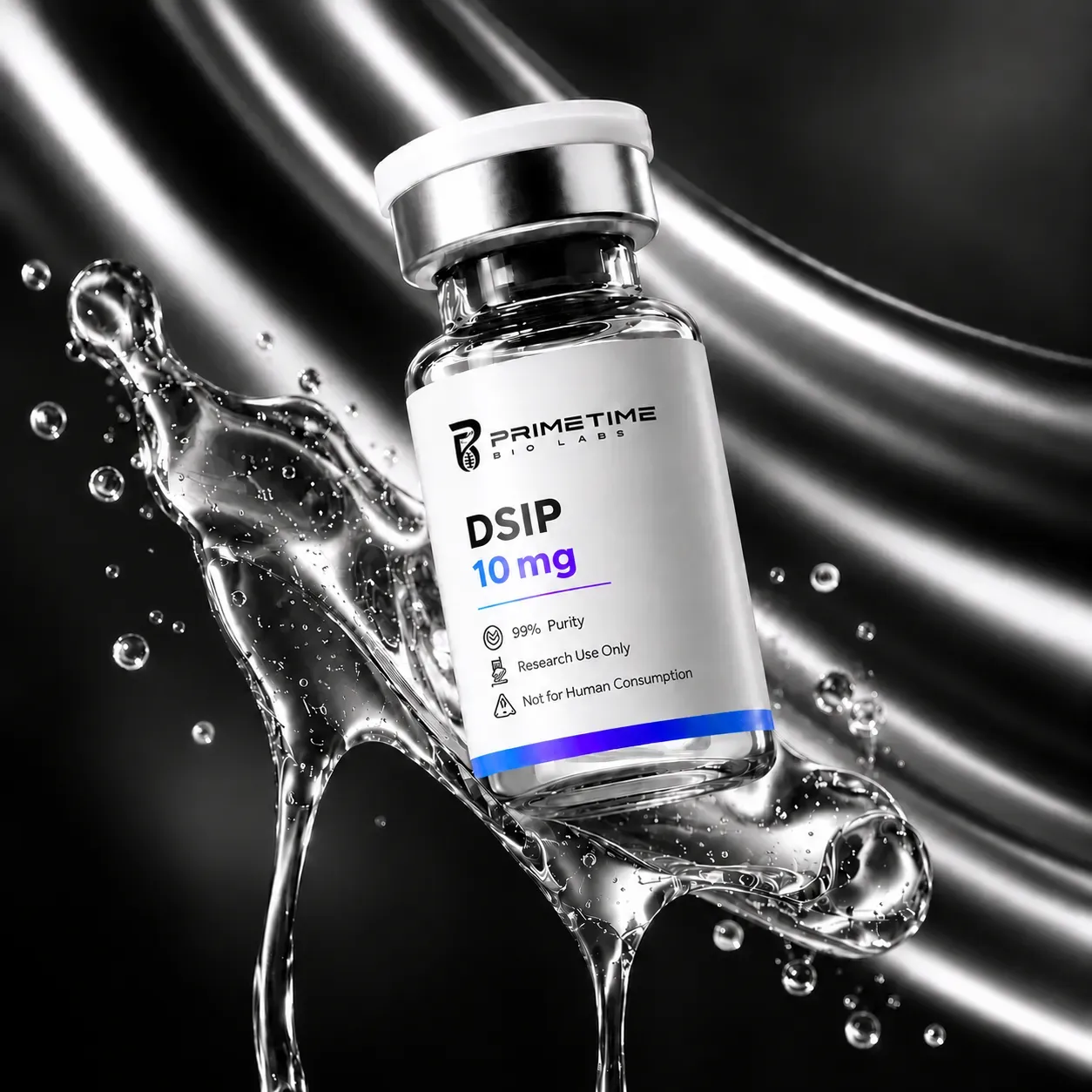
DSIP 10 mg is PrimeTime BioLabs' research-grade preparation of the nonapeptide widely known in the scientific literature as Delta Sleep-Inducing Peptide, or DSIP. The name originates from decades-old peptide research and is now used across the field mainly as a compound identifier rather than a description of confirmed human outcomes — a distinction this page maintains throughout.
Each unit supplies 10 mg of material as a sterile, lyophilized powder in a light-protected glass vial. The vial is labeled with its lot number, which ties the physical product directly to its published Certificate of Analysis (COA). PrimeTime BioLabs includes reconstitution and storage guidance with the product for laboratory handling purposes; this guidance is provided for research-material stability, not as instructions for administration of any kind.
For researchers evaluating sourcing options, three product facts matter most: the exact quantity supplied (10 mg per vial, as reflected in the product name and listing), the physical form (lyophilized powder rather than pre-diluted liquid), and the availability of lot-matched documentation. All three are confirmed on this listing rather than inferred from general peptide-market conventions, which matters because DSIP is sold by multiple suppliers in inconsistent formats, concentrations, and packaging — a source of confusion this page is written to avoid.
DSIP belongs to a broader category of peptides that entered laboratory use through basic neuroscience and endocrinology research rather than pharmaceutical development. That history is relevant context for researchers deciding whether the compound fits a given study design, but it is not evidence that this specific research material produces any effect in a human or animal subject. PrimeTime BioLabs positions this material as a documented research input — defined by its verified identity, quantity, and testing record — rather than by the sleep-related associations attached to its historical name.
The full name Delta Sleep-Inducing Peptide reflects the historical context in which DSIP was first isolated and studied, beginning with research from the 1970s that examined a candidate endogenous factor associated with delta-wave, or slow-wave, sleep activity in animal models. That naming convention has persisted in the literature for decades, even as later work substantially complicated the original picture. Researchers evaluating DSIP as a study compound should treat the name as a historical label rather than a settled description of its biological function.
DSIP is classified in chemical and pharmacological reference sources as a nonapeptide — a short peptide chain of nine amino acid residues. Independent scientific databases, including PubChem, document this classification along with an established sequence, molecular formula, and molecular weight for the compound. Because those reference values describe the peptide as characterized in the broader scientific literature and are not, by themselves, a statement about the specific manufacturing or lot-testing record of this listing, PrimeTime BioLabs directs researchers to this product's own Certificate of Analysis for lot-specific identity and purity data, and to the referenced literature for general compound characterization.
The research history behind DSIP spans several distinct lines of inquiry: early animal studies examining effects on electroencephalographic sleep patterns, biochemical work characterizing the peptide's structure and stability, and a smaller body of human studies conducted primarily in the 1980s and 1990s. Those human studies were limited in scale — typically involving small cohorts of healthy volunteers or individuals with chronic insomnia — and produced mixed results. Some reported measurable changes in reported sleep parameters; others found effects that were modest and difficult to separate from placebo response. A widely cited 2006 literature review described the relationship between DSIP and sleep physiology as an "unresolved riddle," noting that decades of research had not produced a clear, replicated mechanism.
More recent regulatory review has reinforced that caution. In materials prepared for a 2026 FDA advisory discussion of compounding-eligible substances, DSIP (referenced there under the name emideltide) was evaluated for potential inclusion on a bulk drug substances list; the agency's briefing materials concluded that available clinical data were insufficient to support effectiveness for conditions such as chronic insomnia, narcolepsy, or opioid withdrawal, and recommended against listing. That review is a useful, current reference point for understanding where the evidence currently stands — it is not proof that DSIP does nothing, but it is also not a basis for describing DSIP as an established or approved therapeutic agent of any kind.
Research models involving DSIP have also explored possible interaction with GABAergic signaling and endogenous opioid pathways, alongside stress-hormone regulation more broadly, as part of the effort to understand what — if any — physiological role the peptide plays beyond its original sleep-focused framing. These remain active areas of investigation rather than settled findings, and results from one experimental system do not necessarily generalize to another.
Taken together, the appropriate framing for DSIP 10 mg is as a peptide with a long research history and an incompletely resolved mechanism, supplied here as a defined, documented research material — not as a compound with confirmed sleep-related effects in any subject, human or otherwise.
Understanding why DSIP research diverged from a simple sleep-aid narrative helps explain the peptide's current positioning in laboratory science. The original 1970s isolation work identified DSIP from the brain tissue of rabbits under conditions associated with slow-wave sleep, which is how the compound acquired its name. Subsequent decades of study, however, produced a much more complicated picture: some research groups reported reproducible sleep-related electrophysiological changes in animal models, while others found effects that were inconsistent across species, dosing conditions, or experimental protocols. This kind of inconsistency is common in early-stage neuropeptide research and is one reason contemporary reviewers describe the DSIP-sleep relationship as still not fully characterized rather than resolved.
Separately from sleep physiology, DSIP has been examined in the context of stress-hormone regulation, with some research models investigating its relationship to the hypothalamic-pituitary-adrenal axis, and in the context of opioid-system interaction, given structural and functional questions about how short endogenous-type peptides may modulate G-protein-coupled receptor signaling. None of these lines of inquiry has produced a single, agreed-upon mechanism of action, and researchers working with DSIP in these contexts should expect to consult current primary literature rather than rely on any single historical summary, including this one.
It is also worth distinguishing between DSIP as studied in academic literature and DSIP as supplied commercially. The compound referenced in decades of peer-reviewed research was produced under a range of synthesis and formulation conditions that are not necessarily identical to any single commercial preparation, including this one. PrimeTime BioLabs' own testing — HPLC and mass spectrometry, documented per batch via the Certificate of Analysis — verifies the identity and purity of the specific lot supplied under this listing; it does not, and cannot, retroactively confirm that this material behaves identically to the compound used in any particular published study.
DSIP 10 mg is manufactured under controlled production conditions and independently verified via HPLC (high-performance liquid chromatography) and mass spectrometry prior to release. These two methods serve complementary purposes: HPLC evaluates the chromatographic purity profile of the material, separating the target peptide from process-related impurities or degradation products, while mass spectrometry provides mass-based confirmation that the measured molecule is consistent with the expected peptide identity.
It's worth being precise about what this testing does and does not establish. A reported purity percentage describes the relative analytical purity of the material under the stated method; it is not a measure of biological activity, a guarantee of a specific outcome in a research model, or a substitute for study-specific quality controls a researcher may need to run. Mass spectrometry confirms that a sample's measured mass aligns with the expected molecular identity; it does not independently verify sterility, endotoxin status, or storage stability beyond the conditions tested.
Because DSIP is supplied as a lyophilized powder rather than a pre-reconstituted solution, the analytical testing described above reflects the material as received — prior to any dilution, reconstitution, or handling performed in a receiving lab. Researchers working across multiple labs or protocols should treat vial-to-vial consistency as something to verify against the accompanying COA rather than assume automatically, standard practice for any lot-based research material.
Analytical testing of this kind is a quality and identity control, not a clinical or therapeutic validation. A COA documenting purity and identity says nothing about safety, efficacy, or suitability for use outside of qualified laboratory research — a distinction that matters given how often peptide purity claims are marketed as though they answered a much broader question.
Analytical chemistry testing of peptide research materials generally falls into two categories: identity testing, which confirms that a sample is the compound it is labeled as, and purity testing, which quantifies how much of the sample consists of that compound versus impurities, degradation products, or synthesis byproducts. HPLC is typically used for the latter, separating components by their interaction with a chromatography column and reporting relative peak area as a proxy for purity. Mass spectrometry contributes to the former, measuring the mass-to-charge ratio of ionized sample components to confirm that the dominant species matches the expected molecular weight of the target peptide.
Neither method, individually or combined, tests for everything a laboratory might want to know about a research material. Sterility and endotoxin testing — where performed and documented — are separate analytical processes from purity and identity testing, and researchers with protocols sensitive to microbial contamination or endotoxin load should confirm which specific tests appear on the COA for their batch rather than assuming a purity figure implies sterility. Similarly, a high purity percentage describes the material as tested at the time of analysis; it does not describe long-term stability after reconstitution, which depends on storage conditions, handling, and time elapsed since reconstitution.
This product is intended for in-vitro laboratory research only. DSIP 10 mg is not approved for human or veterinary use, has not been reviewed by the FDA, and must not be used as a food, drug, or cosmetic. It is not intended for diagnosis, treatment, cure, or prevention of any disease or condition.
DSIP's common name — Delta Sleep-Inducing Peptide — reflects historical research terminology rather than a confirmed clinical function or an FDA-recognized indication. No sleep-related, stress-related, or other physiological outcome should be inferred from the name of the compound or from its inclusion in academic research literature. Regulatory materials reviewed as part of a 2026 FDA advisory discussion concluded that available clinical data for DSIP-related substances did not support effectiveness for conditions including chronic insomnia; that finding underscores that this listing should not be interpreted as, or substituted for, any approved medical product.
Purchasers are responsible for ensuring that their use of this material complies with applicable laws, institutional research protocols, and biosafety practices in their jurisdiction. PrimeTime BioLabs makes this product available exclusively to qualified researchers and laboratories for legitimate research applications.
Storage and handling guidance is provided for the purpose of preserving the integrity of the research material and does not constitute instructions for human or animal administration in any form.