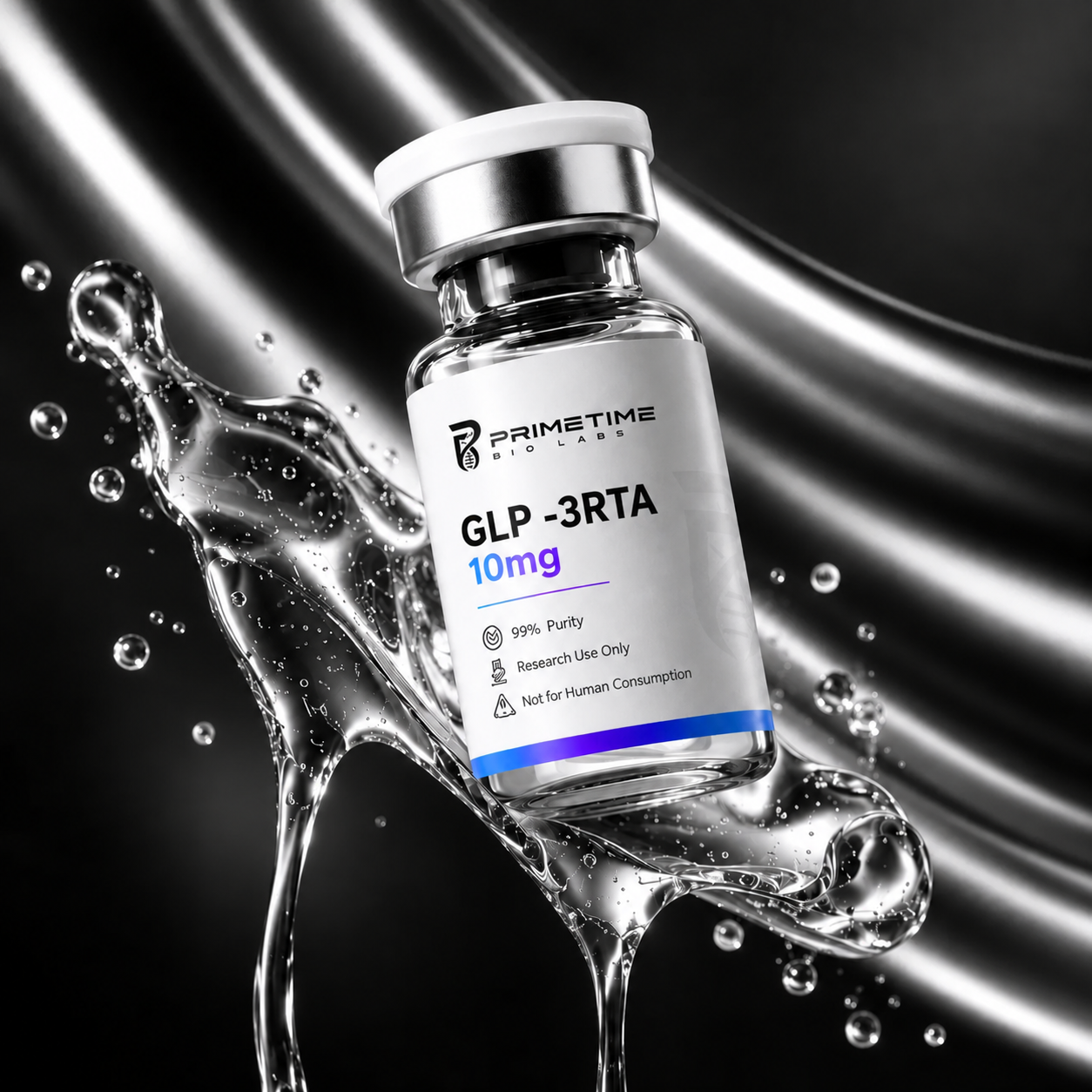
GLP-3RTA is the commercial name PrimeTime BioLabs uses for a research-grade synthetic peptide supplied as a single-use lyophilized vial, sealed and light-protected to preserve peptide integrity during shipping and storage, with a lot-specific label for batch traceability.
The name GLP-3RTA is not, on its own, a piece of official pharmaceutical or scientific nomenclature. It is a research-market designation — one that a number of peptide suppliers have adopted, with varying degrees of consistency, to describe a synthetic triple-receptor agonist peptide. "GLP-3" is shorthand for the fact that the material is studied for combined activity across three metabolically relevant receptor systems; there is no naturally occurring hormone or receptor called "GLP-3." Buyers evaluating any product under this name, from any supplier, should treat the label as a starting point and verify the underlying material against batch-specific documentation rather than assuming a fixed identity from the name alone.
In the broader research-peptide market, GLP-3RTA is most commonly associated with retatrutide, known during its development by Eli Lilly under the code LY3437943 — an investigational triple agonist at the GIP, GLP-1, and glucagon receptors that remains in Phase 3 clinical development and has not received FDA approval. That association is a market convention, not a guarantee that every GLP-3RTA product from every supplier is chemically identical. For PrimeTime's specific GLP-3RTA material, the scientific identity should be confirmed against this product's own Certificate of Analysis and any internal reference documentation before being stated as fact on a customer-facing page; until that verification step is complete, this page describes GLP-3RTA as a research-market designation commonly linked to retatrutide, without asserting that PrimeTime's exact batch has been independently confirmed as retatrutide.
Format and packaging specifics for this product are pulled directly from PrimeTime's product configuration rather than assumed from competitor listings, since supplier-to-supplier variation in stated molecular weight, sequence disclosure, and purity claims is common in this segment of the market. Where a specification cannot be confirmed against PrimeTime's own documentation, it is left unstated rather than inferred.
This product is intended exclusively for laboratory and in vitro research applications by qualified personnel. It is not formulated, labeled, or sold for human or animal use of any kind.
Where PrimeTime's documentation confirms the underlying material as retatrutide, the research interest in this compound centers on its behavior as a triple agonist — a single peptide engineered to engage three distinct G-protein-coupled receptors rather than one or two. The three receptor targets studied in the scientific literature are the glucose-dependent insulinotropic polypeptide receptor (GIPR), the glucagon-like peptide-1 receptor (GLP-1R), and the glucagon receptor (GCGR). Each of these belongs to the class B family of GPCRs and signals primarily through cAMP-mediated pathways following ligand binding, a mechanism that has been characterized extensively for GLP-1 receptor agonists individually and is now being examined in combination for triple-agonist peptides.
The rationale for combining all three targets in one molecule, as described in the peer-reviewed literature on retatrutide, is that each receptor contributes a different piece of metabolic signaling. GLP-1 and GIP receptor activation are both incretin pathways, meaning they are studied for glucose-dependent effects on insulin secretion and gastric emptying. The addition of glucagon receptor agonism is the structural feature that distinguishes triple agonists like retatrutide from single-target agents (GLP-1 agonists) and dual-target agents (GIP/GLP-1 co-agonists such as tirzepatide); glucagon receptor engagement is studied separately in the literature for its role in hepatic energy substrate use. Research models examining triple-receptor peptides look at how these three signals interact rather than assuming their effects simply add together.
Structurally, the peer-reviewed and regulatory literature describes retatrutide as a modified 39-amino-acid peptide. Reported structural features include Aib (2-aminoisobutyric acid) substitutions at two positions in the backbone, an α-methyl-leucine substitution, a lipidated lysine residue carrying a C20 fatty diacid attached through a γGlu-AEEA linker, and a C-terminal serinamide. The lipid side chain is functionally significant: it is what allows the peptide to bind reversibly to serum albumin, which is the structural basis for its extended half-life relative to unmodified incretin peptides. Independent identity testing of any material sold under a name like GLP-3RTA needs to confirm the presence and correct attachment of this lipid modification specifically — a peptide backbone that matches by mass alone, without the lipid conjugate intact, is not the same molecule, which is why mass spectrometry (rather than HPLC purity data alone) is the relevant analytical method for identity confirmation.
Reported identifiers associated with retatrutide in the literature include a molecular formula of C₂₂₁H₃₄₂N₄₆O₆₈ and an average molecular weight in the range of approximately 4,731 Da, along with a CAS registry number that is widely cited across supplier documentation, though PubChem does not currently maintain a fully resolved public record under that number. Because of this gap in primary-database coverage, identifiers of this kind should be treated as figures reported in secondary literature and supplier documentation rather than as confirmed by a single canonical public source, and should be cross-checked against KEGG Drug and peer-reviewed sources rather than repeated uncritically from competitor product pages.
Preclinical and early clinical research on triple-receptor agonism has generally been framed around comparative pharmacology: how a molecule engaging all three receptors behaves differently, in laboratory and clinical study models, from single-target GLP-1 agonists or dual-target GIP/GLP-1 agonists. Investigators working with peptides in this class have examined receptor-binding affinity across the three targets, downstream cAMP accumulation in receptor-expressing cell lines, and comparative signaling kinetics — the kind of mechanistic work that sits upstream of any question about whole-organism outcomes. That distinction matters for anyone reading supplier or literature claims about this compound: a finding about receptor binding in an isolated cell assay is a different category of evidence from a finding in a controlled clinical trial, and neither is evidence about a specific commercial research product's behavior unless that product has been separately tested.
It is important to separate three distinct bodies of evidence when discussing this research area. First, there is molecule-level research: what published, peer-reviewed literature has established about retatrutide's receptor pharmacology and structure. Second, there is clinical investigational research: the Phase 3 program Eli Lilly is conducting on its own investigational drug product, which has not been approved by the FDA and is not available for prescription use. Third, there is PrimeTime's own research material, GLP-3RTA, which is a separate product manufactured and tested independently of Lilly's clinical supply chain. None of PrimeTime's testing or documentation for this product constitutes clinical validation, and nothing on this page should be read as extending Lilly's clinical findings to PrimeTime's material. Researchers working with this product are studying a research-grade peptide in a laboratory context, not administering a clinical drug candidate.
Every batch of GLP-3RTA is tested before release, and the results specific to your vial's lot number are available through the downloadable Certificate of Analysis linked above. Because "purity" and "identity" answer two different analytical questions, it's worth understanding what each test actually establishes.
HPLC (high-performance liquid chromatography) measures chromatographic purity — the proportion of material in a sample that elutes as the expected peak relative to other detectable substances. An HPLC purity figure tells you how much of the vial's contents matches the primary peak profile; it does not, on its own, confirm that the primary peak is the specific molecule the product is represented to be. A degraded peptide, a truncated sequence, or a related peptide lacking a key structural modification can still produce a clean-looking HPLC trace if it elutes similarly to the target compound.
Mass spectrometry (MS) is the complementary test that addresses identity rather than purity. MS measures the molecular mass of the material in the vial and compares it against the expected mass of the target compound, including any lipid modification or linker chemistry. For a peptide where a structural feature like a fatty-acid conjugate is central to its identity — as is reported to be the case for retatrutide — MS is the analytical step that confirms the modification is present and correctly attached, rather than simply confirming a peptide backbone of approximately the right size.
Read together, an HPLC purity percentage and an MS identity confirmation answer different questions, and a COA that reports only one of the two leaves a real gap in what has actually been verified. When reviewing documentation for this or any research peptide, it's worth checking whether both tests were performed, by which laboratory, and against which reference standard.
PrimeTime's Certificate of Analysis for this product reports the batch number, purity result, testing method, and analysis date for the specific lot shipped to you — figures that vary batch to batch and should always be matched against the lot number printed on the vial rather than assumed to carry over from a previous order. What a COA establishes is the analytical result for that specific batch at the time of testing: a purity and/or identity finding under the stated method. What a COA does not establish is human safety, clinical efficacy, FDA approval, or suitability for any use outside qualified laboratory research — a batch-level analytical document speaks to the material's chemical characteristics, not to any therapeutic claim.
Store lyophilized vials at -20°C, protected from light, until ready for laboratory use. Once reconstituted for research purposes, keep refrigerated at 2-8°C and reference the handling window noted on the Certificate of Analysis for that lot, since stability after reconstitution is a property of the specific formulation and storage conditions rather than a fixed universal figure.
Batch traceability is maintained through the lot number printed on each vial, which corresponds directly to the COA available for download. Because peptide research materials in this category can vary from one production run to the next — in yield, in minor process variation, and occasionally in the specific reference standard a laboratory tests against — matching the vial's lot number to its corresponding COA, rather than relying on a general purity claim from the product page, is the more reliable way to confirm what a given shipment actually contains. Researchers who require additional documentation beyond the standard COA, such as a full analytical report or a certificate from a specific accredited laboratory, should contact PrimeTime directly to determine what supplementary documentation is available for a given batch.
GLP-3RTA is distributed exclusively for qualified laboratory and in vitro research purposes. It carries no FDA approval, is not a drug, dietary supplement, food, or cosmetic product, and is not intended for human or animal consumption, diagnosis, treatment, or prevention of any disease or condition.
Where PrimeTime's documentation associates this product with retatrutide (LY3437943): retatrutide is an investigational compound currently in Phase 3 clinical development sponsored by Eli Lilly and Company. As of this writing, it has not received FDA approval for any indication and is not available as an approved prescription medicine. PrimeTime's GLP-3RTA research material is manufactured, tested, and sold independently of Eli Lilly's clinical trial supply chain; it is not the same product as, and has not been evaluated alongside, the investigational drug product used in Lilly's clinical studies. Nothing in this listing should be read as claiming clinical equivalence, FDA clearance, or therapeutic validation for PrimeTime's material.
This product must be handled only by trained laboratory personnel in a properly equipped research setting, and must not be administered to humans or animals under any circumstances. PrimeTime does not provide dosing guidance, reconstitution protocols, administration instructions, or treatment schedules for this or any research compound, and none should be inferred from this page.
Purchasers are responsible for ensuring their use of this product complies with applicable federal, state, and local regulations governing research materials in their jurisdiction, and for confirming their institution's or facility's authorization to handle research peptides of this kind.