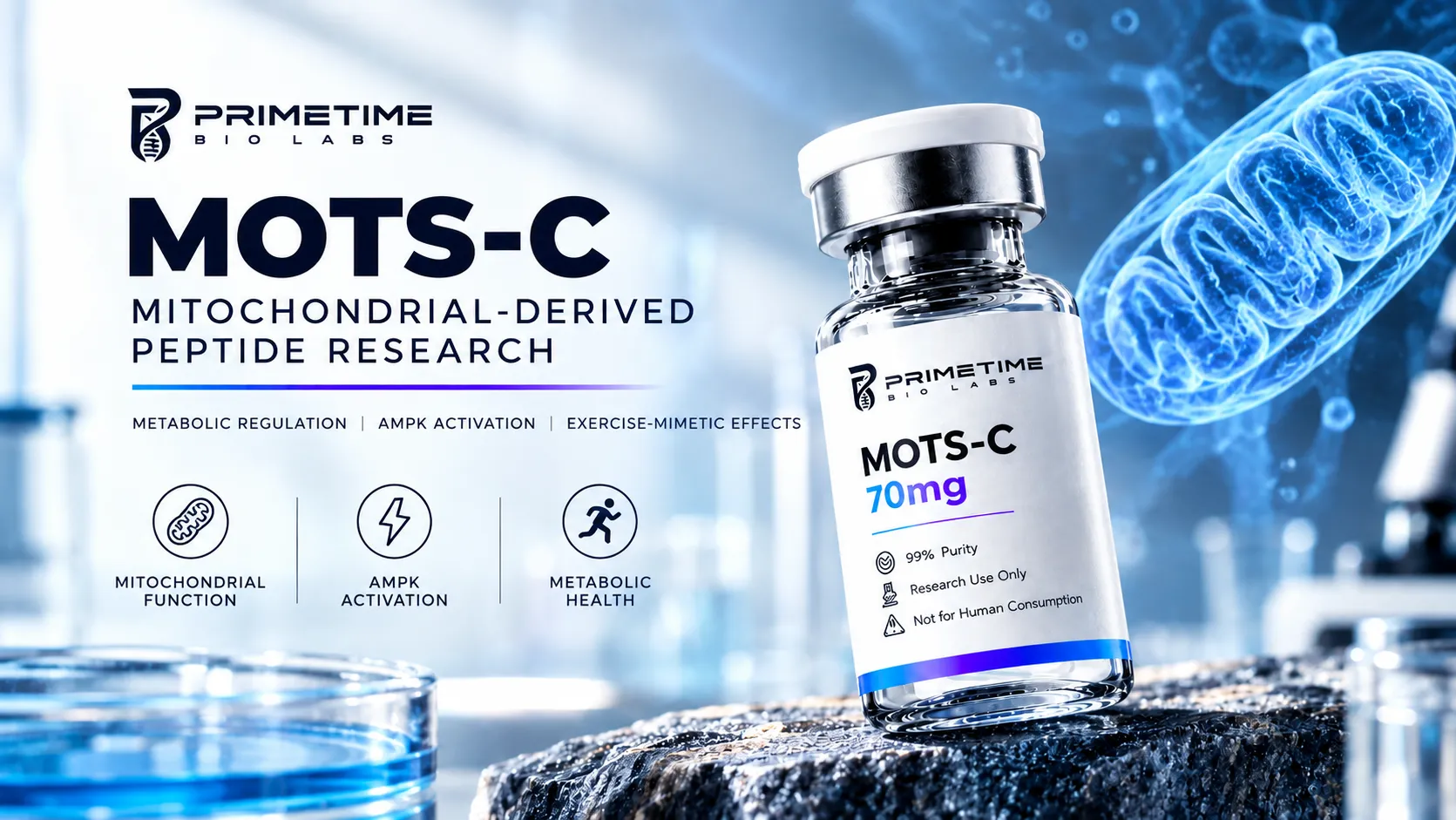
MOTS-c is a 16 amino acid peptide encoded inside mitochondrial DNA, within the 12S rRNA gene. Researchers study how it affects AMPK signaling, glucose handling and the body's response to exercise. Almost every treatment finding so far comes from cells and mice. No regulator has approved MOTS-c for human use, and controlled human results have not been published.
This page is research information for a scientific audience. It is not medical advice, and it gives no human use, dosing or administration guidance.
What a mitochondrial-derived peptide actually is
Mitochondria carry their own small circle of DNA, separate from the chromosomes in the nucleus. For decades that genome was thought to encode only the machinery mitochondria use for energy production. Short reading frames hidden inside mitochondrial RNA genes changed the picture.
Humanin was the first of these to be described, in 2001, as a peptide that protected neurons in cell models (Hashimoto et al., 2001). MOTS-c followed in 2015, found inside the 12S rRNA gene (Lee et al., 2015). Its name is an abbreviation of mitochondrial open reading frame of the 12S rRNA-c.
Three distinctions matter here, and marketing copy often blurs all three.
- A mitochondrial-derived peptide is not the same as a mitochondrial protein. Most proteins that work inside mitochondria are encoded in the nucleus and imported.
- It is not a conventional signaling peptide either, because its gene sits in the mitochondrial genome.
- It is not interchangeable with other mitochondrial-derived peptides. Humanin, MOTS-c and the small humanin-like peptides are separate molecules with separate literature.
Researchers describe this two-way traffic between the two genomes as mitonuclear communication. MOTS-c became an interesting case because a mitochondrial product appeared to act on nuclear genes.
Quick facts and verified identity
Every molecular value below carries its source. Where a value rests only on supplier catalogs, the table says so.
- Field: Name — Value: MOTS-c, mitochondrial open reading frame of the 12S rRNA-c — Source and confidence: Lee et al., 2015
- Field: Entity type — Value: Mitochondrial-derived peptide (MDP) — Source and confidence: Primary literature
- Field: Gene locus — Value: MT-RNR1, the mitochondrial 12S rRNA gene — Source and confidence: UniProt A0A0C5B5G6
- Field: Length — Value: 16 amino acids — Source and confidence: UniProt, reviewed Swiss-Prot entry
- Field: Sequence — Value: MRWQEMGYIFYPRKLR — Source and confidence: UniProt, reviewed Swiss-Prot entry
- Field: Molecular formula — Value: C101H152N28O22S2 — Source and confidence: Calculated from the UniProt sequence, matching the formula shown in public chemical databases
- Field: Molecular weight — Value: About 2,175 Da average mass — Source and confidence: UniProt lists 2,175; calculation from the sequence gives 2,174.6
- Field: CAS number — Value: 1627580-64-6 — Source and confidence: Listed consistently across chemical supplier catalogs and public compound databases, not independently confirmed against the CAS Registry
- Field: Research focus — Value: Metabolic signaling, AMPK activation, exercise biology, aging — Source and confidence: Peer-reviewed literature
- Field: Human evidence — Value: Observational human data plus one recruiting trial with no posted results — Source and confidence: ClinicalTrials.gov NCT07505745
- Field: FDA status — Value: Not approved for any use, and not on the 503A Bulks List — Source and confidence: FDA PCAC meeting materials, July 2026
One honest note on the CAS number. Supplier catalogs and compound databases repeat 1627580-64-6 with no disagreement, which is reassuring but not the same as a registry check. The sequence, formula and mass stand on firmer ground. UniProt supplies a reviewed sequence, and the formula follows from that sequence by arithmetic.
How MOTS-c relates to AMPK and metabolic signaling
The 2015 discovery paper proposed a specific route, and it is more interesting than a simple switch. MOTS-c appeared to inhibit the folate cycle, which slowed the building of new purines. That slowdown let an intermediate called AICAR build up, and AICAR activates AMPK, the enzyme cells use to sense low energy.
AMPK matters because it shifts cells toward burning fuel and away from storing it. Exercise activates it too, which is where the exercise mimetic framing began.
- Pathway or process: Folate cycle and purine synthesis — What researchers observed: MOTS-c inhibited the cycle, AICAR accumulated, AMPK switched on — Model: Cell lines and mice — Evidence type: Preclinical mechanism — What it does not establish: That the same sequence runs at meaningful levels in treated people
- Pathway or process: Insulin sensitivity and body weight — What researchers observed: Treatment prevented diet-induced obesity and insulin resistance — Model: Mice — Evidence type: Preclinical intervention — What it does not establish: Any human metabolic or weight outcome
- Pathway or process: Nuclear gene regulation — What researchers observed: Under glucose restriction, MOTS-c moved into the nucleus and worked with NRF2 at antioxidant response elements — Model: Human cell lines — Evidence type: Preclinical mechanism — What it does not establish: A measurable effect on health in a whole organism
- Pathway or process: Exercise response — What researchers observed: Exercise raised MOTS-c in skeletal muscle and in circulation — Model: Humans — Evidence type: Observational — What it does not establish: That raising MOTS-c causes the benefits of exercise
- Pathway or process: Mitochondrial bioenergetics — What researchers observed: Treatment improved muscle mitochondrial performance through PGC-1α and AMPK — Model: Transgenic mice — Evidence type: Preclinical intervention — What it does not establish: Human performance effects
The 2026 work from Gudiksen and colleagues is worth sitting with, because it complicates a popular claim (Gudiksen et al., 2026). Mice given MOTS-c showed better mitochondrial efficiency and lower oxidative damage. In the human arm of the same paper, researchers measured no arterio-venous difference during one-legged knee extensor exercise. Their reading is that skeletal muscle may not be the source of the MOTS-c that circulates after exercise.
Treat exercise mimetic as a research label and not a finding. It describes why scientists find the molecule interesting. No published trial shows that MOTS-c reproduces what training does for a person.
What the main MOTS-c studies actually found
This table is the core of the page. Each row names the model, the study type and the limitation that keeps the result honest.
- Study or program: Lee et al. — Year and source: 2015, Cell Metabolism — Model or participants: Cell lines and mice — Study type: Discovery and intervention — Main finding: Identified MOTS-c, mapped the folate-AICAR-AMPK route, and prevented diet-induced obesity and insulin resistance in mice — Evidence level: Preclinical — Key limitation: No human treatment data of any kind
- Study or program: Kim et al. — Year and source: 2018, Cell Metabolism — Model or participants: Human cell lines — Study type: Mechanism — Main finding: Under metabolic stress MOTS-c entered the nucleus and regulated nuclear genes, including antioxidant response targets — Evidence level: Preclinical, cell only — Key limitation: Cell behavior does not predict organism-level outcomes
- Study or program: Reynolds et al. — Year and source: 2021, Nature Communications — Model or participants: Young, middle-aged and old mice, plus exercising adults — Study type: Animal intervention and human observation — Main finding: Treated mice performed better physically, and exercise raised MOTS-c in human muscle and blood — Evidence level: Mixed, animal treatment plus human observation — Key limitation: The human half measured natural levels only, with nobody treated
- Study or program: Fuku et al. — Year and source: 2015, Aging Cell — Model or participants: Northeast Asian population genetics — Study type: Hypothesis article — Main finding: Proposed that the m.1382A>C variant in the MOTS-c region may help explain Japanese longevity — Evidence level: Hypothesis, not a trial — Key limitation: The authors framed it as a suggestion needing more research
- Study or program: CB4211, an analog — Year and source: 2021 company results, Phase 1a and 1b — Model or participants: 65 healthy adults, then 20 adults with obesity and fatty liver — Study type: Controlled human trial of a different molecule — Main finding: Liver fat fell by a similar amount in treated and placebo groups, while some liver enzyme and glucose differences reached significance — Evidence level: Human, but analog — Key limitation: CohBar later stated in a quarterly filing that it had not identified suitable formulations for CB4211
- Study or program: Gudiksen et al. — Year and source: 2026, Free Radical Biology and Medicine — Model or participants: Transgenic mice, plus exercising adults — Study type: Preclinical intervention with human physiology — Main finding: Improved mitochondrial efficiency in mice, and no sign that working muscle releases MOTS-c in humans — Evidence level: Mixed — Key limitation: Human measurements were physiological, with no treatment arm
- Study or program: MOTS-MET — Year and source: Registered 2026, NCT07505745 — Model or participants: 120 adults with prediabetes and overweight or obesity — Study type: Phase 2a, randomized, double-blind, placebo-controlled — Main finding: None yet, because the trial has posted no results — Evidence level: Pending — Key limitation: Listed as recruiting at a single site, with a registry status last verified in March 2026
Two rows deserve extra care from anyone citing this page.
The CB4211 row is about an analog, not about MOTS-c. CohBar developed it as a modified version, and a result from a modified molecule does not transfer to the original. The 2021 topline release reported that liver fat dropped in both arms, with a 5.03% absolute reduction on drug and 4.88% on placebo. In its 2023 quarterly filing, the company stated it had not identified suitable formulations for CB4211.
Fuku's 2015 entry is a perspective article, and several popular write-ups present it as a longevity study. The authors proposed a hypothesis about a mitochondrial variant and asked for more research (Fuku et al., 2015).
How MOTS-c compares with humanin
Both peptides come from mitochondrial DNA, and that is where the easy similarities stop.
- Feature: Year first reported — MOTS-c: 2015 — Humanin: 2001
- Feature: Length — MOTS-c: 16 amino acids — Humanin: 24 amino acids in the commonly studied form
- Feature: Encoding gene — MOTS-c: 12S rRNA gene, MT-RNR1 — Humanin: 16S rRNA gene, MT-RNR2
- Feature: Early research focus — MOTS-c: Metabolism, insulin sensitivity, exercise — Humanin: Neuroprotection in cell models of Alzheimer's disease
- Feature: Proposed signaling — MOTS-c: Folate cycle, AICAR, AMPK, nuclear gene regulation — Humanin: Receptor-mediated cell survival signaling
- Feature: Human treatment evidence — MOTS-c: None published — Humanin: None published
Nobody has run a head-to-head trial, so there is no evidence-based way to rank them for effect or safety. Any page that ranks them is ranking marketing claims.
What happened at the PCAC meeting and what it means
On July 23 and 24, 2026, the FDA's Pharmacy Compounding Advisory Committee met to consider seven peptides for the Section 503A Bulks List. That list names bulk drug substances that compounding pharmacies may legally use. MOTS-c was on the agenda for July 23.
FDA staff had already published their position in the briefing materials, proposing that both MOTS-c free base and MOTS-c acetate not be included. The committee disagreed. Members voted 7 to 5 with two abstentions to recommend inclusion, and six of the seven peptides received favorable votes that week.
Here is what that vote did and did not do.
- It did not approve MOTS-c as a drug, because advisory committee votes have nothing to do with the drug approval process.
- It did not add MOTS-c to the 503A Bulks List, since only notice and comment rulemaking can do that.
- It did not make compounding lawful, and law firm analyses published in August 2026 reached the same reading.
- It did recommend a direction to FDA, and the agency is free to accept or reject that recommendation.
One detail from the briefing materials is easy to miss. The nomination for MOTS-c was withdrawn before the meeting, and FDA presented the substance to the committee anyway.
For sport, the position is settled and separate. USADA states that MOTS-c is prohibited at all times under the metabolic modulators section of the WADA Prohibited List, as an AMPK activator. A therapeutic use exemption is highly unlikely, according to the same page, because the peptide has no approved therapeutic use.
What research-use-only positioning means here
Research-use-only is a statement about intended use. A material sold under that label is sold for laboratory research, and it is not sold or supplied for human or veterinary use. That is the whole of what the label asserts.
What an RUO label does not establish, on its own:
- Identity, meaning that the vial holds the peptide named on it.
- Purity, meaning how much of the contents is the intended molecule.
- Sterility, endotoxin levels, or anything about the physical quality of the preparation.
- Safety or effectiveness for any purpose in any species.
- FDA approval or any other regulatory clearance.
- Legal suitability for any particular use by any particular buyer.
Documentation answers some of those questions and not others. A certificate of analysis can speak to identity and purity for the batch it covers, which is a narrow claim and a useful one. Our guide to reading a peptide certificate of analysis explains what those documents actually prove. A companion guide covers evaluating a research peptide supplier.
Clean analytical results still say nothing about biological activity in a living organism. Those are different measurements answering different questions.
What is known about side effects and safety
The honest summary here is a short one. Controlled human safety data for MOTS-c has not been published.
FDA's 2026 review of MOTS-c for compounding recorded no human safety studies identified for the substance. USADA, writing for athletes, states plainly that nobody knows under what conditions MOTS-c might be safe, because no human clinical trial has been completed. That same page reports effects described by people who buy the peptide online, naming increased heart rate, injection site irritation and insomnia. Those are reports from unsupervised use, not findings from a controlled study, and the difference matters.
Animal studies report tolerability within their own designs, which tells you about dosing in those animals and little else. The MOTS-MET trial lists treatment-emergent adverse events as a primary outcome, so controlled safety data may eventually exist.
Preclinical work also carries a caution that peptide marketing rarely mentions. A 2026 study of human mesenchymal stromal cells found that MOTS-c activated AMPK signaling as expected (Xing et al., 2026). The same treatment reduced cell proliferation and raised senescence markers. Pretreated cells also failed to repair injured kidneys in a mouse model. Metabolic activation and useful function came apart in that system.
What the current evidence does not show
Treat every line below as an open question and not a settled answer.
- Whether the cellular mechanism produces any meaningful health outcome in people.
- Whether rodent metabolic results generalize to humans, since many metabolic findings have not.
- What long-term human safety looks like at any exposure.
- Whether the exercise mimetic framing holds beyond the narrow findings that inspired it.
- Whether CB4211 results say anything at all about MOTS-c, given that it is a different molecule and the tested formulation was abandoned.
- Whether circulating MOTS-c after exercise even comes from working muscle, which 2026 human data called into question.
- What the PCAC vote means in practice, because rulemaking has not happened.
- Whether a pure, correctly identified sample has any particular biological effect, which analytical testing cannot answer.
The bottom line
MOTS-c has earned its scientific attention. A peptide encoded in mitochondrial DNA that activates AMPK and reaches the nucleus is a genuinely novel finding. The discovery work has held up across a decade of follow-up studies.
Cells and mice still supply most of the evidence base. Human data so far describes natural MOTS-c levels during exercise, with nobody treated and nothing measured against placebo. The registered Phase 2a trial will matter when it reports, and it has not reported.
Regulators have not moved as far as headlines suggest. FDA has approved nothing, the 503A Bulks List has not changed, and sport bans the peptide outright.
MOTS-c materials referenced on this site are sold for research use only. They are not drugs, foods or dietary supplements, and they are not for human or veterinary use, diagnostic use, or any therapeutic purpose. A research-use-only designation does not establish identity, purity, sterility, safety, effectiveness, regulatory approval or legal suitability for any application. Buyers are responsible for handling these materials lawfully and for their own compliance obligations.