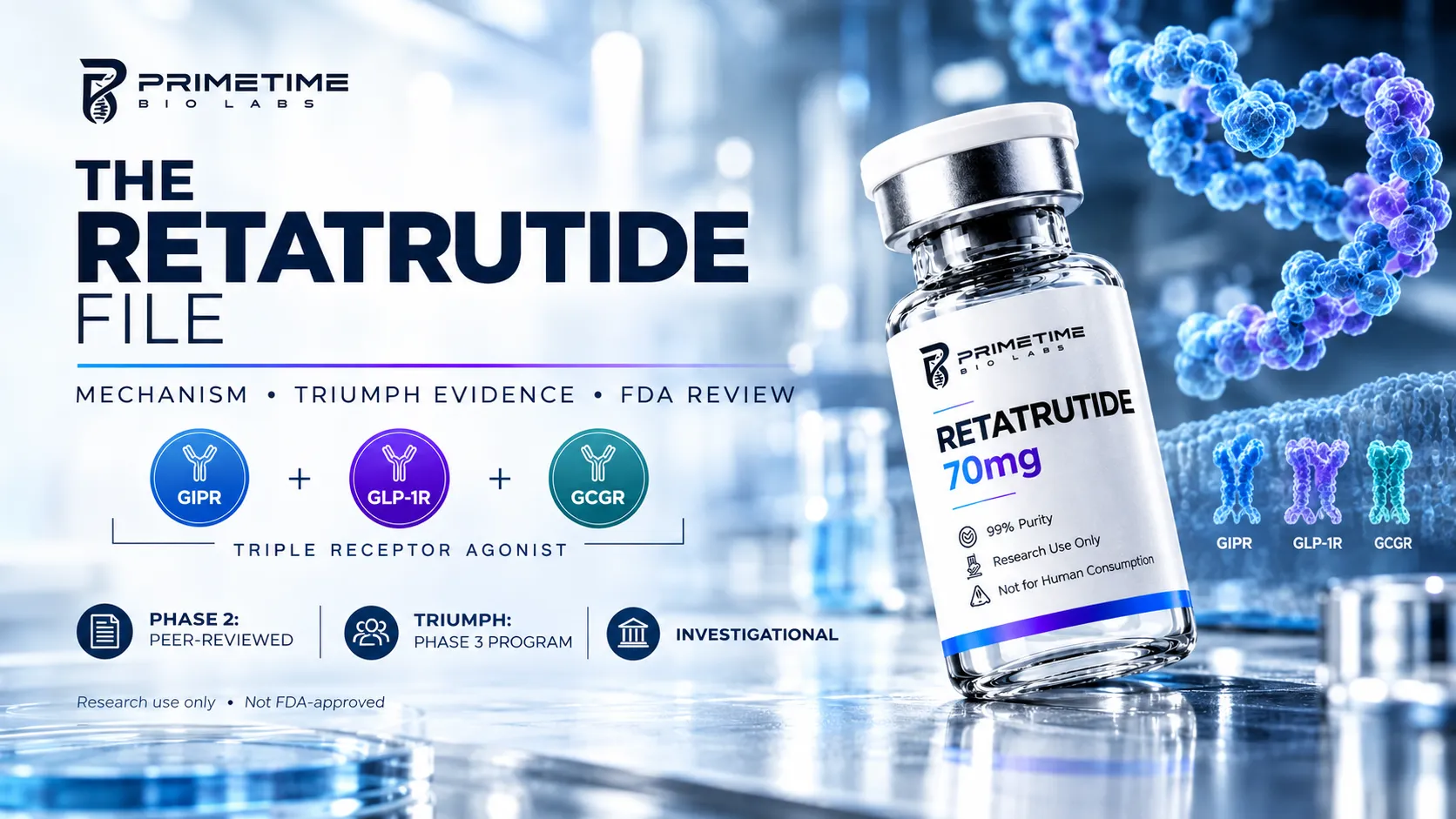
Retatrutide is an investigational peptide from Eli Lilly, known in development as LY3437943. It activates three receptors at once: GIP, GLP-1, and glucagon. Researchers call that design a triple agonist. The FDA has not approved retatrutide for any use, and Lilly has not yet filed an approval application for it.
Why the retatrutide picture keeps changing
Three Phase 3 trials of retatrutide read out in 2026 alone, and two of them reached full peer-reviewed publication on the same day. That pace is why so much of the material written about this compound in early 2026 is now out of date.
Retatrutide sits in an unusual position. It has a large and growing body of human clinical evidence behind it. It also has no regulatory approval anywhere, and it is widely sold online as a research compound by sellers with no connection to the trials. Those two facts get mixed together constantly, and separating them is most of what a careful reader needs.
The sections below cover what the molecule is and what its three receptor targets do. They then set out what each TRIUMPH trial reported, how the compound stands against the approved incretin medicines, and where the regulatory process sits.
The quick facts about retatrutide
Retatrutide is a synthetic peptide, not a natural hormone and not a small-molecule drug. Its identity is documented in the FDA's Global Substance Registration System under unique ingredient identifier NOP2Y096GV.
- Attribute: Generic name — Verified detail: Retatrutide (INN, USAN)
- Attribute: Development code — Verified detail: LY3437943
- Attribute: Developer — Verified detail: Eli Lilly and Company
- Attribute: Compound class — Verified detail: Synthetic lipidated peptide, unimolecular triple receptor agonist
- Attribute: Receptor targets — Verified detail: GIP receptor, GLP-1 receptor, glucagon receptor
- Attribute: Peptide length — Verified detail: 39 amino acids
- Attribute: Amino acid sequence — Verified detail: YAQGTFTSDYSILLDKKAQAAFIEYLLEGGPSSGAPPPS, with Aib at positions 2 and 20, alpha-methyl-leucine at position 13, a C-terminal serinamide, and a C20 diacid side chain attached at Lys17 through a gamma-glutamate and AEEA linker
- Attribute: CAS registry number — Verified detail: 2381089-83-2
- Attribute: Molecular formula — Verified detail: C221H342N46O68
- Attribute: Average molecular weight — Verified detail: Approximately 4,731 Da
- Attribute: FDA UNII — Verified detail: NOP2Y096GV
- Attribute: Development status — Verified detail: Phase 3, investigational
- Attribute: US regulatory status — Verified detail: Not approved; no application filed as of October 2026
Two notes on that table matter more than the numbers themselves.
The sequence, the CAS number, and the UNII come from the FDA substance registry record, not from a product listing. The registry record itself carries a calculated molecular weight of about 4,092 Da, flagged by the system as estimated. That figure reflects only the peptide backbone, because the system defaulted to a calculated value and left out the lipid side chain. Rebuilding the full molecule from the registered sequence, including the C20 diacid side chain, gives C221H342N46O68 and roughly 4,731 Da. That agrees with the formula most commonly published, which is why this article reports it.
Sellers do not agree with each other on these values. Product pages circulate at least three different molecular formulas for the same compound name, with weights ranging from about 4,091 to about 4,895 Da. A number on a listing is not a measurement. An incorrect molecular weight is one of the clearer signs that a listing was assembled from scraped text.
How retatrutide acts on three receptors
A triple agonist is one molecule that switches on three separate receptors. Retatrutide does this with a single 39-residue peptide chain, not a mixture of three compounds.
- Receptor: GLP-1 receptor — Physiological role: Incretin signalling; influences insulin release, gastric emptying, and appetite signalling — What trials studied: Shared target with approved incretin medicines; contributes to the glycaemic and weight endpoints measured in TRIUMPH — What activating it does not establish: That any particular share of the observed effect came from this receptor
- Receptor: GIP receptor — Physiological role: The second incretin pathway; involved in insulin secretion and fat tissue metabolism — What trials studied: Shared target with tirzepatide, the approved dual agonist — What activating it does not establish: That dual targeting alone explains the trial results
- Receptor: Glucagon receptor — Physiological role: Influences hepatic glucose output and energy expenditure — What trials studied: The element that distinguishes retatrutide from the approved incretin medicines — What activating it does not establish: That added glucagon activity is the reason for any specific trial outcome
The combination rationale is straightforward in theory. Glucagon receptor activity is thought to raise energy expenditure, while GLP-1 and GIP activity act on appetite signalling and insulin response. Pairing them in one molecule is meant to let each contribution work alongside the others.
Theory is where that reasoning stops. Trials measured whole-molecule outcomes such as body weight, HbA1c, and pain scores. None of them isolated the contribution of each receptor in people. Attributing a specific percentage of weight change to glucagon activity is mechanistic interpretation, and it carries far less weight than the trial results themselves.
One terminology point causes recurring confusion. Online writing sometimes labels retatrutide a "GLP-3" compound. No receptor called GLP-3 exists in human biology. The phrase appears to have emerged as informal shorthand for a third-generation incretin compound, and it is not scientific terminology.
What the TRIUMPH trials found
Four Phase 3 TRIUMPH trials have reported results so far. Two reached full peer-reviewed publication on September 29, 2026, and two remain at the level of company-reported topline data.
Reading these results calls for one piece of technical vocabulary. Lilly reports each trial under two statistical approaches, called estimands, and they give different numbers for the same trial. The efficacy estimand asks what the result would have been had participants stayed on treatment throughout. The treatment-regimen estimand asks what happened on average across everyone randomised, whether or not they stayed on the drug. Press coverage usually quotes the first, and peer-reviewed papers usually lead with the second. That single difference explains why the same TRIUMPH-1 result appears in print as both 28.3% and 25.0%.
- Study: TRIUMPH-1 — Registry ID: NCT05929066 — Population: 2,339 adults with obesity or overweight and at least one weight-related condition, without diabetes — Design: Phase 3, randomised, double-blind, placebo-controlled master trial with knee osteoarthritis and sleep apnea baskets, 80 weeks — Comparator: Placebo — Primary endpoint: Percent change in body weight at week 80 — Main reported result: Treatment-regimen estimand: -17.6%, -23.7%, -25.0% across the three study arms versus -3.9% placebo. Efficacy estimand: -19.0%, -25.9%, -28.3% versus -2.2% — Safety signal: Gastrointestinal events most common; discontinuation due to adverse events 4.1% to 11.3% across arms versus 4.9% placebo — Evidence status: Published in full, New England Journal of Medicine, September 29, 2026
- Study: TRIUMPH-2 — Registry ID: NCT05929079 — Population: 1,152 adults with obesity or overweight and type 2 diabetes, at 92 sites across eight countries — Design: Phase 3, randomised, double-blind, placebo-controlled, 80 weeks — Comparator: Placebo — Primary endpoint: Percent change in body weight at week 80 — Main reported result: Treatment-regimen estimand: -11.9%, -16.8%, -18.8% versus -5.1% placebo. Efficacy estimand: -12.7%, -19.1%, -20.8% versus -4.0%. HbA1c fell by up to 1.6 points — Safety signal: Diarrhoea 27% to 34% versus 13% placebo; dysesthesia and hypotension more frequent than placebo; seven deaths across the trial, all judged unrelated to treatment by investigators — Evidence status: Published in full, The Lancet, September 29, 2026
- Study: TRIUMPH-3 — Registry ID: NCT05882045 — Population: 1,949 adults with severe obesity (BMI 35 or above) and established cardiovascular disease — Design: Phase 3, randomised, double-blind, placebo-controlled, 80 weeks — Comparator: Placebo — Primary endpoint: Percent change in body weight at week 80 — Main reported result: Efficacy estimand: -21.6% and -22.6% across the two study arms versus -3.2% placebo — Safety signal: Diarrhoea up to 30.1% versus 8.7% placebo; discontinuation due to adverse events 9.8% and 13.5% versus 4.8% placebo — Evidence status: Company topline only, reported July 23, 2026; peer-reviewed publication pending
- Study: TRIUMPH-4 — Registry ID: NCT05869903 — Population: 445 adults with obesity or overweight and knee osteoarthritis, without diabetes — Design: Phase 3, randomised, double-blind, placebo-controlled, 68 weeks — Comparator: Placebo — Primary endpoint: Percent change in body weight at week 68 — Main reported result: Efficacy estimand: -26.4% and -28.7% across the two study arms versus -2.1% placebo — Safety signal: Nausea 38.1% to 43.2% versus 10.7% placebo; dysesthesia up to 20.9% versus 0.7%; discontinuation 12.2% and 18.2% versus 4.0% — Evidence status: Company topline only, reported December 11, 2025; peer-reviewed publication pending
Each of those trials used a stepwise escalation schedule. Participants started at a low weekly amount, which increased every four weeks until the assigned study level was reached. That is a description of how the studies were run, under medical supervision, and nothing in it transfers outside a clinical trial.
TRIUMPH-1 carried two additional endpoints worth separating out, because they measure something other than weight. Among 574 participants who also had knee osteoarthritis, WOMAC pain scores fell by 3.2, 3.5, and 3.6 points across the retatrutide arms. Pain scores in the placebo group fell by 1.9 points. Among 243 participants with obstructive sleep apnea, apnea-hypopnea events per hour fell by 22.8, 34.3, and 32.1, against 9.6 with placebo. Both results were statistically significant against placebo in the published analysis.
TRIUMPH-3 added cardiovascular event data, and the picture there is genuinely unsettled. Pre-specified analysis found 44 broad cardiovascular events on retatrutide against 52 on placebo. That gives a hazard ratio of 0.82, with a confidence interval from 0.55 to 1.22. The narrower three-point measure went the other way, 27 events against 23, a hazard ratio of 1.12 with an interval from 0.64 to 1.96. Lilly reported that events occurred less often than the trial had anticipated in both arms. Neither result settles the cardiovascular question, and Lilly is running a separate event-driven outcomes trial, TRIUMPH-Outcomes (NCT06383390), designed to answer it.
How retatrutide compares with tirzepatide and semaglutide
No published trial has compared retatrutide head to head against either approved medicine. Every comparison currently in circulation lines up results from separate trials with different participants, different lengths, and different endpoints.
- : Developer — Retatrutide: Eli Lilly — Tirzepatide: Eli Lilly — Semaglutide: Novo Nordisk
- : Receptor activity — Retatrutide: GIP, GLP-1, glucagon — Tirzepatide: GIP, GLP-1 — Semaglutide: GLP-1
- : US regulatory status — Retatrutide: Investigational; no application filed as of October 2026 — Tirzepatide: Approved and marketed — Semaglutide: Approved and marketed
- : Evidence base — Retatrutide: Four Phase 3 trials reported, two published in full — Tirzepatide: Multiple completed Phase 3 programmes plus post-approval use — Semaglutide: Multiple completed Phase 3 programmes plus post-approval use
- : Head-to-head evidence against retatrutide — Retatrutide: None published — Tirzepatide: TRIUMPH-5 is running and has not reported — Semaglutide: None running
- : Main open question — Retatrutide: Long-term safety, cardiovascular outcomes, and whether any advantage survives direct comparison — Tirzepatide: How it performs against a triple agonist — Semaglutide: How it performs against a triple agonist
Cross-trial comparison fails here for concrete reasons, not out of caution. TRIUMPH-1 enrolled participants with an average baseline BMI of 40.0 and ran for 80 weeks. Other programmes enrolled different populations over different periods, and they handled dropouts with different statistical rules. Stacking those percentages next to each other produces a chart that looks informative and is not.
The one trial designed to settle part of this question is TRIUMPH-5 (NCT06662383). It randomises roughly 800 adults with obesity to retatrutide or tirzepatide, with percent change in body weight at week 80 as its primary endpoint. Registry records list estimated primary completion as November 2026 and estimated study completion as December 2026. The trial is active and no longer recruiting. Until it reports, no honest ranking of the two compounds exists.
The regulatory timeline and what happens next
Retatrutide has not been approved by the FDA for any use. No application for approval has been filed, which places it earlier in the process than many readers assume.
- Date: 2023 — Event: TRIUMPH Phase 3 programme begins, enrolling more than 5,800 participants across four registrational trials — Status: Historical
- Date: December 11, 2025 — Event: TRIUMPH-4 topline results reported, the first Phase 3 readout — Status: Historical, company-reported
- Date: May 21, 2026 — Event: TRIUMPH-1 topline results reported — Status: Historical, company-reported
- Date: July 23, 2026 — Event: TRIUMPH-2 and TRIUMPH-3 topline results reported; Lilly states it is completing the manufacturing and controls data package for a filing — Status: Historical, company-reported
- Date: September 29, 2026 — Event: TRIUMPH-1 published in the New England Journal of Medicine; TRIUMPH-2 published in The Lancet — Status: Historical, peer-reviewed
- Date: November and December 2026 — Event: TRIUMPH-5 estimated primary completion and study completion — Status: Anticipated, per registry estimate
- Date: First quarter of 2027 — Event: Lilly plans to submit a Biologics License Application to the FDA — Status: Planned, per company statement
Two distinctions in that table carry real weight.
A plan to file is not a filing. Lilly stated in July 2026 that it intends to submit in the first quarter of 2027. The company said it was still completing the manufacturing and controls package needed to do so. Filing timelines in this industry move regularly.
Submission does not amount to approval either. After a filing arrives, the FDA reviews the application and may approve it, reject it, or ask for more data. Anyone publishing a retatrutide availability date today is guessing, because the first step has not happened yet.
What research-use-only means for retatrutide peptide products
Retatrutide is sold online by many vendors under research-use-only labelling. Those products and the compound studied in TRIUMPH are not the same thing, and the distinction is worth being precise about.
Research-use-only is a labelling and distribution category. It signals that material is supplied for laboratory work and is not an approved medicine for people. The label describes an intended use. It makes no claim about what is inside the vial.
Lilly states its own position in plain terms. Its press releases state that retatrutide is available legally only to participants in its clinical trials. The company also states that the molecule cannot be legally sold or marketed for human use. The Drugs.com monograph puts the point more sharply. It warns that retatrutide cannot be legally purchased, prescribed or compounded, and that any product presented as retatrutide is not legitimate and may be dangerous.
Three things follow, and none of them require assuming bad faith from any seller.
A matching name does not establish a matching molecule. Retatrutide has a specific 39-residue sequence with three non-standard modifications and a lipid side chain. Identity is established by analytical testing against that structure, not by a product title.
A certificate of analysis documents a tested sample, and reading one properly is its own skill. Our guide to reading a peptide certificate of analysis covers what identity, purity and assay results each establish, and what they leave unproven. Our guide to evaluating a research peptide supplier covers documentation practices more broadly.
Trial evidence does not transfer to a different material. Everything the TRIUMPH programme established applies to the compound Lilly manufactured, to its specification, administered under trial protocol. No result from those trials says anything about any other material.
What side effects have clinical trials reported
Gastrointestinal events were the most frequently reported adverse events in every TRIUMPH trial that has reported, and their frequency rose with the study level assigned.
TRIUMPH-1 followed 2,339 adults with obesity and without diabetes for 80 weeks. Nausea was reported by 28.6%, 38.4% and 42.4% of participants across the three retatrutide arms, against 14.8% on placebo. Diarrhoea reached 34.1%, constipation 26.1%, and vomiting 25.3% at their highest arm figures, each well above placebo.
Two non-gastrointestinal signals recur across trials. Dysesthesia means altered or unusual sensation. It was reported by up to 12.5% of participants in TRIUMPH-1 against 0.9% on placebo, and reached 20.9% in the highest TRIUMPH-4 arm against 0.7%. Urinary tract infections were also more frequent than placebo in several trials. Lilly characterised these events as generally mild to moderate, with most resolving during treatment.
Discontinuation gives a blunter read on tolerability than any individual symptom. Withdrawal due to adverse events ran from 4.1% to 11.3% across TRIUMPH-1 arms, against 4.9% on placebo. TRIUMPH-2 ranged from 3.8% to 11.6% against the same placebo figure. In the highest TRIUMPH-4 arm it reached 18.2%, against 4.0%. Seven deaths occurred across the TRIUMPH-2 arms including placebo, and investigators judged all of them unrelated to the study drug.
None of this amounts to a safety profile in the regulatory sense. Trial populations were screened, monitored, and excluded for specific conditions. Absence of a signal in a trial of this size and length does not establish that a risk does not exist.
What the current evidence does not prove
Clear evidence on some questions sits alongside no evidence at all on others. Keeping those separate is the single most useful habit when reading about this compound.
- Claim: Retatrutide reduces body weight against placebo over 68 to 80 weeks — Evidence level: Primary human evidence — What the evidence supports: Supported by four Phase 3 trials, two peer-reviewed
- Claim: It reduces knee osteoarthritis pain and sleep apnea events in those subgroups — Evidence level: Primary human evidence — What the evidence supports: Supported by TRIUMPH-1 published results
- Claim: Three-receptor activity explains the size of the effect — Evidence level: Mechanistic interpretation — What the evidence supports: Reasoned, not demonstrated in humans
- Claim: It performs better than tirzepatide or semaglutide — Evidence level: Insufficient evidence — What the evidence supports: No head-to-head trial has reported
- Claim: It improves cardiovascular outcomes — Evidence level: Insufficient evidence — What the evidence supports: TRIUMPH-3 results point in conflicting directions; the outcomes trial is ongoing
- Claim: It is safe over the long term — Evidence level: Insufficient evidence — What the evidence supports: Longest reported exposure is 104 weeks in a 532-participant extension
- Claim: Online research products behave like the trial compound — Evidence level: Insufficient evidence — What the evidence supports: Trial results apply only to the material studied
Generalisability deserves a line of its own. TRIUMPH participants were screened against defined criteria, which excluded people with a history of pancreatitis and certain thyroid conditions, among others. Results from a screened trial population do not automatically describe what happens in a broader one.
The bottom line on retatrutide
Retatrutide now has one of the larger Phase 3 evidence bases of any investigational metabolic compound. Four trials have reported, and two were published in full during September 2026. The three-receptor design is real, the trial results are substantial, and the open questions are equally real. Long-term safety, cardiovascular outcomes, and performance against existing medicines all remain unanswered. Regulatory review has not started, because no application has been filed.
Readers encountering retatrutide sold online should hold two ideas at once. The clinical evidence is genuine. It describes a specific compound made to a specific standard, and it does not extend to anything else carrying the same name.
Research use only. Retatrutide is an investigational compound that has not been approved by the FDA or any other regulatory authority. Products sold under this name are supplied for laboratory research use only. They are not for human or veterinary use, not for diagnostic or therapeutic use, and not for use in food. This article is educational and is not medical advice.