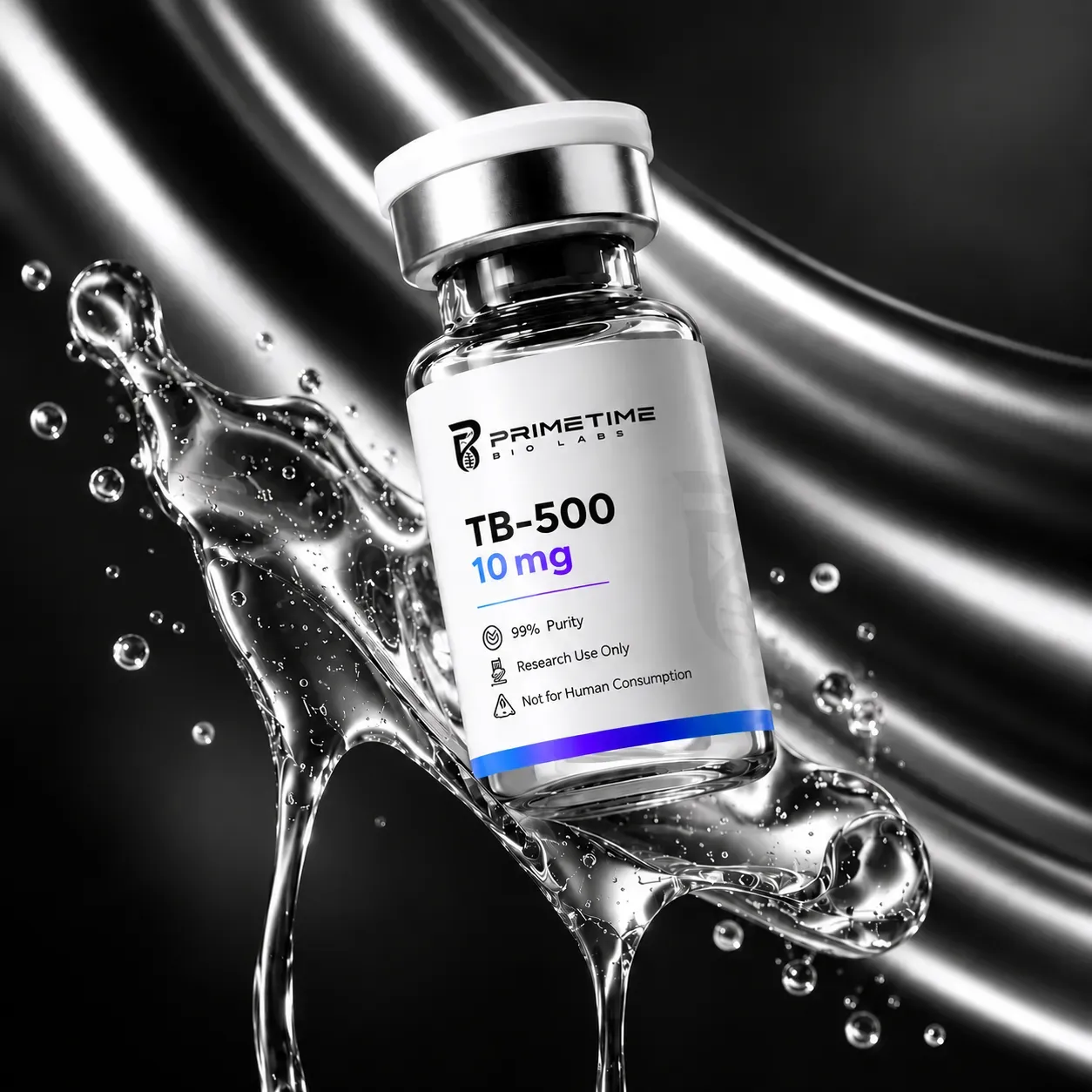
Pull up a certificate of analysis for a vial labeled TB-500. Some of them name the peptide Ac-LKKTETQ, then print CAS 77591-33-4 right beside it. That second number belongs to a different molecule. It identifies full-length thymosin beta-4, a protein roughly five times heavier than the fragment named on the same line.
Mixing up those identifiers is not a small paperwork slip. It decides which research applies to the material in the vial.
What Is TB-500
TB-500 is a synthetic peptide built from seven amino acids. Its full name is N-acetyl-Leu-Lys-Lys-Thr-Glu-Thr-Gln, usually written as Ac-LKKTETQ. An acetyl group caps the front end of that chain.
Chemical suppliers and the PubChem record give CAS 885340-08-9, molecular formula C38H68N10O14, and an average molecular weight of 889.02 g/mol. Mass spectrometry labs confirm identity against a monoisotopic mass near 888.49 Da.
Where does the sequence come from? It maps to residues 17 through 23 of thymosin beta-4, a peptide human cells make on their own. Chemists picked that stretch because it holds the actin-binding region, then synthesized it alone and capped it.
A researcher buying TB-500 for laboratory work is buying that fragment, nothing larger.
TB-500 and Thymosin Beta-4 Are Not the Same Molecule
What thymosin beta-4 is
Thymosin beta-4 is a natural protein built from 43 amino acids. It turns up in most human cells and in fluids including blood and tears. Its main known job is sequestering actin, meaning it binds loose actin monomers and helps govern how cells rebuild structure. The listed identifiers are CAS 77591-33-4, formula C212H350N56O78S, and a molecular weight near 4,963.4 g/mol.
What TB-500 is
TB-500 is one short stretch lifted out of that protein, seven amino acids against 43. At 889.02 g/mol it weighs under a fifth of the parent protein. It carries the actin-binding region and leaves the other 36 residues behind.
Why the two get mixed up
Vendors regularly list a product as TB-500 and attach the full-length protein's CAS number and molecular weight to it. One publicly posted certificate names the fragment Ac-LKKTETQ on its identity line and prints CAS 77591-33-4 underneath. Both entries cannot describe the same material. Knowing the two number sets lets a buyer check any label quickly.
Why the distinction matters for evidence
Human trial data in this field belongs to the full-length protein. FDA briefing documents from the July 2026 advisory meeting state that no direct human administration studies of the TB-500 fragment exist. Findings on thymosin beta-4 should not be treated as direct clinical evidence for TB-500. A label error moves an entire evidence base onto a molecule that never earned it.
How TB-500 Is Thought to Work
Thymosin beta-4 binds monomeric actin, called G-actin, and holds it in reserve. That reservoir shapes how cells migrate and rebuild structure after damage.
Van Troys and colleagues mapped the binding site in 1996, using synthetic variants of the full protein (EMBO J, PMID 8617195). They located the actin-binding motif at residues 17 to 22, the hexapeptide LKKTET. Lysine 18 proved important for making contact with actin.
TB-500 covers that motif plus one extra residue. Describing its mechanism means describing the parent protein's active region, which is a structural fact and not an efficacy finding. Carrying the motif does not establish that an isolated fragment behaves the same way in a living body.
What Human Trials Actually Tested
RegeneRx Biopharmaceuticals ran the clinical program behind almost all of this data. The company was developing thymosin beta-4 as a drug, so its press releases count as sponsor evidence. Peer-reviewed publications carry more weight than those releases do.
Dermal wounds, RGN-137 topical gel
- Molecule tested: full-length thymosin beta-4 in a topical gel
- Pressure ulcer trial (NCT00382174): 72 patients with Stage 3 and Stage 4 ulcers, randomized and placebo-controlled across three doses
- Safety outcome: safe and well tolerated at all three doses, with no drug-related serious adverse events (sponsor release)
- Efficacy outcome: no statistically significant difference against placebo for complete wound healing or rate of healing
- Venous stasis ulcer trial (NCT00832091): 72 patients at sites in Italy and Poland, treated up to 84 days. Reported safe and well tolerated, with no dose-limiting adverse events (sponsor release)
- Attribution: both trials tested full-length thymosin beta-4, not the TB-500 fragment
Eye disease, RGN-259 ophthalmic solution
- Molecule tested: full-length thymosin beta-4 at 0.1% in a preservative-free eye drop
- Dry eye Phase 2: 72 subjects, single-center, controlled adverse environment model, 28 days (Clin Ophthalmol 2015, PMID 26056426). It missed both primary endpoints, with some secondary measures favoring treatment
- ARISE-1: a 317-patient Phase 2b/3 dry eye trial completed in March 2016, followed by ARISE-2 and ARISE-3
- Neurotrophic keratopathy Phase 3 (SEER-1): 18 patients. Complete corneal healing reached 6 of 10 treated against 1 of 8 on placebo, at p = 0.0656 (Int J Mol Sci 2023, PMC9820614)
- Regulatory status: US orphan drug designation for neurotrophic keratopathy, granted 2013, with no marketing approval
- Attribution: tested full-length thymosin beta-4, not the TB-500 fragment
Cardiac injury, RGN-352 injectable
- Molecule tested: full-length thymosin beta-4, given intravenously
- Trial status: the registered Phase 2 study in heart attack patients (NCT01311518) was withdrawn before initiation
- Outcome: none; the record lists zero enrollment
- Attribution: planned around full-length thymosin beta-4, not the TB-500 fragment
What the Evidence Does Not Show
- No published controlled human trial has tested the TB-500 fragment on its own, and FDA briefing documents record no direct human administration studies of it.
- No established human safety profile exists for the fragment, and long-term effects remain unmeasured.
- No study has compared TB-500 against BPC-157 in the same model.
- No dose-response data exists for the fragment in humans.
Is TB-500 Safe
Nobody can answer that from human data on the fragment, because none has been published.
What does exist sits one molecule over. Trials of full-length thymosin beta-4 described it as safe and well tolerated in dermal and ophthalmic use. That phrase is the sponsor's characterization of those studies. FDA has separately listed the fragment LKKTETQ among bulk substances that may present significant safety risks in compounding, citing limited human exposure data.
The tumor question deserves plain handling. Researchers in 2003 used an adenovirus to make mouse melanoma cells overexpress thymosin beta-4 (JNCI, PMID 14625258). Mice injected with those cells averaged 46.7 metastatic lung nodules against 10.9 in controls (n=20, P below .001). Cell migration rose 2.3-fold and vessel counts rose 4.4-fold. Note carefully what that study actually was. It used mice, the full-length molecule, and genetic overexpression inside tumor cells, with no peptide administered. The unknown stays unknown.
Several groups have clear reasons for caution. Athletes under WADA jurisdiction face sanctions. Anyone pregnant or breastfeeding has no safety data to work from. A cancer history warrants caution on mechanistic grounds alone.
The 2026 Regulatory Timeline
US peptide rules moved quickly this year. Each step below is labeled for what it was.
- 27 February 2026: public comments from the HHS Secretary, who called the Category 2 designations illegal and signaled movement toward compounding. Those were remarks by an official, not an agency action.
- 15 April 2026: FDA notice that 12 peptide bulk substances, including TB-500 free base and acetate, would leave Category 2 after seven days. Nominators had withdrawn their nominations, making this procedural. It was not a safety finding and authorized no compounding.
- 16 April 2026: a Federal Register notice convening a Pharmacy Compounding Advisory Committee meeting for 23 and 24 July.
- 22 April 2026: the date those Category 2 removals took effect.
- 23 July 2026: the committee vote. The vote split 8 to 6, with one abstention, recommending TB-500 for the 503A Bulks List for wound healing. FDA's own briefing documents had opposed listing all seven peptides under review.
Where does that leave TB-500 in the US today? It is not FDA approved, and it is not on the 503A Bulks List. Adding it would require formal notice-and-comment rulemaking, which has no announced timeline.
Other jurisdictions have taken a firmer line. WADA prohibits "Thymosin-β4 and its derivatives e.g. TB-500" under section S2, covering peptide hormones and growth factors. A June 2025 Medsafe classification paper records thymosin beta-4 and TB-500 as prescription medicines in New Zealand and Australia.
Why This Article Contains No Dosing Protocol
Some pages about TB-500 print human dosing schedules. This one does not, and the reason is straightforward.
No controlled human trial of the fragment has been published, so no dose-response data exists. Any protocol printed today is extrapolated from the parent molecule or built on nothing measurable. Writing one down would dress guesswork up as guidance.
What a TB-500 Certificate of Analysis Should Show
A certificate answers four separate questions. Identity asks what the molecule is. Purity asks what fraction of the material is that molecule. Quantity asks how much sits in the vial, and method asks how the lab measured it.
A correct TB-500 certificate shows identity as Ac-LKKTETQ, the thymosin beta-4 fragment spanning residues 17 to 23. Supporting identifiers should read CAS 885340-08-9, formula C38H68N10O14, and molecular weight 889.02 g/mol. Purity figures normally come from HPLC, and mass spectrometry confirms identity near a monoisotopic mass of 888.49 Da.
The red flag is easy to spot. A certificate headed TB-500 that lists CAS 77591-33-4, or a molecular weight near 4,963, is describing full-length thymosin beta-4.
Note: A high purity figure says the vial contains plenty of what the certificate names, and nothing about whether that substance is safe. Purity is not a safety finding.
Our guide on how to read a peptide certificate of analysis covers the rest.
TB-500 and BPC-157 Compared
These are unrelated peptides with separate research histories.
BPC-157 is a 15-amino-acid sequence derived from a protein in gastric juice, studied mostly in tendon, ligament and gut models. TB-500 is the actin-binding region of thymosin beta-4, and work there has concentrated on cell migration and tissue repair.
No published study has put them head to head in the same model, so anyone ranking one above the other is offering an opinion. Our BPC-157 explainer covers that peptide's evidence base in comparable detail.
What Is the Wolverine Stack
"Wolverine stack" is an internet nickname for pairing BPC-157 with TB-500, borrowed from the comic character known for fast healing.
The term circulates widely in forums and vendor copy. No published research has studied the two compounds together, so a popular nickname proves nothing here.
Bottom Line
TB-500 is a defined chemical entity. It is the seven-amino-acid fragment Ac-LKKTETQ, CAS 885340-08-9, weighing 889.02 g/mol, covering residues 17 to 23 of thymosin beta-4. Any label pointing at CAS 77591-33-4 points at a different molecule.
Human trial evidence belongs to that other molecule. July 2026 produced an advisory recommendation and nothing binding, so US status is unchanged. Researchers sourcing TB-500 should read the certificate first.