Buy the same compound from three suppliers and the paperwork may disagree with itself. One listing gives a molecular weight of 401.9 g/mol. Another prints 403.93 for what it calls the same product. A third pairs a formula with a weight that formula cannot produce. All three call the product GHK-Cu, and all three describe a real substance. Neither number is a typo, and that is the interesting part. They come from two different ways of writing the same copper complex, and almost nobody selling the peptide explains which convention they used.
That confusion runs through much of what gets published about this molecule. So this article starts with the chemistry, then works outward to the human evidence and the regulatory position.
The Short Version
GHK-Cu is the copper-bound form of a human tripeptide, glycyl-L-histidyl-L-lysine. It was first described in human serum in 1973 (PMID 4349963). The preclinical literature is large and covers collagen signaling, antioxidant pathways, and broad gene-expression changes. The human literature is small, almost entirely topical, and mixed. A 2026 systematic review found 20 studies, of which 18 were preclinical and only 2 were randomized controlled trials (PMID 42619529). Much of the mechanistic work traces to one research group with commercial ties, and independent replication is thin.
This article covers identity, chemistry, mechanism, human trials, COA interpretation, storage, and US regulatory status. It does not cover dosing or usage of any kind.
GHK Is Not GHK-Cu, and the Difference Is the Whole Story
Vendors, blogs, and even some review papers swap three names freely. GHK, GHK-Cu, and Copper Tripeptide-1 get used as though they were interchangeable labels for one product. Two of them are, and one is not.
GHK is the bare tripeptide on its own. Glycine, histidine, lysine, in that order, with nothing bound to it. GHK-Cu is that same tripeptide holding a copper(II) ion. The copper is not merely packaging around the peptide. It is coordinated directly into the molecule, and the published mechanistic work attributes much of the biological signal to the copper-bound form.
Copper Tripeptide-1 is the INCI name, the standardized label term used on cosmetic ingredient lists. It refers to the same entity as GHK-Cu. That is a naming fact and nothing more, and it carries no claim about what any cosmetic product does.
Why does this matter for reading the literature? Because studies do not always say which form they used. A paper testing bare GHK in cell culture is not evidence about GHK-Cu, and the reverse holds too. One human hair study covered below tested GHK without copper, and it still gets cited online as GHK-Cu evidence. When a study does not name the form, its result cannot be lined up against one that does.
What GHK-Cu Is Made Of, Exactly
Free GHK, the uncomplexed peptide
- Sequence: Gly-His-Lys, a three-residue peptide
- CAS number: 49557-75-7
- Molecular formula: C14H24N6O4
- Average molecular weight: 340.38 g/mol
- Monoisotopic mass: 340.1859 Da
The GHK-Cu complex, and the number vendors disagree on
- CAS number: 89030-95-5
- Coordination: one copper(II) ion per peptide, a 1:1 complex
- Written as the deprotonated chelate: C14H22CuN6O4, average 401.91 g/mol
- Written as the simple adduct: C14H24CuN6O4, average 403.93 g/mol
- PubChem lists the entry under CID 378611
Here is the reason this section exists. Those two molecular weights are not a rounding disagreement, and neither one is invented. When copper(II) binds the peptide, it displaces two protons from the molecule. That gives the neutral 1:1 chelate the formula C14H22CuN6O4, at 401.91 g/mol. Some databases and supplier sheets list the compound as peptide plus copper with no proton loss. That convention gives C14H24CuN6O4, at 403.93 g/mol, and both numbers appear on documentation that looks authoritative.
The red flag is not either number on its own. It is a document pairing one formula with the other formula's molecular weight, which tells you nobody checked. In the complex, copper(II) is coordinated by the glycine alpha-amino nitrogen, the deprotonated amide nitrogen of the glycine-histidine bond, and the histidine imidazole nitrogen.
Salt forms change the arithmetic
GHK-Cu is often supplied as a salt, and acetate is common. A salt form adds counter-ion mass and shifts the formula weight away from both figures above. A certificate of analysis has to name the form it reports. The value 401.91 g/mol describes the free complex and not the acetate salt of it.
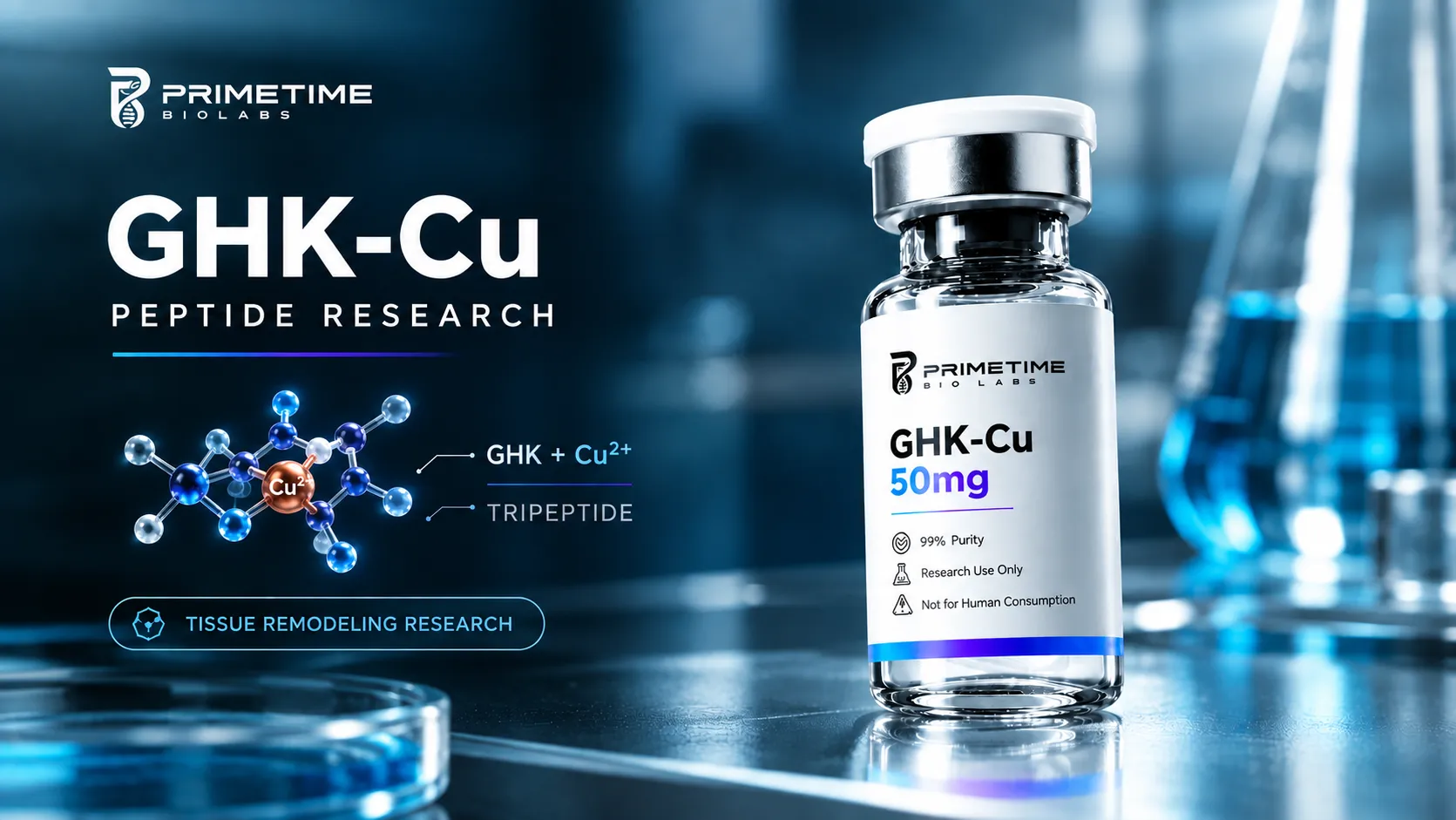
PrimeTime BioLabs lists its research material on the GHKCU product page, and the same tripeptide appears as a component in the GLOW and KLOW blends.
About that blue color
GHK-Cu solutions are blue, and the color is real chemistry. It comes from a d-d electronic transition in the copper(II) center. The exact shade shifts with hydration and coordination geometry, which makes it an analytical observation of one property and nothing else.
Blue is not a purity assay. A vivid blue solution can still be impure, and shade comparison between batches proves very little. What the color does tell you is directional. A GHK-Cu solution that turns green or goes colorless has lost its copper coordination. At that point it is no longer the complex named on the label.
What GHK-Cu Does at the Cellular Level
Most of what gets described as GHK-Cu's mechanism comes from cell culture and animal models. The underlying findings are real and measurable. The language used to summarize them online usually is not.
On matrix proteins, fibroblast studies report increased mRNA expression for type I collagen and glycosaminoglycans. The same work reports modulation of metalloproteinase activity (cell culture, summarized in PMID 42619529). That is a measured change in gene expression and enzyme activity in cultured cells. It is not a measurement of collagen in living human skin, and the two should never be written as one result.
On copper handling and redox signaling, the proposed mechanism is that the peptide acts as a copper carrier. Copper is an essential cofactor for the lysyl oxidase family of cross-linking enzymes (mechanistic interpretation, reviewed in PMID 42787770). The same review describes GHK as an endogenous matricryptin released from collagen and SPARC. Anti-inflammatory effects reported in preclinical work include suppression of TGF-beta and IL-6 (PMID 42619529).
Gene-expression profiling produced the most quoted claim about this molecule. A 2015 review reported that GHK can up- and downregulate at least 4,000 human genes (PMID 26236730). The number is accurate as a description of expression-array output. It is not a description of any outcome in a person. A gene that changes expression in culture has not been shown to change anything a researcher would notice.
One more thing belongs here, and competitors leave it out. A large share of the GHK and GHK-Cu review literature comes from one research group led by Loren Pickart. The affiliation printed on those papers is Skin Biology, a skin-care company in Bellevue, Washington (PMIDs 18644225, 22666519, 26236730, 29986520). That is not a reason to discard the work. It is a reason to notice that the field's most cited summaries and a commercial interest share an author. Independent groups have replicated relatively little of that work. Some independent work does exist alongside it. A University of Washington group reported plasma GHK declining from roughly 200 ng/mL at age 20 to roughly 80 ng/mL at age 60 (PMID 35083444).
What Human Trials Have Actually Tested
The human record is thinner than the marketing implies, and it is worth walking through trial by trial.
Venous stasis ulcers, 1992
- Trial: Bishop et al., Journal of Vascular Surgery (PMID 1495150)
- Design: prospective randomized, evaluator-blinded, three arms
- Participants: 86 evaluable patients
- Form tested: topical tripeptide copper complex, 0.4% cream
- Endpoint type: clinical, ulcer size reduction
- Outcome: the copper complex was no better than inert vehicle placebo
- Limitation: a genuine negative result in a reasonably sized human trial, rarely cited on vendor pages
CO2 laser-resurfaced skin, 2006
- Trial: Miller et al., Archives of Facial Plastic Surgery (PMID 16847171)
- Design: randomized, blinded evaluators, post-procedure regimen with or without GHK-Cu
- Participants: 13 patients completed
- Form tested: topical GHK-Cu skin care products
- Endpoint type: both objective and patient-reported
- Outcome: no significant difference in erythema, wrinkles, or objectively rated skin quality
- Outcome, secondary: patient-reported overall skin quality favored GHK-Cu at P = .04
- Limitation: 13 completers cannot rule out a modest real effect, and an unblinded questionnaire is the study's weakest endpoint
Male pattern hair loss, 2016
- Trial: Lee et al., Annals of Dermatology (PMID 27489425)
- Design: placebo-controlled, three arms, six months
- Participants: 45 patients
- Form tested: a complex of 5-aminolevulinic acid and GHK, the peptide without copper
- Endpoint type: clinical, hair count, length, and thickness
- Outcome: hair count rose in both active arms over six months
- Limitation: the lower-dose arm beat the higher-dose arm, and length and thickness did not differ
- Limitation, form: this does not test GHK-Cu, and it cannot separate GHK from the 5-ALA beside it
Scalp injections in a growth-factor blend, 2018
- Trial: Kapoor and Shome, Journal of Cosmetic and Laser Therapy (PMID 29482481)
- Design: open-label, single-arm, no control group
- Participants: 1,000 patients
- Form tested: an injectable blend of VEGF, bFGF, IGF, KGF, thymosin beta-4, and copper tripeptide-1
- Endpoint type: clinical, hair pull test and videomicroscopy
- Outcome: reduced hair fall in 83% of patients, with higher total hair count at one year
- Limitation: six active ingredients and no control arm, so nothing is attributable to copper tripeptide-1
Multi-ingredient topical products, 2024 and 2025
- Trials: two open-label single-center studies of products containing copper tripeptide-1 (PMIDs 39449909, 41001334)
- Design: open-label, interventional, no placebo arm
- Endpoint type: instrument-measured scalp and skin parameters
- Outcome: statistically significant improvements in flaking, hydration, and scar appearance
- Limitation: multi-ingredient formulations with no control group, leaving the peptide's contribution unmeasured
On hair loss specifically, the honest summary is narrow. No published human trial has tested GHK-Cu on its own for hair loss. Existing human hair studies all used combination products. One tested copper-free GHK with 5-aminolevulinic acid (PMID 27489425). Another used a six-ingredient injectable blend with no control group (PMID 29482481). Claims that GHK-Cu affects DHT or 5-alpha-reductase have no published data behind them at all.
What the Evidence Does Not Show
Several widely repeated claims about GHK-Cu do not survive a source check.
There are no published human trials of injectable GHK-Cu on its own. Every human study described above used a topical product or an injected multi-ingredient blend. Two 2026 sports medicine reviews searched for musculoskeletal evidence and found none. One concluded plainly that no clinical data support its use for musculoskeletal conditions (PMIDs 41476424, 42578445).
Systemic claims about gut, lung, bone, and nerve tissue rest on animal and cell work. The COPD research often cited as lung evidence measured plasma GHK in 9 patients against 11 healthy controls. It then tested GHK-Cu in mouse muscle and cultured myotubes (PMID 36905132). That is an association plus a preclinical model, and not a human outcome.
The null results deserve naming here. The 1992 venous ulcer trial found no benefit over placebo in 86 patients (PMID 1495150). The 2006 laser trial found nothing on its objective endpoints (PMID 16847171). An irradiated rat flap model found no difference in ischemia, vessel number, or VEGF expression (PMID 23744835). A rat ACL study randomized 72 animals and found better knee laxity at 6 weeks. That advantage had disappeared by 12 weeks once treatment stopped (PMID 25731775).
Two citations circulate widely and should not be used. A frequently quoted 1998 facial cream study reports improvements of roughly 70%, 50%, and 40%. It appears in a journal that PubMed does not index, so those percentages cannot be checked against a primary source. A commonly cited 2008 comparison against retinol also fails a literature check. This article cites neither of them.
A 2026 systematic review of microneedle delivery screened 1,247 records and kept 64. It concluded that no registered, adequately powered human trial of microneedle-delivered GHK-Cu has been published (PMID 42787770). Everything beyond small topical skin studies remains preclinical until better trials exist.
How GHK-Cu Differs From BPC-157 and TB-500
GHK-Cu
- A three-amino-acid human peptide that carries a copper ion
- Studied mostly for skin, matrix remodeling, and wound-related signaling
- Has small topical human trials, with mixed and partly negative results
- No systemic randomized controlled trials in humans
BPC-157
- A 15-amino-acid sequence derived from a protein found in gastric juice
- Studied mostly in tendon, gut, and soft-tissue animal models
- Human data is limited to a case series with significant design flaws (PMID 41476424)
- Covered in depth in our BPC-157 article
TB-500
- A synthetic fragment corresponding to the active region of thymosin beta-4
- Studied for cell migration and tissue repair in preclinical models
- The published human trial program tested the parent molecule, not the fragment
- Covered in depth in our TB-500 article
Researchers reach for these three to ask different questions. GHK-Cu work centers on copper-dependent matrix signaling in skin. BPC-157 work centers on gut and tendon models. TB-500 work centers on actin binding and cell migration. No head-to-head human trial has compared any two of them, so ranking them against each other is speculation and not a finding.
How to Read a GHK-Cu COA
A certificate of analysis answers several separate questions, and purity is only one of them.
HPLC purity tells you what fraction of the peptide-related material is the target peptide. It does not tell you whether the copper is still coordinated to that peptide. A sample can report high chromatographic purity while the copper has partly dissociated. The assay is measuring the peptide and not the complex. Purity and identity are different tests, and purity alone never establishes safety.
Mass spectrometry is where identity gets settled. The intact 1:1 complex and the free peptide differ by about 61 Da, which is easy to distinguish. Protonated free GHK appears at m/z 341.19. The protonated intact chelate appears near m/z 402.11 on a monoisotopic basis. A spectrum showing only the free peptide signal is telling you something the purity percentage will not.
A few more things a good GHK-Cu certificate carries. It names the salt form it reports, because the acetate salt and the free complex have different formula weights. It states net peptide content against the label claim, since peptide content and gross powder mass differ. It reports copper content, which is what supports a 1:1 stoichiometry claim over a 2:1 one.
The red flags here are specific ones. A CAS number that does not match the named form is one. A molecular weight printed beside a formula that does not produce it is another, and that is the most common error on GHK-Cu paperwork. A purity percentage with no identity method behind it is a third.
Our guide to reading a peptide certificate of analysis covers the general structure of these documents in more detail.
How GHK-Cu Holds Up in Storage
What the published literature establishes
One preformulation study gives real stability data (PMID 25384620). GHK-Cu proved susceptible to hydrolytic cleavage under basic and oxidative stress, and less so under acidic stress. The same study found the peptide stable in water and in buffers across pH 4.5 to 7.4. That held for at least two weeks at 60 degrees C. Three degradation products were identified by HPLC with mass spectrometry, one of which was free histidine. The compound is strongly hydrophilic, with log D values between -2.38 and -2.49.
That study also reported formulation compatibility findings. GHK-Cu was compatible with Span 60 based niosomes and less stable with the negatively charged lipid dicetyl phosphate.
What vendors claim, and what nobody has published
- Lyophilized storage at -20 degrees C is commonly quoted as 2 to 3 years
- Storage at 2 to 8 degrees C is quoted for shorter and less consistent periods
- Reconstituted material is variously described as holding for 1 week, 4 weeks, or 6 weeks
- These are supplier conventions, and not findings from a peer-reviewed stability study
- No published shelf-life study surfaced that tests these specific durations for GHK-Cu
The gap between a 1-week figure and a 6-week figure is not a small one, and no source resolves it. Treat all of these as handling conventions with unknown experimental backing. Chelating agents such as EDTA compete for copper, which is a known property of copper complexes generally. Formulation-specific incompatibility claims for GHK-Cu are mostly vendor statements.
Where GHK-Cu Stands With Regulators
GHK-Cu is not an FDA-approved drug for any indication. Copper Tripeptide-1 exists as an INCI cosmetic ingredient name, which is a labeling convention and carries no agency endorsement.
The compounding position moved twice in 2026, and the primary documents say the following. On April 15, 2026, FDA announced the removal of 12 peptides from Category 2 of the interim 503A bulks list. GHK-Cu left Category 1 at the same time, effective April 22, 2026, because its nominations had been withdrawn.
That removal did not hold for long. In early May 2026, one nominator clarified that it had meant to withdraw only its nomination of the injectable route of administration. It wished to retain the nomination for non-injectable routes, and FDA accepted the clarification. GHK-Cu was reinstated to Category 1 on May 5, 2026. The FDA nominations document updated May 14, 2026 now lists the entry as GHK-Cu except for injectable routes of administration. The restoration covers non-injectable routes only, and injectable GHK-Cu remains outside Category 1.
FDA has not been silent on the injectable question. Its page on substances that may present significant safety risks addresses GHK-Cu directly. It states that compounded injectable drugs containing GHK-Cu may pose risk for immunogenicity, due to the potential for aggregation and peptide-related impurities. The same page notes limited data in humans to inform safety-related considerations.
What happens next is already scheduled. FDA has said it will hold a Pharmacy Compounding Advisory Committee meeting before the end of February 2027. GHK-Cu is named on the list of bulk drug substances that committee will consider for the 503A list. The others named alongside it are cathelicidin (LL-37), dihexa acetate, melanotan II, and PEG-MGF.
Two distinctions are worth keeping separate. Removal from a category is an administrative consequence of a withdrawn nomination. It is not an agency finding that a substance is safe or effective. Anything written about what the February 2027 meeting will decide is interpretation, because the committee has not met. This regulatory picture is current as of the dates above and should be re-checked before anyone relies on it.
PrimeTime BioLabs supplies GHK-Cu for research use only. It is not for human or veterinary use, and nothing here is medical advice.
Questions Researchers Actually Ask
What does GHK-Cu stand for?
GHK is the single-letter shorthand for the amino acid sequence glycine, histidine, lysine. Cu is the chemical symbol for copper. Together they name a three-amino-acid peptide bound to a copper(II) ion, in a 1:1 complex. The full chemical name is glycyl-L-histidyl-L-lysine copper.
GHK vs GHK-Cu, what is the difference?
GHK is the bare tripeptide with nothing bound to it, at 340.38 g/mol. GHK-Cu is the same peptide holding one copper(II) ion, at 401.91 g/mol when written as the deprotonated chelate. The copper is coordinated into the molecule, and it carries much of the biological signal described in the literature.
Is Copper Tripeptide-1 the same as GHK-Cu?
Yes, the two names describe the same chemical entity. Copper Tripeptide-1 is the INCI name, the standardized term used on cosmetic ingredient labels, and GHK-Cu is the name used in research settings. This is a naming equivalence only, and it implies nothing about what any product containing the ingredient actually does.
How does GHK-Cu work at the cellular level?
In cell culture, GHK-Cu is reported to increase mRNA expression of type I collagen and glycosaminoglycans, and to modulate metalloproteinase activity. Proposed mechanisms include copper delivery to lysyl oxidase enzymes and antioxidant signaling. These are cell-culture and mechanistic findings, and not demonstrated outcomes in human tissue.
What do the human trials actually show?
Human data is small, topical, and mixed. A 2026 systematic review found only 2 randomized controlled trials among 20 studies (PMID 42619529). A 13-patient laser resurfacing trial found no objective benefit, though patient satisfaction was higher (PMID 16847171). An 86-patient venous ulcer trial found no benefit over placebo (PMID 1495150).
Does GHK-Cu work for hair loss?
No published human trial has tested GHK-Cu alone for hair loss. Existing human hair studies used combination products, including one testing copper-free GHK with 5-aminolevulinic acid (PMID 27489425). Another used a six-ingredient injectable blend with no control group (PMID 29482481). Neither design isolates what the peptide itself contributed.
GHK-Cu vs BPC-157, what is each studied for?
GHK-Cu research centers on copper-dependent matrix signaling, skin remodeling, and wound-related pathways, with small topical human trials. BPC-157 research centers on gut and tendon repair in animal models, with human evidence limited to a flawed case series. No head-to-head trial has ever compared them directly.
Is GHK-Cu FDA approved?
No, GHK-Cu is not an FDA-approved drug for any indication. On the FDA nominations document updated May 14, 2026, it sits in Category 1 except for injectable routes of administration. Injectable forms stay outside that category, and FDA has flagged potential immunogenicity risk for them. A Pharmacy Compounding Advisory Committee will consider it before the end of February 2027.
What should a GHK-Cu COA show?
It should name the exact form and salt, and give a CAS number matching that form. The molecular formula and the molecular weight printed beside it must agree with each other. It should show an identity method, usually mass spectrometry, confirming the intact complex near m/z 402.11. Purity alone is not sufficient evidence of identity.
Does this article tell me how much to use?
No, this article contains no usage guidance of any kind. It covers chemistry, evidence, analytical verification, and regulatory status only, with no dosing, administration, reconstitution, or cycling information. GHK-Cu sold for research is research material, and questions about human use belong with a qualified medical professional.
The Bottom Line
What is real here is fairly narrow. GHK-Cu is a well-characterized copper complex with a substantial preclinical literature and a handful of small topical human trials. Two of those trials returned negative results on their objective endpoints. What is interesting but unproven is everything systemic, including hair, joint, gut, and lung claims. Those all rest on animal models, cell culture, or gene-expression data. What would change the picture is easy to describe and has not happened. Large, independent, adequately powered randomized trials of the compound on its own would settle questions that four decades of mechanistic work have not.
If you are verifying material and not just reading about it, start with the paperwork. Our COA reading guide covers what each section of those documents can and cannot tell you.