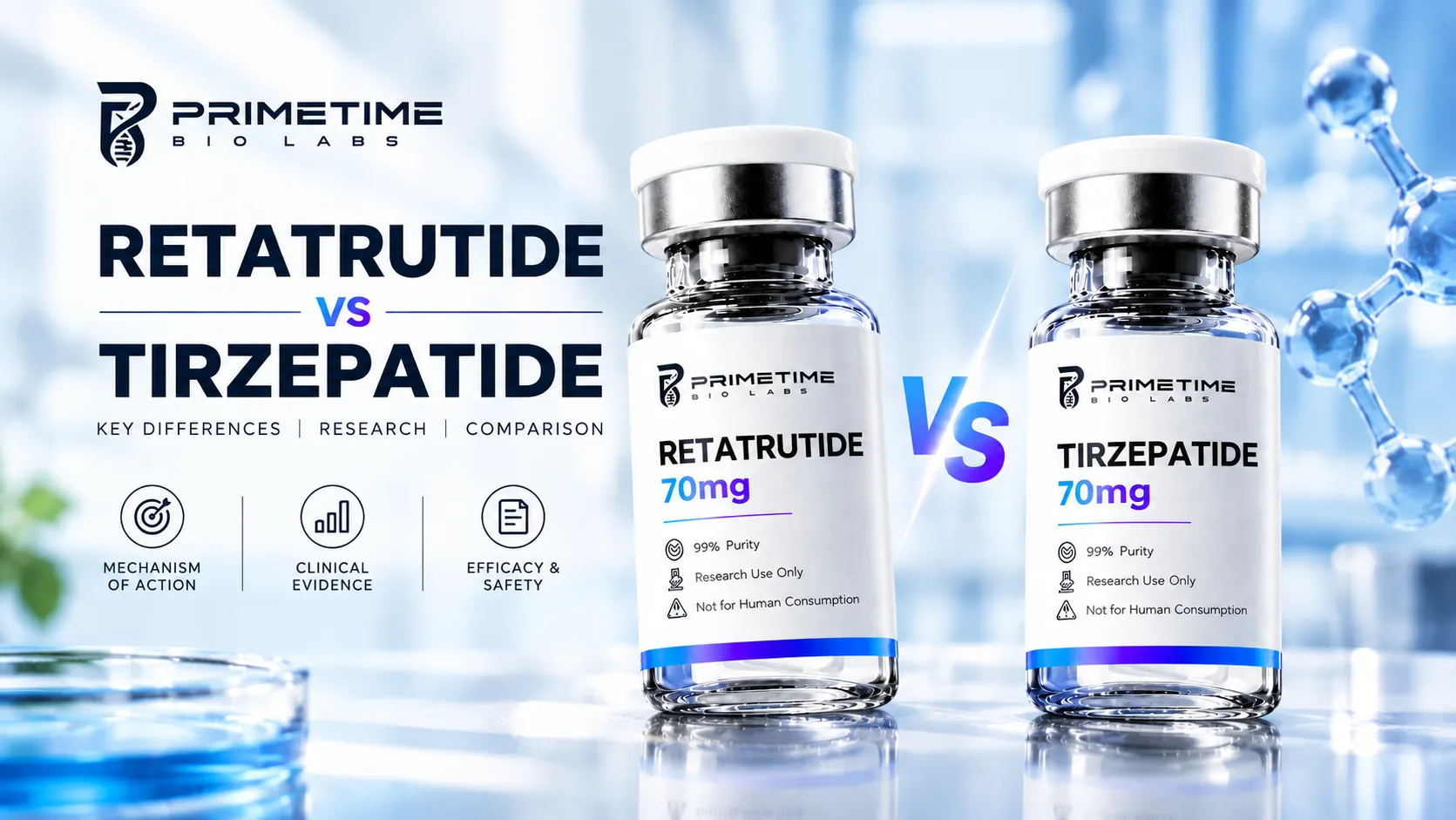
Retatrutide and tirzepatide are hormone receptor agonists developed by Eli Lilly. Tirzepatide is approved and activates two receptors, GIP and GLP-1. Retatrutide is investigational and adds a third, glucagon. Every weight-loss percentage comparing the two comes from separate trials. The one randomized head-to-head trial, TRIUMPH-5, is registered as NCT06662383 and has not reported.
What the evidence supports if you ask which is stronger
Retatrutide produced larger weight reductions than tirzepatide in the trials each compound has run. That is the honest summary, and it stops well short of what most comparison pages claim. No completed randomized trial has tested the two against each other, so superiority remains unestablished.
The two sit at different stages of the regulatory system. Tirzepatide is approved by the FDA for four separate uses and carries years of post-approval exposure. Retatrutide has four reported Phase 3 trials, two of them published, and no marketing application on file.
Their gap is also narrower than the circulating figures suggest. Matched on the same statistical method, the difference at the highest doses studied is 5.8 percentage points. Pairing figures calculated by different methods stretches that gap to 7.4 points.
Below, this article shows where each number came from and which pairs can honestly sit side by side. It also covers how the safety findings diverge and what the registered head-to-head trial can decide.
This article was last verified on 19 October 2026. Sources checked were the TRIUMPH-1 publication in the New England Journal of Medicine and the TRIUMPH-2 publication in The Lancet. The SURMOUNT-1 and SURPASS-CVOT publications were also checked, along with FDA review documents and the approved Mounjaro and Zepbound labeling. Drugs@FDA and the EU Clinical Trials Information System record for TRIUMPH-5 complete the list. Prepared by the PrimeTime BioLabs editorial team. A named medical reviewer has not yet been assigned.
One receptor is the entire difference
Tirzepatide binds two receptors, and retatrutide binds three. That single addition is the whole pharmacological story, and it is why the two compounds get compared at all.
Both activate the GLP-1 receptor, which slows stomach emptying and reduces appetite signaling. Each also activates the GIP receptor, a second incretin target whose contribution to weight loss has never been isolated in humans. Retatrutide adds the glucagon receptor on top of those two.
Glucagon activation is expected to raise energy expenditure, increase fat breakdown, and push the liver to burn stored fat. Those expectations come from receptor biology and early-phase work. No trial has separated the glucagon contribution and measured it on its own.
Adding a receptor does not automatically produce a larger effect. Researchers still cannot say how much of tirzepatide's result comes from GIP rather than GLP-1, and the same gap applies to glucagon in retatrutide. A three-receptor compound could outperform a two-receptor one for reasons unrelated to the third receptor, including dose, exposure and who was enrolled.
One naming point is worth correcting here. There is no GLP-3 receptor in human pharmacology. Product names built around GLP-3 are commercial labels rather than receptor science, and retatrutide targets GIP, GLP-1 and glucagon.
Every number in circulation comes from a different trial
TRIUMPH-1 and SURMOUNT-1 were run four years apart, by the same sponsor, against placebo rather than against each other. Neither was designed to rank one compound above the other. Any figure that places them side by side is an indirect comparison, whatever the page presenting it says.
The deeper problem is that both trials reported their results twice, using two different statistical approaches called estimands. An estimand is simply a rule for deciding whose data counts and how missing data gets handled.
One of them, the treatment-regimen estimand, counts everyone who was randomized, including people who stopped taking the drug. Under the efficacy estimand the question changes. It estimates what would have happened if everyone had stayed on treatment throughout.
Those two rules produce two different answers from the same patients. For retatrutide at 12 milligrams, the efficacy estimand gives 28.3 percent and the treatment-regimen estimand gives 25.0 percent. At tirzepatide 15 milligrams, the figures are 22.5 percent and 20.9 percent.
The placebo value moves too, and that is the detail that catches people out. In SURMOUNT-1, placebo was a 2.4 percent reduction under the efficacy estimand. Under the treatment-regimen estimand it was 3.1 percent. Pairing a figure from one rule against a figure from the other mixes two incompatible accounting systems.
One common version of that error sets 28.3 percent against 20.9 percent. It puts retatrutide's efficacy estimand beside tirzepatide's treatment-regimen estimand, and inflates the gap to 7.4 points. Matched correctly, the same two trials give 5.8 points.
A second habit worth flagging is the 24.2 percent figure that still headlines several comparison pages. That number came from a 338-person Phase 2 trial at 48 weeks. Phase 3 results superseded it in 2026, so it is not the current retatrutide efficacy figure.
The only retatrutide vs tirzepatide comparisons that hold up
Only three pairings survive proper scrutiny. Each matches like with like, and each is still indirect.
- Efficacy — Retatrutide 12 mg, TRIUMPH-1, 80 weeks: −28.3% (placebo −2.2%) — Tirzepatide 15 mg, SURMOUNT-1, 72 weeks: −22.5% (placebo −2.4%) — Difference: 5.8 points
- Treatment-regimen — Retatrutide 12 mg, TRIUMPH-1, 80 weeks: −25.0% (placebo −3.9%) — Tirzepatide 15 mg, SURMOUNT-1, 72 weeks: −20.9% (placebo −3.1%) — Difference: 4.1 points
The third pairing uses each trial's own model-based treatment difference against placebo. That is the figure regulators work from.
- Difference vs placebo — Retatrutide 12 mg: −21.0 points — Tirzepatide 15 mg: −17.8 points (−19.3 to −16.3)
- Source — Retatrutide 12 mg: TRIUMPH-1, 80 weeks — Tirzepatide 15 mg: Zepbound labeling, section 14.1, 72 weeks
One longer-term figure is worth reporting carefully. TRIUMPH-1 ran a 24-week extension to week 104, and the 12 milligram group reached a 30.3 percent reduction on the efficacy estimand. Four caveats belong beside that number. It is the efficacy estimand rather than the treatment-regimen estimand, which gave 29.9 percent. That figure belongs to the 12 milligram arm alone. The 532 participants often quoted alongside it are the total extension population across all four arms, not the group that reached 30.3 percent. And that arm continued at 12 milligrams rather than escalating, since escalation applied to the placebo and 4 milligram groups.
Tirzepatide has no matching 104-week obesity figure, so the 30.3 percent result has no comparator at all.
The two trials did not study the same people
Matched estimands fix one problem and leave another untouched. The two trials enrolled different populations and ran for different lengths of time.
TRIUMPH-1 enrolled 2,339 adults with obesity and without type 2 diabetes, over 80 weeks, at doses of 4, 9 and 12 milligrams weekly. Mean baseline body mass index was 40.0 and mean baseline weight was 112.7 kilograms.
SURMOUNT-1 enrolled 2,539 adults with obesity and without type 2 diabetes, over 72 weeks, at doses of 5, 10 and 15 milligrams weekly. Mean baseline body mass index was 38.0 and mean baseline weight was 104.8 kilograms.
The doses are not equivalent in milligrams. Twelve milligrams of retatrutide and 15 milligrams of tirzepatide are each that compound's highest studied dose. That correspondence is the only one available.
How much the population matters shows up inside the retatrutide program itself. TRIUMPH-2 enrolled adults with obesity and type 2 diabetes. Its 12 milligram group lost 18.8 percent on the treatment-regimen estimand, against 25.0 percent in TRIUMPH-1. Same compound, same dose, same duration, different people, six points of difference.
The safety signals that set them apart
Side-effect rates from separate trials are not comparable risk estimates. They appear here with their trial, dose and placebo attached. How each was collected matters as much as the numbers themselves.
Stomach and bowel effects
At retatrutide 12 milligrams in TRIUMPH-1, nausea reached 42.4 percent against 14.8 percent on placebo. Diarrhea reached 32.0 percent against 13.5 percent, constipation 26.1 percent against 10.9 percent, and vomiting 25.3 percent against 4.8 percent.
Tirzepatide at 15 milligrams in SURMOUNT-1 produced nausea in 31.0 percent, against 9.5 percent on placebo. Diarrhea reached 23.0 percent against 7.3 percent, constipation 11.7 percent against 5.8 percent, and vomiting 12.2 percent against 1.7 percent.
Neither set rises cleanly with dose. Retatrutide diarrhea was higher at 9 milligrams than at 12. Tirzepatide nausea and constipation both peaked at 10 milligrams rather than 15. Calling either pattern dose-dependent would misread the data.
Stopping treatment because of side effects
Discontinuation due to adverse events reached 11.2 percent at retatrutide 12 milligrams, against 4.6 percent on placebo. In SURMOUNT-1 it reached 6.2 percent at tirzepatide 15 milligrams, against 2.6 percent on placebo. It peaked at 7.1 percent in the 10 milligram group.
One figure runs the other way. All-cause discontinuation was lower on tirzepatide than on placebo in SURMOUNT-1, at 15.1 percent against 26.4 percent.
The one signal that separates them
Dysesthesia means an altered or unpleasant skin sensation, often described as burning or tingling. In TRIUMPH-1 it was reported in 12.5 percent of the 12 milligram group and 0.9 percent of the placebo group. The published report describes these events as mostly mild or moderate and judged nonserious.
A tirzepatide figure exists, but it will not carry a direct comparison. The Zepbound labeling reports dysesthesia at 0.4 percent for the 15 milligram dose. That figure is pooled across two trials rather than drawn from SURMOUNT-1 alone, and label reporting uses a different threshold from a trial publication.
This is an asymmetry in what was measured and reported, not proof that tirzepatide cannot cause the same effect. The rate also varies inside the retatrutide program, running considerably lower in TRIUMPH-2 than in TRIUMPH-1.
Heart rate, where the evidence is uneven
Both compounds raise heart rate during treatment. In TRIUMPH-1, pulse rose in the retatrutide groups, peaked around week 20 in the 9 and 12 milligram arms, and declined afterwards. The published article directs readers to supplementary tables for the actual values, and those tables are not in the main text.
Tirzepatide's heart-rate data has been published in full, including values at 72 weeks. It shows the same shape of a rise during escalation followed by attenuation. Comparing a published number against an unpublished one would create a false impression, so no figures appear here for either compound.
Missing published data is not the same as a missing effect. Both compounds do show the increase. Only one has made the full numbers easy to read.
What TRIUMPH-5 will and will not settle
TRIUMPH-5 is the trial everything above is waiting on. It is registered as NCT06662383 and cross-registered in the European Union, and it is the only randomized comparison of these two compounds.
The design answers most of the objections raised in this article. It is a Phase 3, double-blind, two-arm study with no placebo group, comparing retatrutide against tirzepatide in adults with obesity. Both arms titrate to each compound's maximum tolerated dose rather than a fixed milligram amount. The primary endpoint is percent change in body weight at week 80, and the stated objective is to show that retatrutide is superior to tirzepatide.
Enrollment figures differ between the two registries. The European record lists 850 planned participants and the United States record lists 800 as an estimate. No actual enrollment figure has been published. The trial is no longer recruiting, and the European registry records recruitment ending at its European sites in April 2025. Eligibility covers adults with obesity, with or without type 2 diabetes, and no body mass index threshold appears in the public record.
Primary completion is estimated for November 2026 and study completion for December 2026. Both dates are estimates, and no results have been posted or published anywhere. Registration is not a result.
Several things will stay open even after it reports. An 80-week trial cannot settle long-term safety. A trial with no placebo arm cannot produce placebo-adjusted figures. Cardiovascular outcomes sit with a separate ongoing study. And TRIUMPH-5 is not one of the four registrational TRIUMPH trials, which is why several trial trackers leave it out entirely.
One is approved, the other is not, and that gap is wider than it looks
Tirzepatide now holds four FDA-approved indications. Mounjaro is approved for glycemic control in type 2 diabetes, in adults and in children aged 10 and over. It is also approved for reducing the risk of major cardiovascular events. That indication covers adults with type 2 diabetes at high risk, and FDA granted it on 27 August 2026. Zepbound is approved for chronic weight management, and for moderate to severe obstructive sleep apnea in adults with obesity.
The cardiovascular indication deserves careful wording. SURPASS-CVOT randomized 13,299 people with type 2 diabetes and established cardiovascular disease. It compared tirzepatide against dulaglutide rather than placebo. The primary composite event occurred in 12.2 percent on tirzepatide and 13.1 percent on dulaglutide, giving a hazard ratio of 0.92. Non-inferiority was met and superiority was not established.
Both tirzepatide products carry a boxed warning for the risk of thyroid C-cell tumors. The warning records dose-dependent tumors in rats, and states that whether the same happens in humans is unknown. It contraindicates use in people with a personal or family history of medullary thyroid carcinoma, or with multiple endocrine neoplasia syndrome type 2. The label also notes that routine monitoring is of uncertain value.
Retatrutide has no approved indication and no application on file. Lilly stated in a July 2026 press release that it plans to submit a Biologics License Application in the first quarter of 2027.
Whether retatrutide even qualifies for that pathway is disputed. FDA classified the molecule as a drug rather than a biologic. Its regulatory definition of a protein requires more than 40 alpha amino acids, and FDA counted only those. Lilly sued in September 2024, arguing the count should include units the agency excluded. A district court agreed with FDA on the protein definition. It found the agency's handling of a separate question arbitrary, namely what counts as analogous to a protein, and sent the matter back. Lilly appealed to the Seventh Circuit in February 2026, and no decision had been reported as of this article's verification date.
Three distinctions hold throughout this topic. A planned filing is not an approval. Completing a trial is not the same as publishing it. Registering a trial does not produce a result.
Trial results describe a product you cannot buy
Every percentage on this page was generated using pharmaceutical-grade material manufactured for a clinical trial. It was given under medical supervision, to screened participants, on a fixed schedule, with monitoring throughout. That is the setting those numbers describe.
Research-grade material is a separate category. Equivalence between a research vial and the drug product used in those trials has not been established. No trial result transfers across that gap.
A certificate of analysis helps with a narrower question. It can document identity and purity for one specific lot, provided it names the lot, the method and the testing laboratory. Purity by high-performance liquid chromatography describes how clean a sample is, not what it is. Closely related sequences can hide under the main peak. That is why mass spectrometry identity confirmation matters alongside the purity figure.
What a certificate cannot establish is just as important. It says nothing about safety, sterility, biological activity, or whether a material behaves like the product used in a trial. Our guide to reading a certificate of analysis covers what to check and what each test leaves open.
What is known, what is not, and what changes in November
Matched on the same statistical method, retatrutide produced a larger reduction than tirzepatide across their separate trials. The difference is 5.8 points on the efficacy estimand and 4.1 points on the treatment-regimen estimand. Both of those figures remain indirect.
Tirzepatide is approved with four indications and a published safety record. Retatrutide is investigational, has a distinctive dysesthesia signal with no clean comparator, and has not been filed for approval.
TRIUMPH-5 reaches estimated primary completion in November 2026. Until it reports, no one can say which compound performs better when the same trial measures both.
For background on each compound, see our evidence-graded reviews of retatrutide and tirzepatide. The semaglutide evidence file adds three-way context. Our guide to peptide legality covers how research materials sit under current US law.