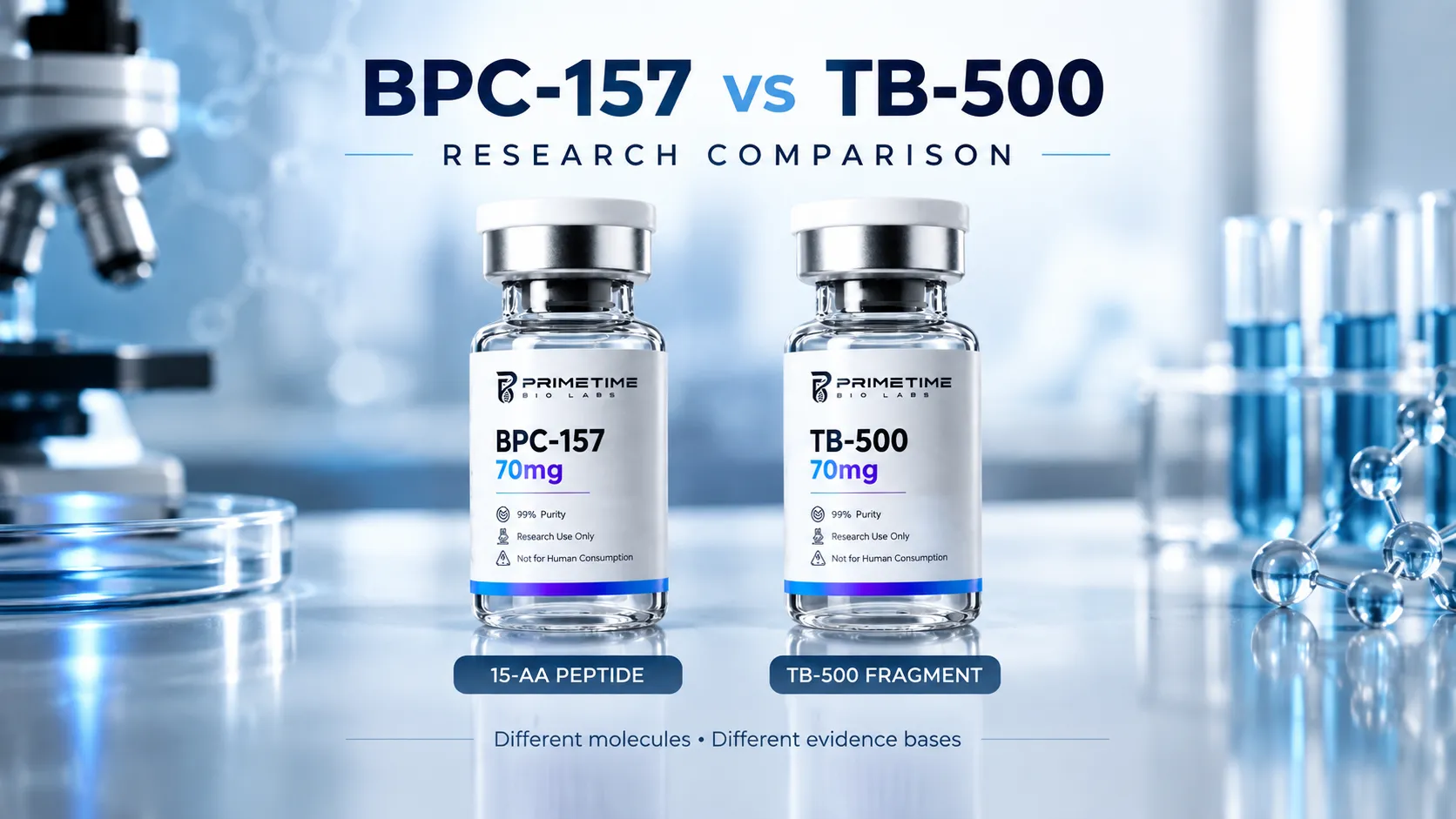
Short answer. BPC-157 and TB-500 are not two versions of the same thing, and not really competitors. They are different molecules studied through different mechanisms, and the evidence behind them is wildly lopsided. BPC-157 has five small published human exposures and a large preclinical literature. The TB-500 fragment has never been given to humans in any published study, and the human data cited for it belongs to a different, larger molecule.
How we graded the evidence. Claims below are labelled human RCT, human pilot, animal, in vitro, or mechanistic interpretation, and findings drawn from thymosin beta-4 rather than the TB-500 fragment say so. Chemical identity, regulatory status and adverse event data come from the FDA briefing documents for the July 2026 Pharmacy Compounding Advisory Committee meeting.
BPC-157 vs TB-500 at a Glance
BPC-157 (free base) | TB-500 (free base) | |
|---|---|---|
Sequence | H-Gly-Glu-Pro-Pro-Pro-Gly-Lys-Pro-Ala-Asp-Asp-Ala-Gly-Leu-Val-OH | Ac-Leu-Lys-Lys-Thr-Glu-Thr-Gln-OH |
Amino acids | 15 | 7 |
CAS number | 137525-51-0 | 885340-08-9 |
UNII | 8ED8NXK95P | QHK6Z47GTG |
Molecular formula | C62H98N16O22 | C38H68N10O14 |
Molecular weight | 1419.5 g/mol | 889.01 g/mol |
Origin | Fragment of body protection compound, described in human gastric juice, Zagreb, 1993 | Synthetic fragment of thymosin beta-4, residues 17 to 23 |
Proposed mechanism | Angiogenic and nitric oxide related signalling (preclinical) | G-actin binding and cell migration (preclinical, largely via parent molecule) |
Published human exposures | 5 | 0 |
Regulatory status | Not FDA approved. Not on the 503A Bulks List. | Not FDA approved. Not on the 503A Bulks List. |
WADA 2026 status | Prohibited, S0 (non-approved substances) | Prohibited, S2.3 (growth factors) |
Those figures matter because vendor pages disagree on the basics. FDA's reviewers found that even compounders' own nomination packages carried molecular formulas and CAS numbers not matching the substance nominated.
What Is BPC-157?
BPC-157 is a pentadecapeptide, a chain of 15 amino acids, described as a fragment of a larger protein found in human gastric juice. It was first reported in 1993 by University of Zagreb researchers, who called it a possible endogenous free radical scavenger and organoprotection mediator.
Three points worth holding onto:
- It has no United States Adopted Name. "BPC-157" is a common name, part of why the same label gets attached to chemically different products.
- It exists commercially as at least two distinct active pharmaceutical ingredients, a free base and an acetate salt, with different CAS numbers.
- It sells in the United States as a supplement ingredient and research chemical, and no country has approved a drug containing it.
What Is TB-500?
This is the single most important distinction in the comparison, and most pages get it wrong.
TB-500 is not thymosin beta-4. Thymosin beta-4 is a naturally occurring 43 amino acid protein found throughout human tissue and secreted into blood, saliva, tears and wound fluid. TB-500 is a synthetic 7 amino acid fragment of residues 17 to 23 of that protein, with an acetyl group at the N-terminal leucine.
The fragment covers the parent molecule's actin-binding region and none of its other functional regions. FDA's reviewers add a point that rarely surfaces on vendor pages: acetylation permanently changes a peptide's charge, hydrophobicity and size, so the profile of the non-acetylated LKKTETQ sequence in the older literature cannot be extrapolated to acetylated TB-500.
Three molecules circulate under overlapping names, and almost all the research belongs to the largest.
How Does BPC-157 Work?
The honest answer is that nobody knows, and the agency reviewing it said so plainly.
The proposed mechanisms, all from animal and cell work, centre on tissue repair signalling. Researchers have hypothesised that BPC-157 upregulates growth factors and their receptors, suppresses inflammatory factors, induces angiogenesis, and stimulates nitric oxide synthesis. *(Evidence grade: animal and in vitro, mechanistic interpretation.)*
Three limitations sit against that in FDA's evaluation. Dose response relationships have not been established, which is unusual: across multiple rodent studies, doses separated by three orders of magnitude produced effects of the same size. The molecular targets have never been identified. Because of both, the agency concluded it is difficult to assess the biological plausibility of the reported effects at all.
Animal pharmacokinetics exist. In beagles and rats given a single intravenous dose, half-life ranged from roughly 5 to 15 minutes. *(Evidence grade: animal.)*
How Does TB-500 Work?
The proposed mechanism is G-actin sequestration. By binding globular but not filamentous actin, the LKKTETQ sequence is thought to buffer the pool of actin monomers available for filament assembly, which governs cell shape, motility and migration. *(Evidence grade: in vitro and mechanistic interpretation, derived largely from the parent molecule.)*
Here the comparison gets uncomfortable for TB-500. FDA identified no in vivo study assessing whether TB-500 itself promotes wound healing. It did find a 2024 in vitro study in which TB-500 free base at 50 micrograms per millilitre produced no significant wound closure in a fibroblast scratch assay, while its metabolite N-acetylated LKKTE produced a small but significant effect. *(Evidence grade: in vitro, single study, no concentration response analysis.)*
Whether TB-500 works in a living organism, and whether any such effect would depend on its breakdown products rather than the fragment, is unknown.
Head-to-Head BPC-157 vs TB-500
Aspect | BPC-157 | TB-500 | Key data point |
|---|---|---|---|
Molecule | 15 aa peptide | 7 aa fragment of a 43 aa protein | TB-500 is a fragment, not the parent |
Proposed mechanism | Angiogenesis, nitric oxide signalling | G-actin binding, cell migration | Neither target is confirmed in humans |
Preclinical depth | Large, 544 articles identified 1993 to 2024 | Thin for the fragment itself | 35 of 36 studies meeting review criteria were preclinical |
Human exposures | 5 published | 0 published | FDA found no human data for TB-500 by any route |
Human pharmacokinetics | None established | None established | Not detected in plasma after rectal administration |
Toxicology package | Partial: genotoxicity, teratogenicity, 28-day repeat dose | None identified | No acute, repeat dose, genotoxicity, reproductive or carcinogenicity studies for TB-500 |
Oral viability | No absolute human bioavailability figure published | Not studied in humans | Both oral claims are unsupported |
WADA 2026 | Prohibited, S0 | Prohibited, S2.3 | Both banned at all times |
Which Has More Human Research?
BPC-157, without question. But "more" is doing heavy lifting there.
FDA's literature search identified exactly five clinical studies giving BPC-157 to humans:
1. A rectal enema study in 24 healthy subjects over eight days.
2. A two week rectal enema study in roughly 26 ulcerative colitis subjects, the BPC-157 arm of a 53 subject randomised trial.
3. An intra-articular injection study in 17 enrolled knee-pain subjects (16 followed up, 12 receiving BPC-157 alone).
4. An intravesical injection procedure in 12 interstitial cystitis subjects.
5. An intravenous infusion pilot in 2 healthy subjects.
Only the second was randomised and placebo controlled, and it exists as a conference abstract, so its endpoints, inclusion criteria and statistical methods cannot be scrutinised. FDA called the data inadequate to support efficacy or safety. A phase 1 oral study on ClinicalTrials.gov has no posted results. *(Evidence grade: one human RCT in abstract only; four human pilot studies.)*
Across all five, no serious adverse events appear to have been reported. That is reassuring as far as it goes, which is not far: the studies were short, small, exploratory in dose, and mostly silent on safety monitoring.
For TB-500, the number is zero. Not "few", not "limited". FDA found nothing in the literature in which TB-500 was given to patients for any condition, by any route.
The rejoinder is that thymosin beta-4 has been studied in humans, including corneal and ulcer healing. True, and beside the point. Parent protein and acetylated fragment are different substances with different regulatory identities, and acetylation alters the properties governing how a peptide behaves. Transferring a finding between them is an assumption.
What Is the Wolverine Stack? Popular Claims vs. Scientific Evidence
"Wolverine stack" is marketing language, not a research term. It means using BPC-157 and TB-500 together, a comic-book reference to rapid healing. The phrasing is common enough commercially that FDA's own briefing document quotes a clinic calling BPC-157 the "wolverine compound" and cites a vendor page promoting a "BPC157 and TB500 wolverine protocol".
The claims-versus-evidence ledger:
The claim: the two are complementary, so combining them repairs better or faster than either alone.
The evidence: none in humans. No controlled study has tested the combination, and because neither compound has established human pharmacokinetics there is no basis for predicting how they interact. The complementary-mechanism argument is an inference from two separate preclinical literatures, one of which does not cover the molecule being sold.
The claim: the combination is well tolerated.
The evidence: the only regulatory signal on record points the other way. In its FAERS review, FDA describes a 40 year old woman who used a product containing BPC-157 and TB-500 labelled for research purposes only, and she developed diffuse hyperpigmentation and gum darkening. She stopped, restarted two weeks later, and the identical reaction reappeared. *(Evidence grade: single spontaneous adverse event report with positive rechallenge.)*
FDA's reading is careful: the events were likely due to the product, given the recurrence on rechallenge, but because it held two peptides neither can be assigned responsibility. One case report is not an incidence rate. It is, however, the closest thing to human data on this specific combination that exists.
What Most Pages Get Wrong
"BPC-157 has 90% oral absorption." No absolute oral bioavailability figure for BPC-157 in humans has been published. FDA states there is no information with which to assess its human pharmacokinetics, and notes that in the two rectal enema studies that measured it, BPC-157 was not detected in plasma. An absorption percentage cannot be derived from an absence of measurement.
"80% combined recovery rate." No study produces this number. Neither compound has a controlled human efficacy trial, so a combined rate has nothing to calculate from.
"TB-500 is thymosin beta-4." It is a 7 amino acid acetylated fragment of a 43 amino acid protein. Listings that call TB-500 a 43 amino acid peptide, or use the names interchangeably, describe a different molecule from the one in the vial.
"BPC-157 completed a phase 2 or phase 3 trial." The ulcerative colitis study is routinely cited this way. It was a 2005 conference abstract and, as far as the published record shows, never appeared as a full paper. Citing an abstract as a completed trial overstates its weight.
"More studies means more effective." One 2025 systematic review identified 544 BPC-157 articles from 1993 to 2024 and, after screening, included 36: 35 preclinical, one clinical. Publication volume measures research interest, not demonstrated effect in humans.
"The FDA cleared these peptides in July 2026." It did not. More on that below.
Are BPC-157 and TB-500 Safe?
Neither has a characterised human safety profile, and the two sit at different points on the spectrum of "we don't know".
For BPC-157, a partial nonclinical package exists at least. It was not mutagenic across bacterial reverse mutation, chromosome aberration and micronucleus assays, and showed no teratogenic effect in pregnant rats at the doses tested. *(Evidence grade: animal and in vitro.)* But 28 day repeat-dose studies in rats and dogs produced signals FDA called potentially clinically relevant: changes in activated partial thromboplastin time, suggesting altered clotting, and liver-associated changes in ALT, glucose and triglycerides. *(Evidence grade: animal.)* No carcinogenicity study exists. In humans, across the five exposures, no serious adverse events appear to have been reported, though monitoring is largely undescribed. FAERS holds three reports for injectable BPC-157: injection site reaction, shortness of breath, and the combination case above. None can be confidently attributed to the compound.
For TB-500 there is no toxicology package at all. FDA identified no acute, repeat-dose, genotoxicity, reproductive, developmental or carcinogenicity study, and no human exposure data by any route. FAERS returned no reports for TB-500 alone.
Two risks apply to both, and to every grey-market peptide. The first is immunogenicity: injected peptides can provoke immune responses, amplified by aggregation and synthesis-related impurities. The second is product identity. FDA reviewers found that commercial certificates of analysis for both compounds typically report purity and little else, with no control of impurity profiles, aggregates, endotoxin or microbial quality. Whatever the research says about a molecule, it says nothing about an unverified vial, which is where how to read a peptide COA and a supplier due-diligence checklist matter more than any mechanism discussion.
What's Their Legal and Regulatory Status?
Neither compound is an FDA approved drug, and no country has approved a product containing either.
In July 2026 both went before the FDA's Pharmacy Compounding Advisory Committee, weighing whether they should join the 503A Bulks List, the mechanism letting compounding pharmacies prepare a substance by prescription. Ahead of the meeting, FDA's own reviewers recommended against all seven peptides under review, concluding for BPC-157 that the evidence did not support effectiveness for ulcerative colitis and its safety profile could not be characterised, and for TB-500 that there was no evidence of effectiveness to evaluate at all.
On 23 and 24 July 2026 the committee voted the other way, recommending six of the seven, including both compounds, by narrow margins and over the objections of the agency's career scientists. Emideltide was the single rejection.
Three things follow, and vendor pages tend to compress all three into "the FDA approved it".
- An advisory committee recommendation is non-binding advice, not a decision.
- FDA must still accept it and complete notice-and-comment rulemaking before any pharmacy has clear authority to compound these substances.
- Listing would be a compounding authorisation, not drug approval. Neither compound would become an approved medicine.
In sport, both are prohibited at all times under the WADA 2026 Prohibited List. BPC-157 is named in category S0, non-approved substances. TB-500 falls under S2.3, where thymosin beta-4 and its derivatives are named. Detection methods for both are published and in use by accredited laboratories, and athletes have been sanctioned on non-analytical evidence, so a clean test is not protection.
The Bottom Line on BPC-157 vs TB-500
Graded on evidence rather than marketing, the comparison is not close, and neither compound looks like a settled proposition.
BPC-157 is better studied by a wide margin, with a substantial preclinical literature, a partial toxicology package, and five small human exposures reporting no serious adverse events. Its gaps are at least legible: no established mechanism, no human pharmacokinetics, no dose response, no carcinogenicity data, one randomised trial existing only as an abstract.
TB-500 is in a different category. The fragment being sold has no human exposure data, no toxicology package, and no in vivo study of its own proposed effect. Its reputation rests on research into a larger molecule it is not, and the one in vitro test of the fragment found no effect.
The "Wolverine stack" adds a third layer of inference on two uncertain foundations, with one positive-rechallenge adverse event report as the only human observation on record.
That asymmetry is the actual finding. Researchers studying angiogenic and nitric oxide mediated repair signalling tend to work with BPC-157, where the preclinical base is deep enough for testable hypotheses. Those studying actin dynamics more often use thymosin beta-4 itself, where the biology is characterised, rather than a fragment whose activity has not been shown independently.
See our BPC-157 deep-dive and our TB-500 deep-dive for compound-level detail, and GHK-Cu, the third compound in this comparison set.
Both compounds referenced here, BPC-157 and TB-500, are supplied for laboratory research only.
For research use only. Not for human or veterinary use.