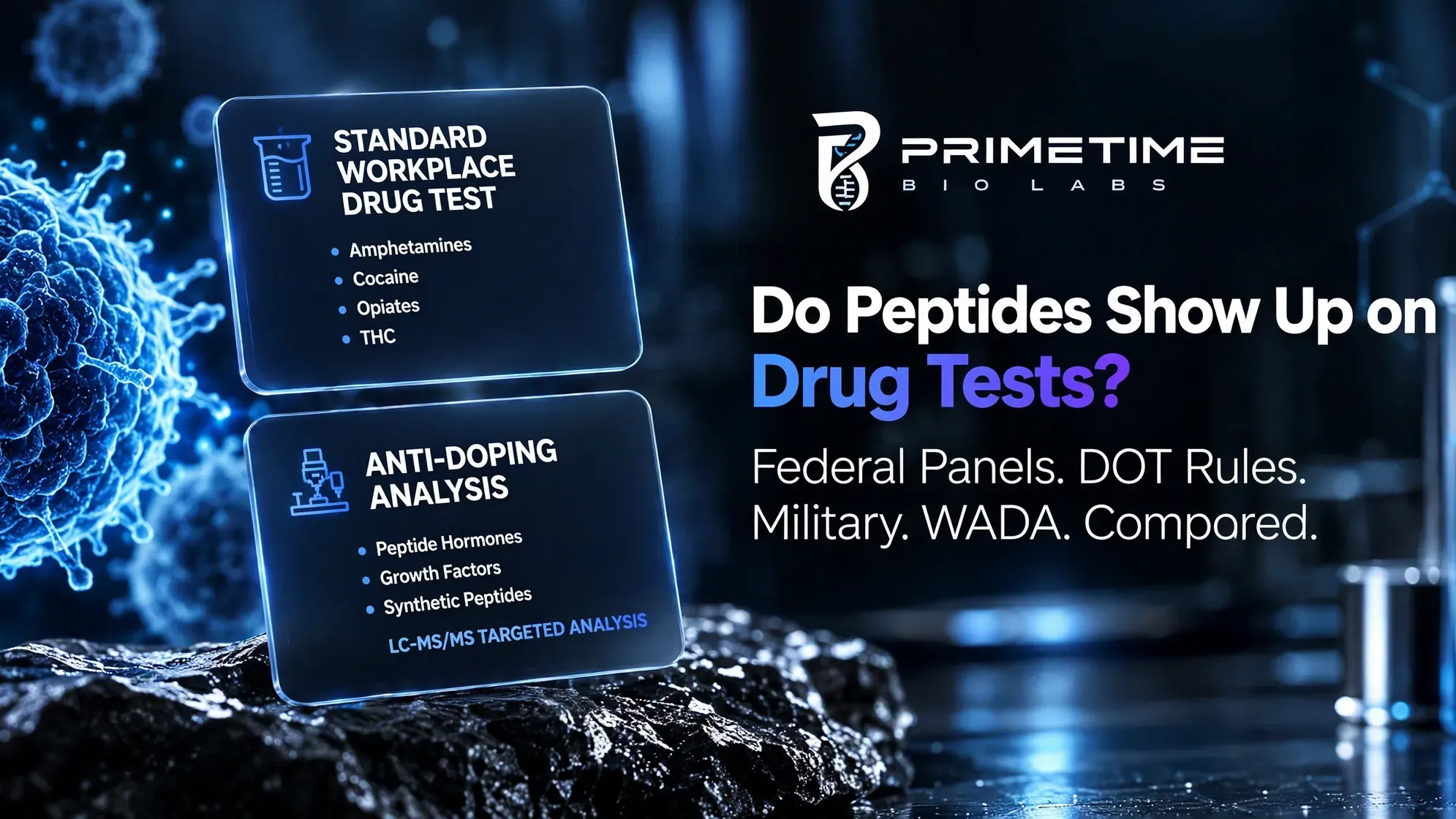
Do peptides show up on drug tests? Standard drug tests do not screen for peptides. The federal workplace panel, the DOT panel and routine military urinalysis each cover a fixed list of small-molecule drug classes. No peptide appears on any of them. Anti-doping testing is a separate system, and it does prohibit many peptides.
The short answer, and why it depends on who is testing
In July 2025, the federal workplace drug-testing panel changed when fentanyl was added to it.
That detail matters more than it looks. A drug test is not a fixed idea. Each programme runs off a published list of analytes, that list carries a date, and it changes when a regulator decides it should. Ask whether peptides show up on drug tests and the honest reply is a question back. Which test, run by whom, under which rule.
For the testing most people encounter, the answer is settled. Workplace panels, DOT panels and routine military urinalysis all screen for small-molecule drugs of abuse. None of them lists a peptide.
Sport operates on an entirely different set of rules. Anti-doping bodies prohibit many peptides by name and by class, and accredited laboratories have built methods capable of finding some of them. That is a separate system with separate rules, and mixing the two is where most confusion starts.
This article walks through each programme in turn. What it screens for, which document says so, and what that document does not establish.
Why a peptide slips past both halves of a drug test
Most people picture a drug test as a single event. It runs in two separate stages.
The screen comes first
Federal rules define an initial drug test as an analysis used to sort negative specimens from those needing further testing. A confirmatory test is a second procedure, run on a separate portion of the same specimen, to identify and quantify a specific drug.
The first tier normally runs on immunoassay. The rules treat that as the baseline by defining anything else as an alternate technology initial test.
An immunoassay works through an antibody raised against a specific target. The antibody recognises that target and compounds close enough to it in structure. Some panels group several analytes together. Where they do, the rules require the assay to be calibrated to one designated target analyte. It must also show at least 80 percent cross-reactivity to the others in its group. That requirement is worth sitting with. A regulator is quantifying how wide the structural neighbourhood around one target has to be.
A compound outside that neighbourhood produces no signal at all, because nothing binds to the antibody.
The confirmation is narrower still
People often assume the second tier catches whatever the first missed. It works the other way around.
Confirmation runs only on specimens that screened at or above the cutoff. Everything below gets reported negative and goes no further. So most specimens never reach the second tier at all.
When a specimen does reach it, the method is targeted. A targeted assay monitors a pre-selected set of ions for a defined list of compounds. Each compound has to be designed into the method beforehand, along with a reference standard. Anything outside that list goes unreported even when it is present in the sample. Researchers have demonstrated this directly, finding compounds in stored data years after the original analysis reported nothing.
Putting those two together
No single published source states that therapeutic peptides fall outside immunoassay drug panels. The conclusion follows from premises that are each separately documented, so it is worth setting out as reasoning rather than as a finding.
Screening assays respond to a named small-molecule target and its close structural relatives. Therapeutic peptides bear no structural relationship to the drugs those panels target. Confirmation reports only what it was built to find, and no panel's target list includes a peptide.
Two honest qualifications belong here, because the tidy version of this story is wrong in both directions.
Structural similarity does not reliably predict cross-reactivity. A six-year review of amphetamine false positives calculated similarity scores for 70 candidate compounds and found the scores unhelpful at predicting which ones actually cross-reacted. So the accurate claim is that a cross-reactant has to bind the antibody. It is not that similarity scoring tells you in advance which compounds will.
Confirmation carries its own failure modes too. The published literature documents failure modes at the confirmation tier, including compounds that co-elute, substances sharing a mass spectrum, and poorly chosen monitoring ions. More specific does not mean absolute.
Stability, half-life and detection windows are three different things
This is where circulating claims about peptides go wrong, and the error is a category error rather than a maths error.
A stability result measures whether a compound stays analytically measurable under stated experimental conditions. It describes a sample in a container. Our storage guide covers that territory, including why shelf life and half-life answer different questions.
Half-life answers a question of its own. It describes how concentration changes under a defined biological model. It does not measure what an assay can find.
A detection window concerns whether a particular method finds a target in a particular specimen under particular conditions. It is specific to the method, the matrix and the programme running the test.
Numbers get copied between these three categories without anyone noting the switch. A figure measured in a tube becomes a figure about a person, then becomes a figure about a test. The available evidence does not establish a universal window for any peptide, and a number lifted from the wrong category cannot supply one.
For how laboratories confirm what a molecule actually is, our COA guide covers mass spectrometry in the identity sense. That is a different job from forensic confirmation, which asks whether a named analyte is present in a biological sample above a defined cutoff.
What the DOT five classes actually cover
Search for a five-panel drug test and you will find hundreds of pages describing one. Very few of them mention that no regulation defines such a thing.
One genuinely five-class panel does exist in US law. It governs transportation workers, and it is set by 49 CFR 40.82.
- Marijuana metabolites — What it covers: The metabolite rather than the parent compound — Peptide analytes screened: No
- Cocaine metabolites — What it covers: Benzoylecgonine — Peptide analytes screened: No
- Amphetamines — What it covers: Amphetamine, methamphetamine, MDMA and MDA — Peptide analytes screened: No
- Opioids — What it covers: Codeine, morphine, the heroin metabolite, and four semi-synthetic opioids — Peptide analytes screened: No
- Phencyclidine — What it covers: PCP — Peptide analytes screened: No
Source for all five rows, 49 CFR 40.82, current as served on 15 October 2026.
The peptide column reads the same way in every row, and that is the useful part. These five classes are the whole of what a DOT laboratory is permitted to look for. The regulation puts it plainly, telling laboratories they must not test DOT specimens for any other drugs.
So what is a commercial five-panel
It is a market convention rather than a legal category. No controlling document defines its contents, providers assemble their own, and two tests sold under the same name can differ.
Most follow the same broad shape as the DOT classes, because that shape came out of federal programmes in the first place. Read any specific provider's analyte list before assuming what it contains. A panel name tells you what somebody chose to call a product.
What a 10-panel adds, and what it still does not tell you
Adding classes to a panel adds more small molecules. It does not add a different kind of assay.
A ten-panel typically extends the five-class shape with categories such as benzodiazepines, barbiturates, methadone, propoxyphene or methaqualone. Those additions are still drugs of abuse, screened by antibodies raised against drugs of abuse. Nothing in the extension reaches a peptide.
The same logic holds further up the scale. Service members and job applicants often ask about a 26-panel test, which appears frequently in search and almost never in a regulation. No controlling document defines a 26-panel, so its contents vary by whoever assembles it. More rows on an invoice does not mean a different class of analytical method.
Panel size and analyte type are separate questions. A number in a panel name counts how many categories a provider bundled together. It says nothing about whether any of those categories is a peptide, and Section 2 explains why the assay type is what settles that.
Which testing programme screens for what
Eight contexts cover almost every version of this question people actually ask. Each runs on its own rules, and each has its own controlling document.
- Workplace five-panel — Designed to screen for: Five broad drug-of-abuse classes, by convention rather than by rule — Peptide analytes in the routine panel: No — Primary source: No controlling document, see Section 3
- Workplace expanded panels — Designed to screen for: Whatever the provider bundles, commonly ten to twenty-six categories — Peptide analytes in the routine panel: Panel size establishes nothing either way — Primary source: No controlling document
- DOT — Designed to screen for: Marijuana, cocaine, amphetamines, opioids, PCP — Peptide analytes in the routine panel: No, and other drugs are forbidden on those specimens — Primary source: 49 CFR 40.82
- Federal workplace — Designed to screen for: Ten analyte groups, including fentanyl since July 2025 — Peptide analytes in the routine panel: No — Primary source: 90 FR 4662
- Military routine urinalysis — Designed to screen for: Cannabinoids, synthetic cannabinoids, cocaine, amphetamines, designer amphetamines, benzodiazepines, opioids including fentanyl — Peptide analytes in the routine panel: No — Primary source: DoDI 1010.16
- Military targeted PED screening — Designed to screen for: Substances outside the routine panel, under separate authority — Peptide analytes in the routine panel: Not a routine panel question, see Section 8 — Primary source: DoDI 1010.16
- WADA anti-doping — Designed to screen for: Substances on the Prohibited List, through programme-specific analysis menus — Peptide analytes in the routine panel: Prohibited is the wrong question, see Section 9 — Primary source: 2026 Prohibited List
- Custom or laboratory-ordered — Designed to screen for: Whatever the ordering party specifies and the laboratory validates — Peptide analytes in the routine panel: Possible in principle, governed by state and employment law — Primary source: No federal source defines this
Three rows that resist a simple answer
Four of the eight rows give a clean no. Three do not, and flattening them would misrepresent what the documents say.
Expanded panels. No regulation defines a ten, twelve or twenty-six panel, so nobody can state their contents in general. The honest answer is that panel size and analyte type are different variables.
WADA. Many peptides appear on the Prohibited List. Whether a given sample gets analysed for one is a separate question with a separate answer, which Section 9 sets out.
Custom or laboratory-ordered testing. This row needs care, because it is where the federal rules stop rather than where they grant something.
Federal panel limits bind federally regulated testing, and they bind the specimen. A DOT specimen cannot be tested beyond its five classes. A federal workplace specimen cannot be tested beyond its ten groups without a narrow, documented exception.
Those rules say nothing about what a private, non-federal employer puts on its own panel. No federal source defines that, because the federal rules grant authority over regulated programmes rather than licensing private ones. State law and general employment law govern instead, and they vary.
So the accurate statement is about a limit on federal authority. It is not a federal permission, and it is not a prediction about any particular employer.
What the matrix is not saying
None of these rows says a peptide cannot be found by any method. They describe what each programme is built to screen for. A laboratory's analytical capability and a programme's panel scope are different things, and Section 9 shows how far apart they can sit.
Workplace testing when no federal rule applies
Two different things get called workplace drug testing, and only one of them runs on a federal panel.
Federal workplace testing
This covers executive-branch agencies and the laboratories, collectors and review officers serving them. Its panel is published, dated and specific.
The current list carries ten analyte groups. They are the marijuana metabolite, the cocaine metabolite, codeine and morphine, hydrocodone and hydromorphone, and oxycodone and oxymorphone. The list continues with the heroin metabolite, phencyclidine, fentanyl, amphetamine and methamphetamine, and MDMA with MDA.
One detail trips up most writing on this subject. Since the 2023 revisions, that list no longer lives in the Mandatory Guidelines themselves. The Secretary publishes it separately in the Federal Register each year. The panels now in force took effect on 7 July 2025, and a March 2026 document restates them unchanged. Anyone quoting the older guideline tables is quoting a list from before fentanyl was added.
No peptide appears anywhere in it.
The rules also close the door on testing a federal specimen for something off-panel. A laboratory may test case by case for a drug outside the panel. That is allowed only on reasonable-suspicion or post-accident collections. It also needs written justification specific to that specimen. Testing routinely for an off-panel class requires a written petition to the Secretary. A certified laboratory may not simply add tests at a review officer's request.
Private employers
Here the honest answer is narrower than people expect, and narrower than most articles admit.
Federal panel rules bind federal programmes and federal specimens. They do not define what a private, non-federal employer may place on its own panel. No federal source does, because these rules grant authority over regulated testing rather than licensing private testing. State law and general employment law govern that question, and they differ considerably.
One law gets cited for this constantly and should not be. The Drug-Free Workplace Act at 41 USC 8102 requires covered federal contractors to publish a policy, run an awareness programme and report convictions. It imposes no drug-testing requirement at all. The words test and testing do not appear in the section.
What applies to any individual reader depends on their employer, their state and their role. That is a question for an employment lawyer rather than an article.
DOT testing and safety-sensitive jobs
Commercial drivers, pilots, train crews and pipeline workers fall under a separate regime with its own closed panel.
The five classes appear in Section 3. The restriction on anything beyond them is the part worth reading in the regulation's own words, because it leaves no room. Laboratories, it says, must not test DOT specimens for any other drugs.
That one sentence does all the work here. A DOT specimen cannot be screened for a peptide, because a DOT specimen cannot be screened for anything outside those five classes.
The fentanyl question
Fentanyl is not on the DOT panel.
This surprises people, since fentanyl joined the federal workplace panel in July 2025. The Department of Transportation proposed adding it in September 2025, with comments closing that October. As of 19 October 2026, no final rule has appeared on the department's published rulemaking list, and the regulation as served carries no fentanyl.
A proposal is not a rule. Check the current regulation before relying on this, because it is the one fact here most likely to change.
Why DOT scope should not be generalised
DOT rules apply to DOT-regulated safety-sensitive employees. They do not describe what a police department, a fire service or a private employer runs, even for roles that feel equally safety-sensitive.
Some of those employers follow federal practice closely. Others set their own panels under state or municipal rules. The accurate statement is that the policy varies by employer, and that the DOT panel describes DOT testing only.
How the military separates prohibition from testing
Service members get the most confusing version of this question, because three different rules apply and they answer three different things.
The routine panel
DoD Instruction 1010.16 sets the technical procedures for military drug testing, and its tables define what laboratories screen every testable specimen for. The current version carries Change 1, effective 22 August 2025.
The panel covers amphetamines, designer amphetamines, benzodiazepines, cannabinoids, synthetic cannabinoids, cocaine metabolites, and opioids including fentanyl and norfentanyl.
That list is broader than the federal civilian panel in places. It includes benzodiazepines and synthetic cannabinoids, which the civilian panel does not. It still contains no peptide, no growth hormone and no anabolic agent.
The prohibition, which is a different document
Separately, the Department of Defense maintains a Prohibited Dietary Supplement Ingredients list under DoD Instruction 6130.06. Operation Supplement Safety publishes and maintains that list.
That list names individual peptides directly. BPC-157 appears on it, alongside GHRP-6, ipamorelin, CJC-1295 and semax. Thymosin beta 4 is listed with TB-500 as an alias, and MK-677 with ibutamoren. Entries carry their reason, typically a WADA class alongside a note that the substance is an unapproved drug.
Here is the distinction that most writing on this subject loses. Being on that list is a policy prohibition. It is not an analyte on a urinalysis panel. BPC-157 is prohibited for service members and absent from the routine panel, and both of those statements are true at the same time.
Worth noting how the official material itself handles this. The published article on BPC-157 states the prohibition and cites its WADA classification. It says nothing whatsoever about drug testing. Neither does the governing instruction behind the list.
No primary source asserts a link in either direction. The separation above is what the documents show rather than something any one of them states.
Targeted testing exists, and it is a third thing
None of this means a service member can only ever be tested against the routine panel.
The instruction provides for expanded and targeted testing. The authority to approve the panel, add analytes and set testing rates sits with a named official. A separate section of the instruction covers steroid, anabolic and performance-enhancing drug testing.
At service level the mechanism is documented in more detail. A 2014 Army memorandum describes steroid testing as commander-authorised. It requires probable cause, legal concurrence and a separate specimen. The memorandum states that random testing and unit sweeps will not be accepted. Air Force forms carry a code used only when something other than routine testing is requested.
One published programme goes further than that. Naval Special Warfare announced random performance-enhancing drug testing in September 2023, covering steroids, human growth hormone and SARMs. It runs in parallel with standard testing rather than as part of it.
So the accurate position has three parts. A routine panel that carries no peptide. A policy prohibition that names several. And separate authority under which testing beyond the routine panel can happen.
Our legality guide covers the legal status of peptides for US service members. This article stays with the testing question.
What WADA prohibits, and what laboratories actually analyse
Sport is the one setting where peptides genuinely are the subject of the rules. It is also where the biggest misconception lives.
Where peptides sit on the Prohibited List
The 2026 Prohibited List took effect on 1 January 2026. Two of its sections capture peptides, and both sit under substances prohibited at all times rather than in competition only.
Section S0 covers non-approved substances, meaning pharmacological substances with no current approval from any government health authority for human therapeutic use. BPC-157 is named there by name.
The second is S2, covering peptide hormones, growth factors, related substances and mimetics. That section runs in three numbered parts. S2.1 deals with erythropoietins and agents affecting erythropoiesis. S2.2 covers peptide hormones and their releasing factors. S2.3 covers growth factors and growth factor modulators, and thymosin beta-4 appears there, with TB-500 given as an example of its derivatives.
One feature of the List matters for how you read it. Every example list is introduced as including but not limited to. A substance missing from the named examples is not thereby permitted, because the class wording governs.
Prohibited is not the same as analysed
Here is the part almost nothing else on this topic explains.
Appearing on the Prohibited List establishes that a substance is banned. It does not establish that any given sample gets analysed for it.
Anti-doping has a separate instrument for that question, the Technical Document for Sport Specific Analysis. It sets Minimum Levels of Analysis, which are mandatory percentages of a sport's eligible tests that must carry a particular analysis. The document exists because those substances need additional analytical methods.
Those minimum levels cover three categories. They are erythropoietin receptor agonists under S2.1.1, growth hormone under S2.2.3, and growth hormone releasing factors under S2.2.4.
Read that list against where BPC-157 and TB-500 actually sit. BPC-157 is in S0, and TB-500 is in S2.3. Neither section carries a minimum level of analysis.
Prohibited, but not routinely looked for.
Whether a particular sample gets analysed depends on the sport, the testing organisation's plan, the applicable percentage and any targeting decision. Being on the List is not what decides it.
The document in force is version 11.0, approved in December 2025 and effective from January 2026. It names all three categories directly. Its own wording is that these substances are "normally not part of a standard Sample analysis conducted by Laboratories".
GLP-1 medicines
Semaglutide and tirzepatide are not on the Prohibited List. Neither appears anywhere in the 2026 edition.
The Monitoring Program covers them instead, under an entry for markers of semaglutide and tirzepatide. That programme tracks substances which are not prohibited, watching for patterns of misuse. Monitored is not banned, and it creates no exemption requirement.
Retatrutide sits in a different position entirely. It is not named on the List and not on the Monitoring Program, and no primary source states a status for it. This article does not infer one from the other GLP-1 medicines.
The NCAA runs its own list
College athletes fall under NCAA rules, which are structured differently and should not be read as a copy of WADA's.
The 2026-27 NCAA banned substances document lists eight classes. One is peptide hormones, growth factors, related substances and mimetics, and it names seven examples. BPC-157, EPO, growth hormone, hCG, ibutamoren, IGF-1 and TB-500.
Notice where BPC-157 sits in each framework. WADA places it in non-approved substances. The NCAA places it inside the peptide class. Same substance, different classification, two frameworks built on their own logic.
The NCAA documents make no reference to WADA at all. Any claim that NCAA rules mirror the Prohibited List is unsupported by the documents themselves.
One more feature of that list matters. It states that the list is neither complete nor exhaustive, and that related substances are banned too.
For per-compound classification detail, see our explainers on BPC-157 and the non-approved substances class and TB-500 and the growth factors class.
Urine, oral fluid, hair and blood are not interchangeable
Sample type changes more than convenience. It changes which analyte the assay has to recognise, which means a method validated for one matrix does not transfer to another.
Federal workplace testing authorises two matrices.
Urine. Authorised, under guidelines effective 1 February 2024.
Oral fluid. Authorised, under guidelines effective 10 October 2023. One operational caveat belongs with that. A SAMHSA list published on 30 September 2026 showed no laboratory certified to conduct oral fluid testing. Authorisation and availability are not the same thing.
Hair. No federal authorisation exists for hair testing. Guidelines were proposed in September 2020 and never finalised, and the current certified-laboratory notice still covers urine and oral fluid only.
Blood. Not addressed in the federal workplace guidelines at all. Anti-doping uses serum, plasma and dried blood spots for some peptide work, which is a different programme under different rules.
Why a method does not transfer is worth one more line. Hair testing targets the parent drug and lipophilic metabolites. Urine testing targets the polar metabolites instead. An assay built for urine is not suitable for hair, even for the same drug.
None of that says any matrix can or cannot find peptides universally. It describes what each programme authorises and what the methods were built for.
Where each peptide stands with testing programmes
Five entries cover the compounds people actually search for. Each separates classification from panel scope, because those answer different questions.
BPC-157. Named in the WADA non-approved substances class since the 2022 List, and listed on the DoD prohibited supplement ingredients list. No routine workplace, DOT or military panel targets it. Published anti-doping research describes urine methods using solid-phase extraction followed by high-resolution mass spectrometry, covering the parent compound and several metabolites.
TB-500. Thymosin beta-4 and its derivatives sit in the WADA growth factors section, and TB-500 is given as an example there. It also appears on the DoD supplement prohibition list. No routine panel targets it as an analyte. Published methods identify the acetylated fragment and its metabolites by chromatography with mass spectrometry.
CJC-1295 and ipamorelin. Both appear on the DoD prohibited supplement list. Both fall within the WADA growth hormone releasing factors subsection, which is one of only three categories carrying a minimum level of analysis. That makes them more likely than most peptides to sit inside an anti-doping laboratory's standard menu for a given sport. Both are named individually in that subsection, alongside sermorelin, tesamorelin, hexarelin and the GHRP series.
GLP-1 medicines. Semaglutide and tirzepatide are not prohibited in sport. They sit on the Monitoring Program, which is a watching brief rather than a ban. No routine workplace, DOT or military panel screens for them either. Retatrutide has no stated status in any primary source we could open, so none is given here.
Collagen peptides. These are a dietary protein rather than a prohibited substance, and no testing programme in this article treats them as an analyte. The confusion here is purely linguistic. Collagen peptides and the research peptides discussed above share a word and very little else.
For how two of these compare on classification, see our BPC-157 and TB-500 comparison.
Nothing in this section applies to any particular commercial product. No claim is made here about what any product would produce on a test.
Can peptides cause a false positive
No reliable evidence shows peptides commonly causing false positives on drug-of-abuse screens. No evidence rules it out either, and the reason for that gap is worth understanding.
False positives happen when something binds an antibody raised against a different target. The published literature documents many examples, including a labetalol metabolite and a trazodone metabolite triggering amphetamine assays, and fluoroquinolone antibiotics triggering opiate assays. For that last one the mechanism remains unknown, and cross-reactivity varies between individual assays.
That variability between assays is the whole point. One study found two methadone immunoassays with false-positive rates differing roughly sixfold on real specimens. Cross-reactivity is a property of a particular antibody rather than of immunoassay as a technique. That is why no general claim about peptides and false positives would mean much.
This is also the honest answer to why the second tier exists. Screening results are presumptive by design. Confirmation by an independent method based on a different physical property is what turns a presumptive result into a reportable one.
Two things get mixed up constantly here and are worth separating. A product contaminated with an undeclared substance can produce a true positive for that substance, which is a supply problem. An assay responding to the wrong compound is a false positive, which is an analytical problem. They have different causes and different remedies.
The bottom line
The programme decides the answer, not the compound.
Ask whether a peptide shows up on a drug test and the useful reply names a programme. Workplace, DOT and routine military panels each publish an analyte list, each list contains small-molecule drugs of abuse, and none of them contains a peptide. Anti-doping runs on a different instrument entirely, prohibiting many peptides while deciding separately which samples get analysed for which classes.
Those are different questions with different documents behind them. Treating them as one question is what produces most of the confusion on this subject.
This article covers testing-methodology information, not employment or legal advice.
Last updated 19 October 2026. Sources checked for this review include the current Federal Register authorised testing panel notice and 49 CFR Part 40 as served by the eCFR. We also checked the Department of Transportation's rulemaking list, DoD Instructions 1010.16 and 6130.06, and Operation Supplement Safety materials. The WADA 2026 Prohibited List and Monitoring Program, the NCAA banned substances document and peer-reviewed analytical literature complete the set. Prepared by the PrimeTime BioLabs editorial team. A named medical reviewer has not yet been assigned.