KLOW searches peaked in July 2026 and remain elevated, yet no published study has ever tested the four-ingredient blend itself. That gap between search volume and scientific evidence is exactly why this page exists.
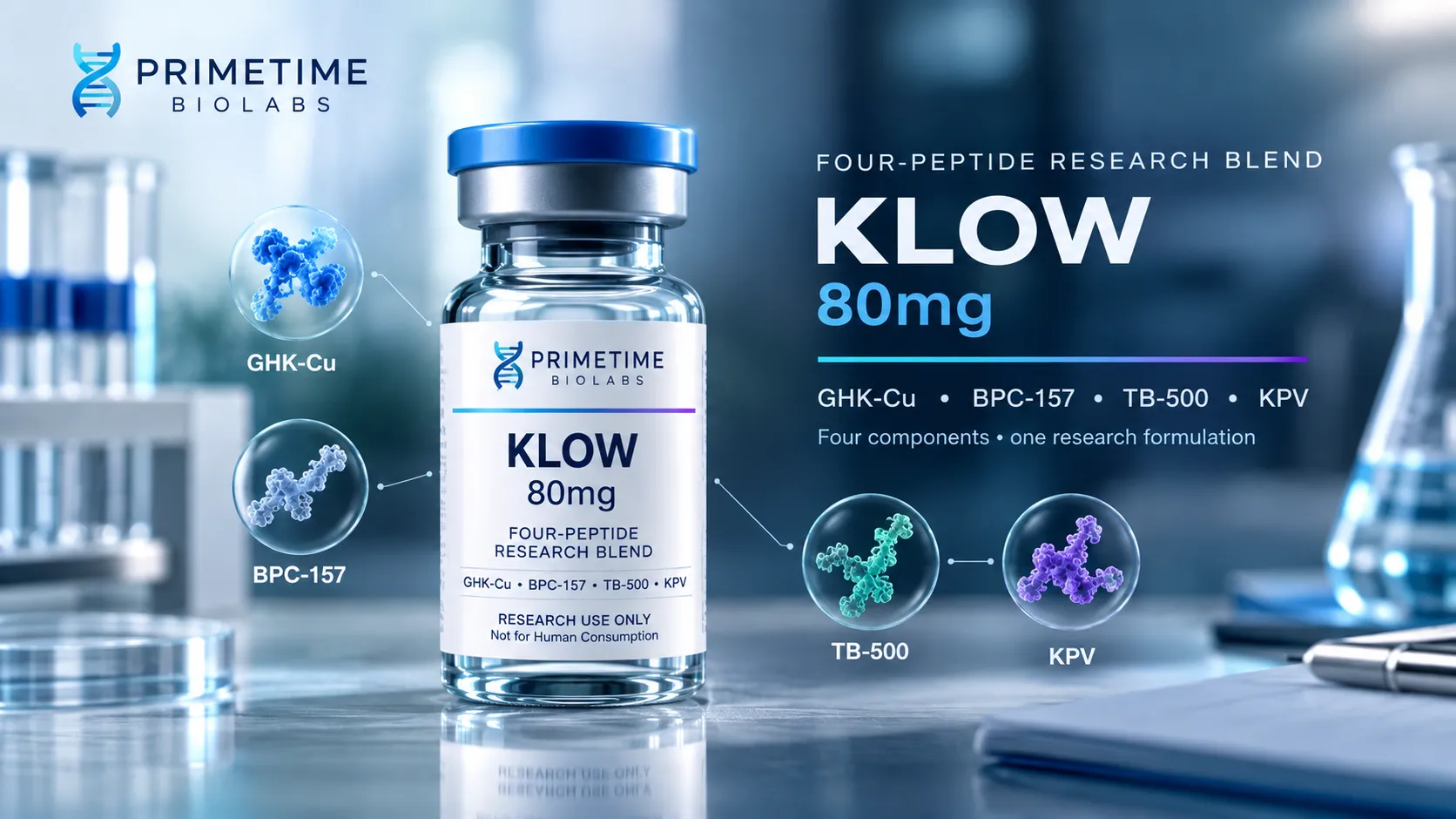
KLOW is a four-peptide research blend: GHK-Cu, BPC-157, TB-500, and KPV. Every benefit claim you'll find attached to it is extrapolated from four separate research literatures, none of which tested these four compounds together.
What follows is an honest accounting of each ingredient's evidence, graded separately. We'll cover why the blend logic has real holes even when the components look promising individually. We'll also explain how KLOW differs from GLOW, what to look for in a certificate of analysis, and why this page won't touch dosing.
Where the name KLOW actually came from
GLOW emerged first, as the industry nickname for a three-peptide combination: GHK-Cu, BPC-157, and TB-500. Different users didn't always arrange the initials in the same order. Even so, the three components stayed consistent enough that "GLOW" became recognizable shorthand in research peptide circles.
KPV was added later by various vendors interested in its anti-inflammatory signaling research. When the fourth ingredient joined the stack, the informal name shifted to KLOW. The K from KPV replaced the G, though no formal standard documents this naming logic.
KLOW is an informal community nickname. No formal standard or single documented owner exists, which is precisely why formulations differ from seller to seller. One vendor's KLOW and another vendor's KLOW share four component names. After that, the similarities can diverge significantly: amounts, ratios, carrier material, and quality controls vary.
One important disambiguation: KLOW the blend has nothing to do with klotho, the aging-related protein sometimes written "Klotho" in research papers. The spelling overlap trips up search algorithms and occasionally misleads readers looking for klotho studies, which are entirely unrelated to this peptide blend.
The common 80 mg total presentation is a vendor convention, not a pharmacological standard. No dose-ranging study established it as an optimal total, and the per-component breakdown within that 80 mg is not standardized across the industry. More on that in the next section.
What's actually inside a KLOW vial
PrimeTime's KLOW 80 mg is a four-peptide lyophilized research blend: GHK-Cu, BPC-157, TB-500, and KPV. The product lists those four components and the 80 mg total, but per-component amounts are not published.
The 50/10/10/10 split circulates widely as "the KLOW formula." That's roughly 50 mg for one component and 10 mg each for the other three. Treat it as an industry convention, not a verified specification for any specific product. Vendors don't even agree on which component holds the dominant share: some assign the large portion to GHK-Cu, others to BPC-157. There is no standardized KLOW formula.
Here's what each component is, in plain terms:
Component | What it is | One-line research role |
|---|---|---|
GHK-Cu | Copper-binding tripeptide (glycine-histidine-lysine + copper) | Skin and extracellular matrix biology; gene-expression modulation studied extensively in topical applications |
BPC-157 | Synthetic 15-amino-acid peptide | Tissue-repair signaling studied across angiogenesis, tendon, muscle, and gut-injury models; predominantly in animals |
TB-500 | Thymosin beta-4-related material (see note below) | Cell migration and actin binding; full-length protein has a human clinical record, commercial fragment does not |
KPV | Tripeptide fragment of alpha-MSH (lysine-proline-valine) | Anti-inflammatory signaling studied in human intestinal cells, mouse colitis models, and one animal wound study |
TB-500 identity note: PrimeTime's documentation does not specify whether its TB-500 material is the full-length 43-amino-acid thymosin beta-4 or a shorter fragment. Many commercial products contain the acetylated 7-amino-acid fragment (residues 17-23). These are meaningfully different molecules with different research records. The COA and manufacturing specification are the authoritative sources on what's actually in the vial; convention isn't.
Every batch of PrimeTime's KLOW 80 mg ships as lyophilized (freeze-dried) powder in a sealed, light-protected vial with a printed lot number. Each batch is third-party tested: HPLC assesses purity; mass spectrometry supports identity confirmation. The batch on file as of September 2026 is Lot PTBL08312026, analyzed 9/2/2026, 99% purity. Batches rotate; verify the current lot on the certificates page.
What the research actually shows for each of the four ingredients
This is the part most KLOW articles skip. Rather than describing the research vaguely, here's a structured summary of where the evidence actually stands for each component, as of September 2026.
Ingredient | Strongest evidence type | Key finding | Biggest limitation |
|---|---|---|---|
GHK-Cu | Human placebo-controlled trials (topical) | A nanolipid-carrier RCT measured reductions in wrinkle volume and depth; separate placebo-controlled and pilot studies (Leyden 2002 conference proceedings; Krüger pilot) found gains in skin thickness, elasticity, and collagen density | Topical skin data doesn't transfer to an injectable multi-peptide blend |
BPC-157 | Animal preclinical | Large preclinical literature across angiogenesis, tendon, muscle, and gut-injury models | No RCT in humans; retrospective knee-pain series only; WADA S0 listing as of 2026 |
TB-500 | Human clinical (full-length protein only) | Full-length thymosin beta-4 has a human clinical record; commercial TB-500 fragment (residues 17-23) has thin direct human data | Most commercial material is the fragment, not the full protein; research doesn't transfer cleanly |
KPV | Human cells + animal in vivo | NF-κB/MAPK signaling and cytokine effects studied in human intestinal cells (Dalmasso 2008); wound healing in a 2006 rabbit-cornea model | No human exposure data by any route; FDA PCAC 2026 review explicitly found none |
---
GHK-Cu (Evidence level: human placebo-controlled trials for topical applications; theoretical-mechanistic for multi-peptide injection contexts)
GHK-Cu is one of the better-studied peptides in this blend, at least for a specific application. Pickart's gene-expression research documented broad modulatory effects across wound healing, anti-inflammatory, and tissue-remodeling pathways. The topical evidence base includes a nanolipid-carrier randomized trial measuring reductions in wrinkle volume and depth. Separate placebo-controlled and pilot work came from Leyden (2002 conference proceedings; 71- and 41-woman studies) and Krüger. Those studies found gains in skin thickness, elasticity, and collagen density.
The limitation that matters here: that evidence is topical. The delivery route, concentrations, and biological context in a topical skin study are not the same as an injectable four-peptide blend. Extrapolating from one to the other is a hypothesis, not a scientific finding.
BPC-157 (Evidence level: animal preclinical, extensive; human observational, thin; no human RCT)
BPC-157 has one of the largest preclinical bodies of evidence of any synthetic peptide in commercial research use. Studies in angiogenesis models, tendon healing, muscle injury, and gastrointestinal injury are well-documented in the animal literature.
The human record is much thinner. A retrospective knee-pain series and a handful of small pilots exist. No randomized controlled trial has demonstrated efficacy for any indication in humans. Worth noting: BPC-157 is listed under S0 (non-approved substances) on WADA's 2026 Prohibited List, meaning it's banned in competitive sport regardless of evidence status.
For a deeper breakdown of BPC-157's research record, see the BPC-157 explainer.
TB-500 (Evidence level: human clinical for full-length protein; insufficient for the commercial fragment)
The molecule problem with TB-500 is real and underreported. Commercial TB-500 products are widely characterized as an acetylated 7-amino-acid fragment: residues 17-23 of thymosin beta-4, not the full-length 43-amino-acid protein. The clinical work (including human trials for cardiac repair) belongs to the full protein. Whether the fragment performs similarly in any context is a separate research question. Direct human data on the fragment itself is thin.
This isn't a knock on TB-500 as a research material. It's a precision issue: if you're citing thymosin beta-4 clinical research to support the commercial fragment, you're citing a different molecule. The TB-500 explainer covers this distinction in detail.
KPV (Evidence level: human in-vitro + animal in vivo; no human clinical data)
KPV is the newest addition to the KLOW blend and, in one sense, the most straightforward to assess. Dalmasso et al. (2008, Gastroenterology) demonstrated NF-κB and MAPK pathway effects, along with cytokine modulation, in human intestinal epithelial cells and mouse colitis models. A 2006 rabbit-cornea wound study showed topical KPV effects in an animal model. The results were striking in context, but the topical-animal combination limits direct transferability.
The FDA's 2026 Pharmacy Compounding Advisory Committee review of KPV found no human exposure data by any route. This reflects KPV's shorter research history rather than a finding against it. The human chapter simply hasn't been written yet. KPV adds a mechanism to the blend's theoretical story, not a proof.
Why four studied ingredients don't make a studied blend
This is the honest center of any serious KLOW discussion.
As of September 2026, no published study (human, animal, or cell-line) has tested these four components together as a defined formulation. The evidence base is for each ingredient separately, in different models, at different concentrations, through different routes, against different endpoints.
The combination logic is intuitive: KPV calms inflammation, TB-500 mobilizes repair cells, BPC-157 signals tissue repair, GHK-Cu rebuilds matrix. That story is coherent, but the data could support additive effects, neutral interaction, or interference. Nobody has looked. A compelling mechanistic narrative is not the same as a tested one.
The fixed-ratio problem makes this matter more, not less. A vial locks the four components at a specific ratio. No dose-ranging study validates any particular split, including 50/10/10/10 or any variant. Increasing total exposure to address one component's potential increases all four simultaneously.
Chemical behavior in solution is a fourth unknown. How these four peptides behave together over time, whether they interact, degrade differently, or affect each other's stability, is unstudied. The lyophilized format removes water-driven degradation during storage, but what happens in solution after reconstitution is a separate question.
How four peptides survive in one vial
Formulators don't just mix four peptides and call it done. GHK-Cu, BPC-157, TB-500, and KPV each bring different solubility characteristics and degradation profiles. GHK-Cu's bound copper is particularly notable: the copper makes it behave differently in solution than the three peptide-only components.
Legitimate multi-peptide research products ship as lyophilized powder because freeze-drying solves the core problem: it removes the water that drives most peptide degradation. A dry powder in a sealed, light-protected vial stores the material in the most stable form available.
Two supporting components appear in well-formulated blends:
Buffers (typically histidine or phosphate) maintain the pH of the reconstituted solution within a range where the peptides remain stable. Different peptides have different pH preferences, so a buffer is the compromise.
Lyoprotectants (sucrose or mannitol are common) protect peptide structure during freeze-drying. Ice crystal formation and concentration effects can damage fragile molecular structures without them.
The sourcing point matters: validated formulation work with known excipient concentrations and documented stability is meaningfully different from untested vendor mixing. Without documentation (specifically a lot-matched COA from a named third-party lab) a buyer typically can't distinguish one from the other. PrimeTime's certificates page is where that documentation lives.
How to read a COA for a four-ingredient blend
A certificate of analysis for a single-peptide product is already worth reading carefully. For a four-ingredient blend, it's more important, because a blend COA can obscure problems that a per-component COA would surface.
Four checks for any KLOW COA:
1. The lot number matches the vial. A generic certificate that doesn't name your batch is not documentation for your product.
2. Identity AND quantity per component are stated. A single purity figure for the whole blend tells you nothing about whether any individual component is present at its claimed amount. Look for per-component identity confirmation and per-component quantity.
3. Identity, purity, and quantity answer different questions. Identity (supported by mass spectrometry) means what's there is what's claimed. Purity (assessed by HPLC) means unwanted materials are below threshold under the stated analytical method. Quantity means how much of each component is present. A 99% result reports purity under that method. It does not establish identity, per-component quantity, sterility, safety, or efficacy.
4. The named testing lab must exist and be verifiable. A COA is only as credible as the lab that produced it. If the lab name can't be verified independently, the certificate is an unverifiable document.
Warning signs include no lot reference, missing per-component amounts, or a lot number that differs from the vial label. A lab that doesn't exist in any external directory is another.
The COA guide covers this in full, including how to verify a testing lab's accreditation. One line is worth holding onto: a clean COA confirms what's in the vial. It doesn't speak to whether the material should be there, at what amounts, or to what effect.
KLOW vs GLOW, what's the real difference
GLOW is PrimeTime's three-component blend: GHK-Cu, BPC-157, and TB-500, at a 70 mg total. KLOW adds KPV and steps up to 80 mg total. You can view GLOW 70 mg for comparison.
GLOW 70 mg | KLOW 80 mg | |
|---|---|---|
Components | GHK-Cu, BPC-157, TB-500 | GHK-Cu, BPC-157, TB-500, KPV |
Total | 70 mg | 80 mg |
What KPV adds | N/A | Anti-inflammatory signaling mechanism studied in human intestinal cells and animal models |
Evidence delta | Three-component preclinical + thin human record | Same three-component base + KPV's preclinical mechanism; still no human data on either blend |
Per-component amounts | Not published by PrimeTime | Not published by PrimeTime |
The honest answer to "is KLOW better than GLOW" is: unknown. Adding KPV adds one more studied mechanism to the theoretical stack. It does not add human clinical evidence, because neither blend has been tested in humans as a formulation. The settling trial would compare the same three-component base with and without KPV, in a controlled study with predefined endpoints. That trial has not been conducted.
The question "can you take both" has the same answer: no data. Running two unstudied blends simultaneously stacks unknowns on top of unknowns.
Why this article won't give you a dosing schedule
In the supplied page-level Search Console export, dosing queries represented 83.3% of visible-query impressions. "How much klow to take daily" and "klow 80 mg dosage per day" are the two most-clicked queries in that export. The demand is real and concentrated.
This page won't answer them, but here's what can be said safely.
The "80 mg" on a KLOW vial describes total peptide content: the combined weight of all four components across the full vial. It is the manufacturer's quantity statement, not a recommended daily amount and not a dosing unit.
Reconstitution (mixing the dry powder with sterile liquid before use) is a standard handling step for any lyophilized peptide research material. This page won't cover volumes, ratios, or steps, because those are protocol decisions that belong outside a product explainer.
Storage guidance is within scope: lyophilized KLOW vials should be kept at -20°C, protected from light, per PrimeTime's own product FAQ. That guidance applies to the sealed, unreconstituted vial.
What this page will never do: no bacteriostatic water volumes, no unit math, no mixing protocols, no cycle schedules, no calculators, no administration steps. KLOW is sold strictly for laboratory and research use. It has not been evaluated by the FDA and is not intended for human or animal consumption. Dosing decisions for any personal protocol belong with a licensed clinician, not a product explainer.
Three things worth holding onto
KLOW is a blend name, not a molecule. The evidence behind it is per-ingredient, uneven in quality, and entirely absent for the four-component combination itself. Paperwork quality (specifically a lot-matched, per-component COA from a named third-party lab) matters more than what any product description says.
From here, the component explainers give each ingredient the space it deserves: GHK-Cu, BPC-157, and TB-500. KPV's dedicated explainer is in the publishing queue. To verify the current lot documentation, the certificates page is the right stop.
For research use only. Not for human or veterinary use.