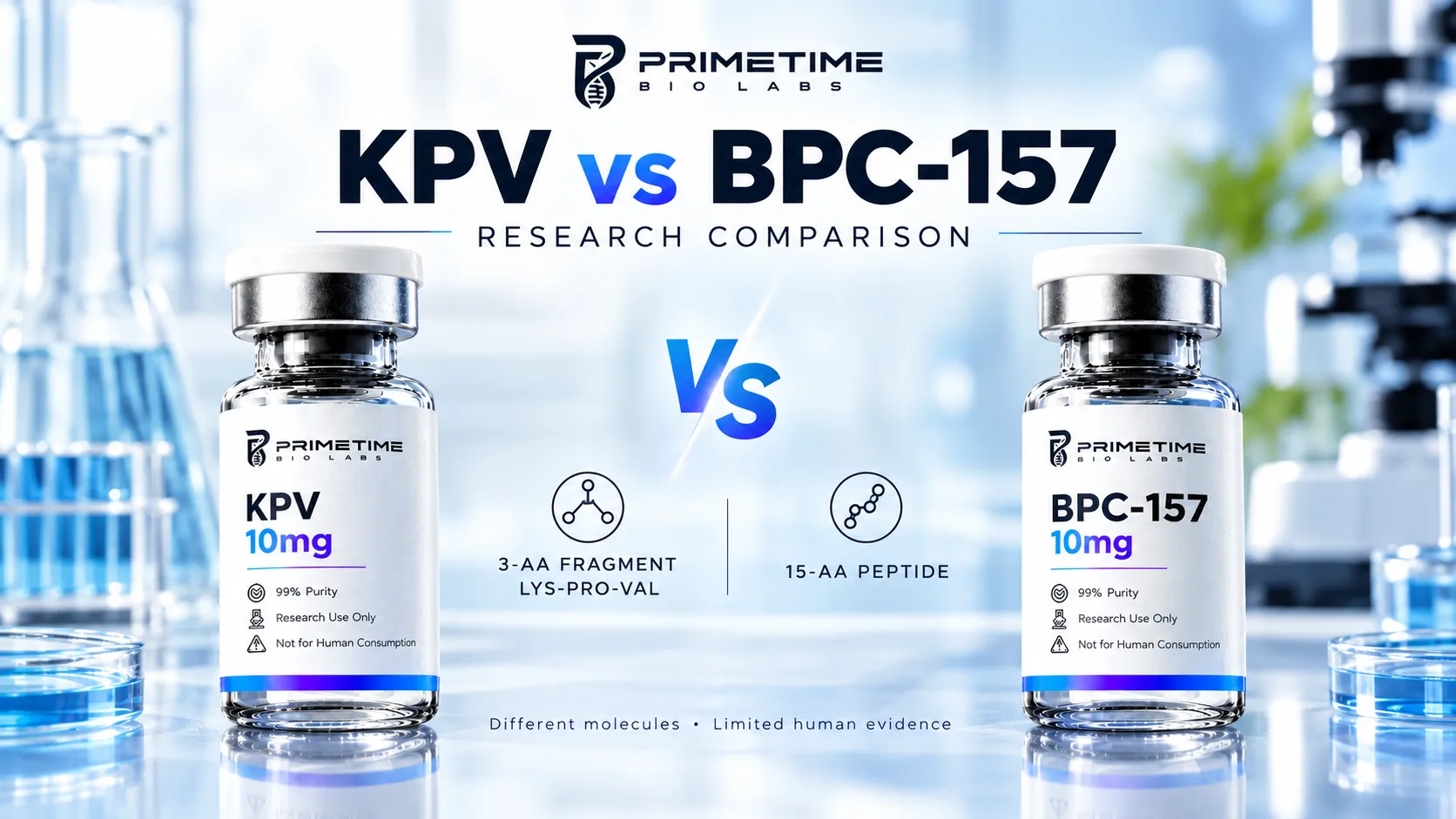
KPV is a three-amino-acid fragment of alpha-MSH, studied mainly for inflammatory signalling. BPC-157 is a fifteen-amino-acid peptide modelled on human gastric juice, studied mainly for tissue repair. Neither has a completed human efficacy trial. No published study has ever tested the two against each other.
The short answer for a researcher choosing a tool
These two compounds answer different research questions. KPV's literature asks how a small peptide enters a cell and interrupts an inflammatory signal. BPC-157's asks whether injured tissue repairs faster after exposure. Neither was built to answer the other's question, so the useful decision is which body of work matches your question.
One fact shapes everything below. No published experiment has tested the two in the same model. Every comparison available to a reader, including this one, reasons across the gap between two separate literatures.
*Last verified 22 October 2026. Prepared by the PrimeTime BioLabs editorial team. Sources checked for this review include primary literature indexed in PubMed, FDA Pharmacy Compounding Advisory Committee briefing documents and meeting materials, and the WADA Prohibited List. A named medical reviewer has not yet been assigned to this article.*
One paper names both compounds, and it is not an experiment
A PubMed search for both compound names returns a single record. It is a 2026 review in the International Journal of Pharmaceutical Compounding, covering advisory-committee recommendations on compounded peptides. The two appear there as regulatory subjects, alongside Epitalon, Semax, MOTS-c and TB-500.
That record contains no experiment. Searched on 21 October 2026, no published study administers both compounds or measures them against a shared endpoint. BPC-157 returns 233 records, KPV 60. Nearly 300 papers, and not one tests the two together.
What KPV's literature tests, down to the transporter
PepT1 uptake and the knockout that makes it load-bearing
Guillaume Dalmasso and colleagues published the foundational work in Gastroenterology in 2008, reporting that the PepT1 transporter carries KPV into intestinal epithelial and immune cells. PepT1 sits low in healthy colon and rises during inflammation, so inflamed tissue takes up more of the peptide.
Emilie Viennois and colleagues supplied the control that makes this load-bearing. In a 2016 mouse study of colitis-associated cancer, KPV reduced tumour formation in normal animals, and in PepT1-knockout animals the effect was absent. Remove the transporter and the benefit disappears.
Evidence tier: animal in vivo, with human cell and biopsy support.
NF-κB, p65RelA, and where the mechanism stops being demonstrated
The 2008 work reported that nanomolar concentrations of KPV suppressed NF-κB and MAP kinase signalling, with cytokine secretion falling alongside. Stephen Land took the mechanism further in 2012, in human bronchial epithelial cells. KPV suppressed nuclear import of p65RelA, a component of the NF-κB complex. A competition assay indicated interaction at the importin-alpha-3 binding site.
One distinction matters, and most writing skips it. The suppression and the binding-site interaction were measured. The proposed blockade of specific importin domains was not.
Evidence tier: human cell culture. Our KPV explainer covers it in full.
What BPC-157's literature tests, and why breadth is not depth
Angiogenesis, nitric oxide and growth-factor signalling
BPC-157 research reports upregulation of VEGF and VEGFR2, driving new blood-vessel growth at injury sites in rodents. Egr-1 and NAB2 rise after exposure, switching on repair genes including PDGF and TGF-beta. Nitric oxide signalling through eNOS appears across gastroprotection studies. These findings come overwhelmingly from animal models and cell culture, describing pathways in rats rather than biology established in people.
No receptor has been identified in three decades
Here the literatures diverge sharply. After more than thirty years, no high-affinity receptor for BPC-157 has been identified.
That absence does not make the findings wrong. It does mean the mechanism cannot be specified the way KPV's can. KPV's account names a transporter, a knockout control and a binding site. BPC-157's names pathways that shift, with no defined target.
Breadth is easy to mistake for strength. Nine tissues with no identified receptor, mostly from one programme, is not stronger evidence than fewer tissues with a knockout control. That reading interprets the record, and is not a proven difference in how the compounds behave in people.
Evidence tier: animal in vivo and in vitro. Our BPC-157 explainer grades that literature tissue by tissue.
The melanocortin receptor question nobody states carefully
KPV comes from a hormone that acts through melanocortin receptors, so the natural assumption is that the fragment does the same. Several findings argue otherwise, and their wording matters.
Stephen Getting and colleagues reported in 2003 that KPV retained its anti-inflammatory effect in mice with non-functional MC1R. An MC3 and MC4 antagonist did not block it, and KPV did not raise cAMP. They concluded that KPV is unlikely to act through melanocortin receptors.
Klaus Kannengiesser and colleagues reached a similar position in 2008 using two colitis models. Their published wording says the effects seem at least partially independent of MC1R signalling.
Read those conclusions carefully. One says unlikely. The other says at least partially independent. Neither says independent.
Two findings keep the question open. Richard Elliott and colleagues reported in 2004 that KPV raised intracellular calcium in MC1R-transfected cells. That response appeared only alongside PIA, an adenosine agonist that inhibits the cAMP pathway. Vincenza Bonfiglio and colleagues found in 2006 that a nitric oxide synthase inhibitor blunted KPV's corneal effect in rabbits.
So the accurate position is narrow. The dominant anti-inflammatory effect does not appear to require melanocortin receptors. Whether KPV engages them at all is unresolved.
Vendor pages get this wrong in both directions. Some assert MC1R and MC3R as the mechanism, which the knockout studies contradict. Others assert flat independence, overstating both papers.
Evidence tier: animal in vivo and human cell culture, unresolved.
Seventeen model families, one shared, zero side by side
Below is where each has actually been tested.
- Colitis — Model: DSS — Species: Mouse — KPV: Yes — BPC-157: Yes — Together: No
- Colitis — Model: TNBS — Species: Mouse — KPV: Yes — BPC-157: Separate work — Together: No
- Colitis — Model: CD45RB-hi transfer — Species: Mouse — KPV: Yes — BPC-157: Not identified — Together: No
- Colitis cancer — Model: AOM/DSS, PepT1 KO — Species: Mouse — KPV: Yes — BPC-157: No — Together: No
- Gastric lesion — Model: NSAID-induced — Species: Rat — KPV: No — BPC-157: Yes — Together: No
- Gut surgery — Model: Fistula, anastomosis — Species: Rat — KPV: No — BPC-157: Yes — Together: No
- Gut, human — Model: Rectal enema, colitis — Species: Human — KPV: No — BPC-157: Yes — Together: No
- Skin permeation — Model: Franz cell — Species: Human tissue — KPV: Yes — BPC-157: No — Together: No
- Cornea — Model: Debridement — Species: Rabbit — KPV: Yes — BPC-157: Separate injury models — Together: No
- Oral mucosa — Model: Chemo mucositis — Species: Rat — KPV: Yes — BPC-157: No — Together: No
- Tendon — Model: Achilles transection — Species: Rat — KPV: No — BPC-157: Yes — Together: No
- Muscle — Model: Transection, crush — Species: Rat — KPV: No — BPC-157: Yes — Together: No
- Bone, nerve, brain, liver, heart — Model: Various — Species: Rat — KPV: No — BPC-157: Yes — Together: No
- Airway epithelium — Model: TNF and virus — Species: Human cells — KPV: Yes — BPC-157: No — Together: No
- Basophils — Model: Degranulation — Species: Human cells — KPV: Yes, negative — BPC-157: No — Together: No
- Antimicrobial — Model: In vitro — Species: Bacteria and yeast — KPV: Yes, conflicting — BPC-157: No — Together: No
- Pharmacokinetics — Model: Intramuscular, IV — Species: Rat, dog — KPV: No — BPC-157: Yes — Together: No
Where the gut models genuinely meet
Of seventeen model families, one is shared. Both have been tested in DSS-induced colitis in mice.
Even there the overlap is thinner than it looks. The studies ran in different laboratories, with different readouts, and neither included the other compound as a comparator. So the strongest statement is modest. Both reduced injury in a mouse colitis model, and nobody has measured them against each other.
Where two literatures only look alike
The phrase gut healing hides the problem. KPV's gut work measures inflammatory signalling, cytokine expression and myeloperoxidase activity. BPC-157's measures lesion area, fistula closure and anastomotic strength. Reducing an inflammatory signal and closing a structural defect are not the same result.
The same applies to skin. KPV's skin data is a human-tissue permeation study reporting passive diffusion below the detection limit. BPC-157's comes from animal burn and wound models. One asks whether the molecule gets in, the other whether tissue repairs. Filed together under skin, they answer unrelated questions. Our GHK-Cu article covers copper-peptide skin evidence, and our BPC-157 and TB-500 comparison covers a third literature again.
How the evidence grades out on each side
- Controlled human trial — KPV: None identified — BPC-157: None published
- Human observational — KPV: None — BPC-157: Five small studies identified by FDA
- Ex vivo human tissue — KPV: Skin permeation, colonic biopsy — BPC-157: Not identified
- Human cell culture — KPV: Multiple lines, one negative result — BPC-157: Tendon fibroblasts
- Animal in vivo — KPV: Mouse colitis, rabbit cornea, rat mucosa — BPC-157: Rat models, nine tissue areas
- Analytical and PK — KPV: Stability and degradation — BPC-157: Rat and dog pharmacokinetics
A PubMed search restricted to trial publication types returns zero records for BPC-157. FDA's BPC-157 briefing document lists five clinical studies.
- Rectal enema — Participants: 24 — Population: Healthy
- Rectal enema — Participants: about 26 — Population: Ulcerative colitis
- Intra-articular — Participants: 17 — Population: Knee pain
- Intravesical — Participants: 12 — Population: Interstitial cystitis
- Intravenous — Participants: 2 — Population: Healthy
Those counts sum to about 81 people across three decades. FDA footnotes that the colitis study randomised 53 subjects without naming the treated arm, so the total may be higher. None was controlled.
For KPV, FDA's briefing document is blunter. It reports no clinical studies and no human exposure data by any route, no pharmacokinetic studies, and no adverse-event reports.
That differs from saying no human research exists. KPV has been studied in human cell lines, ex vivo human skin, human colonic biopsies and blood basophils. In that last study it did not reproduce the parent hormone's suppressive effect, lacking the central binding motif.
A negative result in human cells is still human data.
What combination research does and does not establish
No published study has co-administered KPV and BPC-157. None has measured an additive or synergistic effect, or tested whether the two interact at all.
What exists is a mechanistic argument. One is studied for inflammatory signalling, the other for tissue repair, and those sound complementary. Plausibility is a reason to run an experiment, not a result.
A commercial blend is not evidence either. Formulating two substances together establishes that they fit in one vial, and says nothing about combined effect. Our KLOW article covers what a blend certificate can and cannot tell you. Several comparison pages publish combination protocols under headings about complementary mechanisms, and nothing in the literature supports them.
Where the regulatory record actually stands
The 2026 record moved twice, and both moves are widely misreported.
As of FDA's 22 April 2026 list update, neither compound appears in Category 2 of its interim bulk drug substances policy. Both sit instead among substances nominated and then withdrawn. FDA attributes this to withdrawal by the nominators, and its guidance states that a withdrawal does not reflect an FDA determination. The change came through a website update, not a Federal Register notice.
Removal from Category 2 does not create compounding eligibility. Enforcement discretion applies only to Category 1, and neither compound is on the 503A Bulks List.
FDA's Pharmacy Compounding Advisory Committee met on 23 and 24 July 2026 under docket FDA-2025-N-6895, reviewing seven peptides as free base and as acetate. FDA evaluated BPC-157 for ulcerative colitis, and KPV as a topical cream or gel for wound healing and inflammatory conditions. For KPV, FDA proposed not adding either form to the 503A Bulks List, and it reached the same position on BPC-157.
FDA's documented concerns are specific. For both compounds it cited inconsistent naming and missing data on impurities, aggregates and microbiological testing. It identified no study formally investigating BPC-157 immunogenicity, and wrote that the compound may pose a significant immunogenicity risk.
The committee voted in favour of recommending both compounds. Here the record thins. FDA published no minutes, transcript or vote record, and its posted questions document set out fourteen separate votes. Reported tallies circulate widely, commonly as eight in favour and six against with one abstention. Those come from trade and law-firm reporting, which disagrees on whether the figure describes one vote or several.
An advisory recommendation has no legal effect, and FDA has taken no action on it. The 503A Bulks List, at 21 CFR 216.23, still contains six substances and was last amended in 2019. Neither compound appears on it.
In sport the positions differ. BPC-157 is named in section S0 of the WADA Prohibited List, prohibited at all times. A therapeutic use exemption is unlikely, though applications are assessed case by case. KPV is not named. Because S0 is a catch-all for substances without regulatory approval, absence of a name is not permission. Our guide to peptide legality covers the category system.
Research-material quality is a different question
A certificate of analysis describes material in a vial. It establishes nothing about safety, efficacy, sterility or biological activity. Two checks are compound-specific. KPV stability work identifies lys-pro-diketopiperazine as its major degradation product under stress, so unexplained secondary peaks deserve a question. BPC-157 is supplied as free base and as acetate under one name, which FDA calls a risk because they are different active ingredients.
Otherwise our certificate of analysis guide walks through the method. Research material is not equivalent to material used in published studies, and purity says nothing about whether a finding would reproduce.
Choosing a tool by research question, not by ranking
No overall winner is available, and this article will not invent one.
If the question concerns inflammatory signalling in intestinal tissue, KPV's literature is more specific. It names a transporter, supplies a knockout control, and reaches a nuclear import step.
If the question concerns structural repair across tissues, BPC-157's literature is larger, though it lacks an identified receptor and concentrates in one programme.
If the question concerns oral exposure, both report oral administration in animals, and neither supports conclusions about people. KPV's rests on transporter uptake, BPC-157's on gastric stability. Neither is route guidance.
If the question requires a direct comparison, neither literature can answer it. That experiment has not been run.
Both are supplied for laboratory research only, as KPV 10 mg and BPC-157 10 mg.