How this article grades evidence
Peptide pages often set a rat study and a human trial in the same sentence. Readers deserve better separation than that, so every claim below carries one of six labels.
Controlled human means a study in people with a control group. Uncontrolled human means people, but no control group or no blinding. Animal means a finding in rats, mice or another species. In vitro means cells or tissue in a dish. Analytical means a chemistry result, such as an identity confirmation. Searched for and not found means exactly that.
Not one claim on this page carries the controlled human label. That single fact shapes everything after it.
One more rule governs the whole article. Thymosin beta-4 and TB-500 are different molecules, so findings about the larger protein are labelled as such and never carried across to the fragment.
What is actually in a Wolverine vial
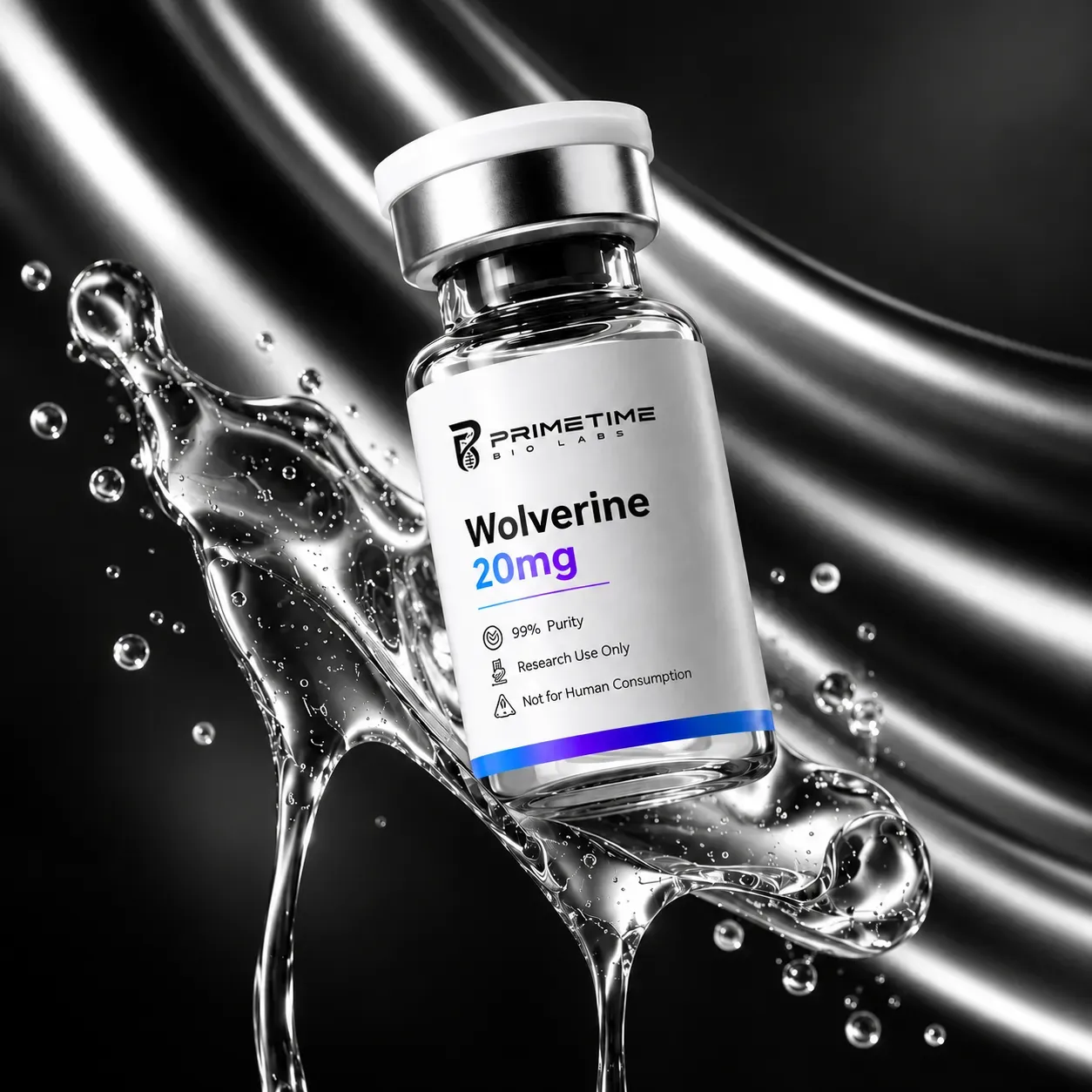
Wolverine holds two peptides that were made separately and then put in the same vial. It is not a single novel compound, and it is not a fusion peptide. PrimeTime's own product page makes this explicit, describing a blend in which each component keeps its own independent mechanism.
The documented specifics are narrow and worth stating exactly. Each vial carries 20 mg of total peptide content. It ships as a lyophilized powder in a light-protected vial, with a lot number printed on the label. The batch referenced on the page is PTB-WOLV-20MG-0925, tested at 99% purity and analyzed on 8/27/2026.
A blend and a two-vial stack differ in research logistics rather than in biology. One vial means one lot number, one certificate, and a fixed proportion that stays the same across every unit from that batch. Two vials mean two lot numbers and two certificates, with the proportion set by whoever designs the protocol.
Each arrangement carries a different reproducibility question. With a blend, repeating an experiment months later means trusting that a new batch matches the old one. Separate vials let the components be documented independently, though they have to be handled as two materials.
Neither format is better than the other, because they answer different questions. PrimeTime sells Wolverine 20 mg research material alongside single-component BPC-157 and TB-500 vials at 10 mg each. That pairing supports a comparative design for any lab that wants one.
What the single vial does not tell you is how its 20 mg divides between the two peptides. The next section takes that question up.
Why anyone calls this Wolverine
The name borrows from a comic-book character associated with rapid healing. Nothing about the pairing was named by a researcher, and no journal uses the term.
Marketing language usually stays in marketing. This nickname did not stay there. FDA's briefing document for the July 2026 compounding meeting quotes a clinic website describing BPC-157 as the "wolverine compound." When a federal evaluation record picks up a nickname from vendor copy, that nickname has travelled further than most.
Three different products share overlapping names, and readers mix them up constantly. The standard Wolverine blend holds BPC-157 and TB-500. A four-peptide clinic version adds CJC-1295 and Ipamorelin, which are growth-hormone-adjacent compounds with their own separate literature. Above that sits a ladder of larger blends. GLOW adds GHK-Cu, and KLOW adds KPV on top of that, as our guide to the KLOW blend sets out.
Those are four different formulations, not four versions of one thing. Evidence about any of them says nothing about the others.
Popularity on its own is not data. A nickname that spreads through forums and product pages tells you what people are searching for, and tells you nothing about what the compounds do.
What the label tells you and what it leaves out
PrimeTime's product page states a total of 20 mg per vial. It does not state the split between BPC-157 and TB-500, and no figure elsewhere on the page supplies one. The 10 mg numbers that appear there refer to the separate single-component vials.
Other suppliers handle the question differently. Several publish 10 mg and 10 mg, giving a one-to-one blend. FDA's briefing document catalogues vendors listing BPC-157 alongside the thymosin beta-4 fragment. Those listings pair 10 mg of BPC-157 with either 25 mg or 50 mg of the fragment. Proportions clearly vary across the market, which means the word "Wolverine" on a label tells a researcher almost nothing about what is in the vial.
Now the part that matters most on this page.
The only controlled study of the two peptides together gave BPC-157 at 10 µg/kg/day and TB-500 at 60 µg/kg/day. By mass, that is roughly one part to six. No commercial blend on sale matches it. The one-to-one proportion sold most widely has never been tested as a combination under controlled conditions, and neither has any other marketed ratio.
So a reader buying any blend, from any supplier, is working with a proportion the published literature has not examined. That is worth knowing before designing anything around it.
The practical response is a documentation question rather than a verdict. Ask what each component's mass is on the certificate for the lot you receive. Check too whether purity was reported for each peptide or for the mixture as a whole. Those are fair questions to put to any vendor, and the answers decide what a given vial can support.
Two analytical limits sit behind that question. A single purity percentage on a two-component product describes the mixture, not the proportion inside it. Mass spectrometry confirms which molecules are present, which is a different question from how much of each one there is.
The one study that gave them together
Biçer and colleagues published the study in *Joint Diseases and Related Surgery* in 2026, at volume 37, issue 3, pages 822 to 837. According to PubMed, it carries PMID 42542926 and was published on 23 July 2026.
The design was a tendon-injury model. Thirty-two male Sprague-Dawley rats, each about 12 weeks old and around 330 g, had the Achilles tendon cut and repaired surgically. Researchers then split them into four groups of eight: an untreated control group, a BPC-157 group, a TB-500 group, and a group receiving both. Treatment ran for four weeks by intraperitoneal injection, after which tendons went either to biomechanical testing or to histological evaluation.
Results came out lopsided in a way worth reading carefully.
Maximum load to failure, which measures how much force a healing tendon takes before it breaks, rose in both single-agent groups against control. Only TB-500 reached statistical significance there. Histological scoring told a similar story. Bonar scores dropped significantly for TB-500, at p = 0.016. For Movin scores the drop reached significance in TB-500 at p = 0.017, and in the combined group at p = 0.040. Collagen type I expression showed no significant difference across groups, while type III did.
The authors summarised the combination result directly. Combined treatment "did not confer additional benefits compared to either agent alone."
Read that conclusion precisely before moving on. No additive benefit is not the same thing as no effect. The combined group did beat untreated controls on one histological measure, and it simply failed to beat the single agents. A page claiming the pairing does nothing has overstated the finding in one direction. Claiming it outperforms single use overstates the finding in the other.
Limits run through the whole study, and the authors name several themselves. They describe the work as exploratory and the findings as preliminary. One explanation comes from the authors themselves. The two agents may converge on shared downstream pathways, a hypothesis the authors say needs further confirmation.
Four structural limits deserve stating alongside it. One injury model in one species cannot speak to other tissues or to people. A single four-week timepoint says nothing about longer healing. Intraperitoneal dosing is routine in rodent work, and it tells you nothing about any human route. And the dose proportion, again, is unlike anything sold.
One detail could not be confirmed. The published abstract says eight animals per group and that tendons went to one analysis or the other, without stating how the eight divided. No per-analysis figure appears anywhere on this page, because the source does not supply one. *(Evidence grade: animal, single study.)*
Why evidence for one peptide is not evidence for the pair
Stacking two literatures does not produce a third one. BPC-157 has a large animal record and a thin human one. The TB-500 fragment has very little of either. Neither number describes what happens when both sit in the same vial.
FDA's reviewers counted the human BPC-157 record for the July 2026 meeting, and the breakdown is more useful than a rounded total. Twenty-four healthy subjects received rectal enemas over eight days. Roughly 26 people with ulcerative colitis received enemas over two weeks. Seventeen subjects with knee pain received intra-articular injections, 12 people with interstitial cystitis received intravesical injections, and two healthy adults received intravenous infusions. That comes to about 81 people across five studies, none of them a completed controlled trial.
For the TB-500 fragment, the same search found no human administration studies at all.
One human observation does concern a combination product, and it is not reassuring. FDA's briefing document describes a 40-year-old woman who used a product containing BPC-157 and TB-500. The label said research purposes only, and she used it twice daily for joint and wound healing support. Diffuse hyperpigmentation and darkening of the gums appeared after a week. She stopped, then used the product again two weeks later, and identical reactions reproduced. Symptoms resolved once she discontinued it entirely.
FDA's own reading is careful and worth carrying intact. The events were likely caused by the product, given that they returned on rechallenge. Because the product held two peptides, though, neither one can be assigned responsibility.
A single spontaneous report is not an incidence rate. It is also the closest thing to human data on this specific pairing that exists anywhere.
One further combination appears in the record and needs precision. FDA notes a 2021 report in which patients with knee pain received a compounded combination of thymosin beta-4 and BPC-157. The parent protein is not the TB-500 fragment, so that work describes a different pairing. It is a real combination exposure, and it is not evidence about this blend.
Compound-level detail sits outside this page by design. Our BPC-157 research review and TB-500 research review grade each peptide on its own, and our head-to-head evidence comparison sets them against each other.
The fragment problem inside the second ingredient
TB-500 is a seven-amino-acid peptide, Ac-LKKTETQ, corresponding to residues 17 through 23 of thymosin beta-4. The parent protein runs 43 amino acids. An acetyl group caps the fragment's front end, which is where the "Ac" comes from.
One correction belongs here, because the wrong version circulates widely. TB-500 is acetylated at its N-terminus. It is not a fragment taken from the N-terminal end of the parent protein, which is a different claim entirely. Esposito and colleagues described the molecule in 2012 as the N-terminal acetylated 17-23 fragment, and their title says exactly that. Ho and colleagues, working on equine doping control the same year, confirmed that residues 17 to 23 carry the actin-binding region of the parent.
Here is where the evidence gets uncomfortable for the fragment.
Rahaman and colleagues quantified TB-500 and its breakdown products in 2024, then tested their activity in fibroblast wound-healing assays. The parent TB-500 produced no significant wound-healing effect. One of its metabolites, Ac-LKKTE, did. Those authors concluded that wound-healing activity previously attributed to TB-500 may belong to that metabolite rather than to the molecule itself. *(Evidence grade: in vitro, single study.)*
Labels in this market get the identity wrong often enough that a buyer should check. FDA's own evaluation records two specific failures. Some supplier websites print the free-base registry number on the acetate form, which is a different substance. A third number also circulates as an alternative, and the agency says it matches neither form.
One set of identifiers is worth memorising, and it comes from FDA's own table. The free-base fragment carries CAS 885340-08-9, molecular formula C38H68N10O14, and a molecular weight of 889.01 g/mol. Its acetate salt weighs 949.1 g/mol. FDA states the relationship plainly, writing that "thymosin beta-4 and TB-500 are not the same substance." A certificate headed TB-500 that reports a weight several times higher is describing the parent protein, not the fragment.
PrimeTime's own TB-500 page describes the fragment at residues 17 to 23 and notes that most cited TB-500 literature concerns the full-length protein. That is an observable fact about the page, and it is the check any reader should run on any supplier.
BPC-157, TB-500 and the combination side by side
This table is the reference asset on this page. Read down the combination column first.
- Achilles tendon healing in rats — BPC-157 alone: Higher load to failure, not significant — TB-500 fragment alone: Significant load-to-failure advantage; Bonar and Movin scores improved — The combination: Movin scores improved vs control at p = 0.040 — Main finding: TB-500 alone carried the only biomechanical advantage; the pair added nothing — Evidence type: Animal — Key limitation: One model, one species, 4 weeks, ratio unlike products sold
- Fibroblast wound closure in a dish — BPC-157 alone: Not tested in this work — TB-500 fragment alone: No significant effect for the parent; metabolite Ac-LKKTE active — The combination: Searched for, none identified — Main finding: Reported fragment activity may belong to a breakdown product — Evidence type: In vitro — Key limitation: Single study, cells only
- Human exposure of any kind — BPC-157 alone: About 81 people across 5 studies — TB-500 fragment alone: None identified by FDA, any route — The combination: One adverse event report on a blended product — Main finding: Small for one component, absent for the other — Evidence type: Uncontrolled human — Key limitation: No controls; one spontaneous report is not a rate
- Completed controlled human trial — BPC-157 alone: None — TB-500 fragment alone: None — The combination: None — Main finding: Nothing in people has been tested under control — Evidence type: Searched for, none identified — Key limitation: Absence found by search, not by systematic review
- Toxicology package — BPC-157 alone: Partial: single-dose IM, genotoxicity, teratogenicity, 28-day repeat dose — TB-500 fragment alone: None identified — The combination: None identified — Main finding: Only BPC-157 has any package, and it is incomplete — Evidence type: Animal — Key limitation: No carcinogenicity study for either
- Human pharmacokinetics — BPC-157 alone: Not established; undetected in plasma after rectal dosing — TB-500 fragment alone: Not established — The combination: Not established — Main finding: No measured human exposure to predict an interaction from — Evidence type: Searched for, none identified — Key limitation: No basis for predicting interaction
- Anti-doping status — BPC-157 alone: Prohibited, S0 — TB-500 fragment alone: Prohibited, S2.3 — The combination: Both components prohibited — Main finding: Either component alone triggers a violation — Evidence type: Regulatory — Key limitation: Prohibited at all times
- FDA approval — BPC-157 alone: None — TB-500 fragment alone: None — The combination: None — Main finding: No approval exists in any country — Evidence type: Regulatory — Key limitation: July 2026 vote was advisory only
Most of the combination column is empty, and that emptiness is the finding. Where a cell reads "searched for, none identified," it means the searches run for this article did not locate a study. It does not mean a systematic review has established that none exists.
What a certificate can settle about a blend
A certificate of analysis answers a handful of separate questions, and people routinely ask it to answer more. Identity asks which molecule is present. Purity asks what share of the material is that molecule. Quantity asks how much sits in the vial. Composition asks how a multi-component product divides. Method asks how the lab measured. Traceability asks whether the document matches the vial in hand.
PrimeTime reports HPLC for purity and mass spectrometry for identity on every Wolverine batch. The page shows batch PTB-WOLV-20MG-0925 at 99%, analyzed on 8/27/2026. That lot number is printed on the vial, and the matching certificate is available from the buyer's account after purchase.
What testing establishes is identity and purity for one lot on one date. Safety falls outside that boundary, and so do effectiveness and sterility. A high purity figure says the vial holds plenty of what the certificate names. It says nothing about whether that substance does anything useful or is safe to handle.
Blends add a wrinkle that single-peptide guidance does not cover. Purity and composition are different attributes, and a mixture can be 99% peptide while the split between its two peptides remains undocumented. Quantity for the vial and quantity for each component are also separate questions.
So with any blended material, read the certificate for which of those six attributes it reports. Our guide to reading a peptide certificate of analysis walks through each section, and our supplier due-diligence checklist covers what to ask before ordering.
What the research does not show
Most pages about this blend list benefits and stop. The gaps deserve their own section.
- No controlled human trial has tested BPC-157 and TB-500 together, by any route, for any purpose.
- Human exposure data does not exist for the TB-500 fragment on its own, by any route.
- Pharmacokinetics in people have not been established for either compound, so nothing supports a prediction about how they interact.
- A toxicology package does not exist for the TB-500 fragment. FDA identified no acute, repeat-dose, genotoxicity, reproductive or carcinogenicity study.
- Carcinogenicity has never been studied for BPC-157 either.
- Dose-response has not been established for BPC-157. In the rodent lesion studies FDA reviewed, 10 ng/kg and 10 µg/kg produced effects of comparable size.
- Marketed blend proportions remain untested, including the one-to-one ratio sold most widely.
- Formulations are not standardised across suppliers, so two vials labelled Wolverine may hold different proportions.
- Published work does not compare a blended vial against the same two peptides given separately.
Absence of evidence is not evidence of absence. Several of these are open questions rather than demonstrated failures, and trials nobody has yet run could close them.
Where this stands with regulators and in sport
Anti-doping is the clearest part of the picture, so start there.
The 2026 WADA Prohibited List took effect on 1 January 2026. BPC-157 appears by name as an example under category S0, non-approved substances. Everything in that class is prohibited at all times and classed as a Specified Substance. TB-500 falls under S2.3, growth factors and growth factor modulators, through an entry naming thymosin-β4 and its derivatives with TB-500 given as the example. Both are banned in and out of competition, and no therapeutic use exemption applies.
Athletes should verify current status through official anti-doping channels.
US compounding policy moved in July 2026, though less far than headlines suggested. FDA's own reviewers evaluated seven peptides and recommended against all of them. On 23 July the Pharmacy Compounding Advisory Committee voted the other way on three of them. Members recommended BPC-157, KPV and TB-500 by eight votes to six, with one abstention. Across both meeting days the committee recommended six of the seven, rejecting only emideltide.
Three things follow, and vendor pages tend to compress all three into a claim of approval.
An advisory committee recommendation is non-binding advice. Adding anything to the 503A bulks list would require formal rulemaking, with a proposed rule and a comment period, and none has begun. Listing would authorise compounding rather than approve a drug, so neither peptide would become an approved medicine even then.
One honesty note about those vote counts. FDA has published no official tallies for the meeting, so the numbers above come from trade-press and law-firm accounts rather than from the agency. Our guide to US peptide law covers the broader framework.
A Phase 2 trial of BPC-157 alone is currently recruiting, registered as NCT07437547. It plans 120 participants with acute grade II hamstring strain, sponsored by Hudson Biotech, at a single site in Shenzhen. Primary completion is estimated for February 2027, no results are posted, and the registry records the study as not FDA-regulated. It studies one peptide, not the blend.
Why there is no protocol on this page
Some pages about this blend print schedules and amounts. This one does not, and the reasoning is short.
No controlled human trial of the combination exists, so no dose-response data exists to build a protocol from. The one controlled animal study used a proportion no product matches, which makes even its numbers a poor starting point for anything.
Any protocol published today is extrapolated from animal work, borrowed from one component, or invented. Writing one down would dress guesswork as guidance.
Figures we checked and chose not to use
Several numbers circulating about this blend could not be substantiated well enough to publish.
Any per-animal split between the combination study's two analyses was excluded, because the published abstract states eight animals per group without saying how they divided.
Per-component masses for the PrimeTime vial were excluded, because the page publishes none and figures from other suppliers describe other products.
A registry number and molecular weight for full-length thymosin beta-4 were excluded. Both circulate widely, including on pages of our own, and neither could be confirmed against a primary chemical register for this review. FDA's briefing document gives identifiers for the fragment and none for the parent protein, so only the fragment's figures appear above.
Claims that the combination outperforms either peptide alone were excluded, because the only controlled test of that question found the opposite.
Human onset and duration figures were excluded, since no controlled human trial exists to measure them in.
A widely repeated figure of around 30 total human BPC-157 exposures was excluded, including from pages that should know better. FDA's per-study counts come to roughly 81, and those counts appear above instead.
The bottom line
The record runs to two molecules, one vendor name, and one controlled experiment. That experiment tested the pair at a proportion nobody sells.
It found no advantage for the two together over either peptide alone, while still showing a histological improvement against untreated controls. Human evidence for the combination consists of a single adverse event report in which symptoms returned when the person used the product again. The fragment making up half the blend has no documented biological activity of its own. One in vitro test suggested its reported activity may belong to a breakdown product.
Three things would change the picture. A controlled study at a proportion people actually use would help most. Human pharmacokinetics for either compound would give some basis for predicting an interaction. In vivo evidence that the TB-500 fragment acts on its own would shore up half this blend.
Until then, the useful work is documentary. Read the certificate for the lot in hand, and check which attributes it reports. Keep the proportion question open rather than assuming a label answers it.
A note on independence. This page sits on the website of a company that sells the product it discusses. That is a commercial interest, and readers should weigh it. The page carries no price, no discount code and no purchase prompt. Its conclusions come from published studies and public regulatory records, including where those records are commercially unhelpful to us.
PrimeTime BioLabs supplies research materials for laboratory and in-vitro use by qualified professionals. They are not for human or animal consumption.