Four sellers publish six different component splits for the GLOW peptide blend. They cannot all describe the same product. PrimeTime BioLabs publishes none, and this article explains why that silence is the only honest position available.
What a GLOW vial states and what it leaves unstated
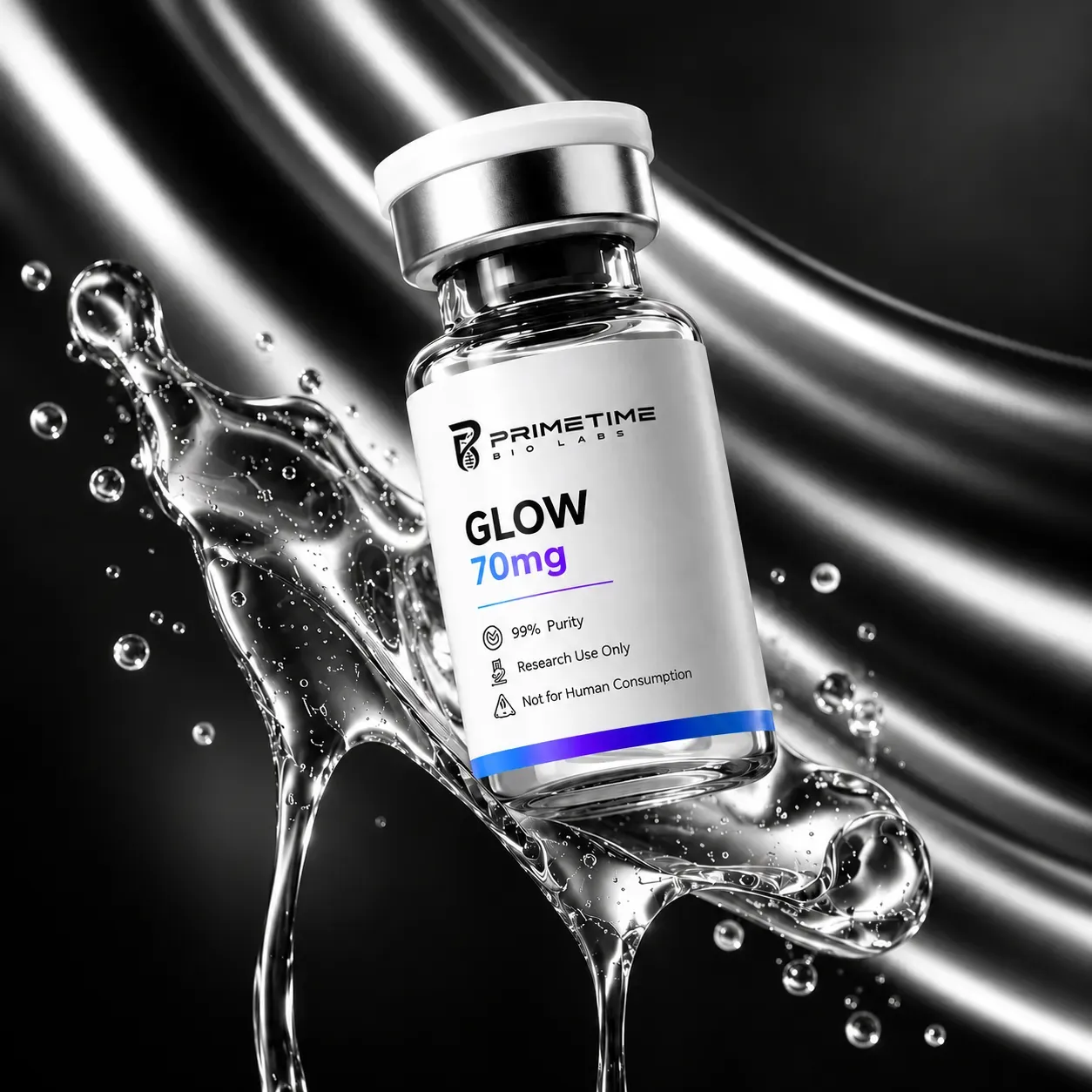
The GLOW product page states three things plainly. The vial holds 70 mg of total peptide content. It contains GHK-Cu, BPC-157 and TB-500. It is sold for laboratory research use only.
It does not state how the 70 mg divides between the three. That absence is deliberate and it is the subject of this article.
GLOW is a research-use-only blend sold as one 70 mg lyophilized vial containing GHK-Cu, BPC-157 and TB-500. Each component has been studied separately, mostly in animal and cell models. No published human trial has tested the three together. PrimeTime BioLabs does not publish per-component amounts. It is not an FDA-approved drug.
Last updated 18 October 2026. Method note. Product facts were reverified against the live product pages on 18 October 2026. Competitor ratio claims were transcribed from the original pages on the same date. Regulatory statements were checked against FDA records and the PrimeTime legal guide. Literature was searched in PubMed on 18 October 2026. Prepared by the PrimeTime BioLabs editorial team. A named medical reviewer has not yet been assigned.
Six points carry the rest of this article.
- GLOW is sold as one 70 mg lyophilized vial holding GHK-Cu, BPC-157 and TB-500.
- PrimeTime BioLabs publishes no per-component amounts for GLOW.
- Four sellers publish six different GLOW ratio figures, and they do not agree.
- No published or registered human trial of the three-component blend could be located.
- The three components do not share the same FDA compounding status.
- A certificate of analysis as normally issued cannot confirm an undisclosed blend ratio.
A total mass is not a formula. Knowing that a vial holds 70 mg tells you the sum. It tells you nothing about the three numbers that produce that sum. A vial could hold 50 mg of one component and 10 mg of each of the others. It could hold roughly 23 mg of each. Both arrangements total 70 mg, and the label distinguishes neither.
The listed price on 18 October 2026 was $79.99. The page links a certificate of analysis for batch PTBL08312026, analysed on 2 September 2026, reporting 99% purity. The page states that this figure applies to that batch alone. You can review the vial yourself on the GLOW product page.
Four published GLOW ratios that cannot all be right
Four sellers publish component splits for GLOW. Between them they publish six distinct mass figures. Three different vial totals appear among those figures. The splits contradict each other, and no seller acknowledges that the others disagree.
Every figure below was read from the original page on 18 October 2026. Each is recorded in the order its own source prints it. The order is not consistent between sources, and reordering them would hide part of the problem.
What each source publishes
- Source jaycampbell.com · Split as printed 50mg, 10mg, 10mg · Order as printed GHK-Cu, BPC-157, TB-500 · Units mg · Per vial or per dose not stated · Vial total none printed in the body · Attributed to clinics in general
- Source abdominalkey.com, first split · Split as printed 50 mg, 10 mg, 10 mg · Order as printed GHK-Cu, BPC-157, TB-500 · Units mg · Per vial or per dose per vial, stated · Vial total 70 mg · Attributed to a common vial, and separately to two named vendors
- Source abdominalkey.com, second split · Split as printed 27 mg, 5 mg, 10 mg · Order as printed GHK-Cu, BPC-157, TB-500 · Units mg · Per vial or per dose ambiguous · Vial total 42 mg · Attributed to no vendor
- Source abdominalkey.com, third split · Split as printed 40/5/5 · Order as printed not stated · Units none stated · Per vial or per dose per vial by implication · Vial total 50 mg · Attributed to one named vendor
- Source revolutionhealth.org · Split as printed 5mg, 10mg, 27mg · Order as printed BPC-157, TB-500, GHK-Cu · Units mg · Per vial or per dose not stated · Vial total none printed · Attributed to no source
- Source peptidedosingprotocols.com · Split as printed 50 mg, 10 mg, 10 mg, and separately a 5:1:1 ratio · Order as printed GHK-Cu, TB-500, BPC-157 · Units mg, plus a dimensionless ratio · Per vial or per dose per vial, stated · Vial total 70 mg · Attributed to most GLOW products in general
None of these is a PrimeTime specification. Each one verifies only what that page published on the date it was read.
Three vial totals appear across six splits. One page publishes 70 mg, 50 mg and 42 mg on its own, and states openly that no official recipe exists. Two pages publish a 70 mg vial and two publish no total at all.
What the sources leave unresolved
- Component order varies, and it matters. Three sources lead with GHK-Cu, and one leads with BPC-157. A reader comparing slash notation across pages can easily attach a number to the wrong peptide.
- Two sources publish the same formulation in different orders. One prints 27, 5, 10 in GHK-Cu order. Another prints 5, 10, 27 in BPC-157 order. The component values in those two are identical. Side by side they still look like two different products.
- One split names no components at all. The 40/5/5 figure appears as bare slash notation. Which peptide the 40 belongs to is not stated anywhere on that page.
- Most sources never say per vial or per dose. Only one of the four separates the two cleanly, and two leave the basis unstated. A vial content and a per-use amount are different quantities, and treating them as one produces a false comparison.
- One 70 mg total is not actually published. On one page the figure appears only inside an outbound link address, never in the text. Reading it as a published claim would mean inferring from a URL.
- Two sources cite a 5:1:1 proportion that their own neighbours contradict. A 27, 5, 10 split is not 5:1:1, because its two smaller components are unequal. A 40/5/5 split works out at 8:1:1.
Put together, these claims cannot be reconciled, and none of them reaches PrimeTime. Two sources publish a 70 mg vial carrying a 50, 10, 10 split. PrimeTime also sells a 70 mg vial. A matching total is not a matching formula. Nothing published by those sellers establishes what is inside a PrimeTime vial, because they are describing their own products or the market in general.
PrimeTime does not publish a per-component split for GLOW. Any figure attached to a PrimeTime vial by a third party is that third party's claim.
Why a GLOW search returns two different products
Searching the word GLOW with the word peptide returns two unrelated categories. Recognising which one you are reading prevents most of the confusion around this topic.
Two different products, one word
- Category topical cosmetic serum · What it is a skincare product applied to skin · Typical components cosmetic peptide ingredients, often named by their cosmetic labelling convention · Sold as a finished consumer cosmetic · Covered in this article no
- Category the GLOW research blend · What it is a freeze-dried laboratory material in a sealed vial · Typical components GHK-Cu, BPC-157 and TB-500 · Sold as a research-use-only material, not a finished product · Covered in this article yes
The two share a word and nothing else. A cosmetic serum is a regulated consumer product with a finished formulation. The research blend is a raw laboratory material sold for in-vitro work, and it is not a cosmetic, a drug or a supplement.
This article covers the second category only. It offers no skincare guidance and makes no comparison between the two on performance.
What each component's evidence does not settle about the blend
Each of the three components has its own research record. Those records are uneven, and none of them reaches the combination.
Method note. Evidence below is labelled by what was actually tested. Human means a study in people. Animal means a study in living animals. Cell means laboratory work outside a living body. Review means a paper summarising other work, not new testing.
What each component contributes, and what it leaves open
- Component GHK-Cu · Strongest evidence type human studies exist, largely in topical cosmetic contexts, alongside extensive animal and cell work · What can cautiously be said it is the most studied of the three and has a long research record · What stays unknown about the blend whether topical findings transfer to a lyophilized research material, and what share of a GLOW vial it occupies
- Component BPC-157 · Strongest evidence type a large animal literature with a very small and mostly uncontrolled human record · What can cautiously be said preclinical interest is substantial and well documented · What stays unknown about the blend whether any of it applies when combined with two other peptides, and at what amount
- Component TB-500 · Strongest evidence type human trials exist for the full-length parent protein, not for the shorter fragment sold under this name · What can cautiously be said the parent molecule has a human record the fragment does not share · What stays unknown about the blend whether fragment findings exist at all, and what amount a GLOW vial carries
- Component the three combined · Strongest evidence type none located · What can cautiously be said nothing specific to the combination · What stays unknown about the blend everything, including whether combining them changes anything
Six peer-reviewed reviews published in 2026 each name all three components. They appear in sports medicine, orthopaedic and pain medicine journals, and in a journal of aging research [1] [2] [3] [4] [5] [6]. Each one assesses the components individually, and the depth of that treatment varies between them. None of them evaluates a three-component blend.
Three of those reviews state the limitation directly. A scoping review found that most identified publications used preclinical animal models, and that human studies were few and largely uncontrolled [1]. A narrative review reported that no clinical data support GHK-Cu for musculoskeletal conditions [2]. A third noted a current absence of clinical trials across the peptides it covered [4].
One of the six goes further and names the gap this article is about. Reviewing peptides in aging research, it lists combination therapy effects among the significant knowledge gaps still open [6]. That is a published acknowledgement that combining these compounds has not been evaluated.
Evidence status: no published or registered human trial could be located. A PubMed search intersecting all three components was run on 18 October 2026. It returned six records, and all six were reviews. None was indexed as a clinical trial or a randomised controlled trial. A search for a registered combination study returned no registry record. This is a dated search finding and not proof that no such study exists anywhere.
Evidence for three separate ingredients is not evidence for a blend of those ingredients. That gap is the central limitation of every claim made about GLOW. This section compresses the component-level detail on purpose. Separate reviews cover GHK-Cu, BPC-157 and TB-500 individually. A further article sets out the head-to-head comparison of BPC-157 and TB-500.
Where GHK-Cu, BPC-157 and TB-500 each stand with the FDA
A single-ingredient product has one regulatory status. GLOW has three, and they are not the same. This is a genuine feature of a blend and it is easy to misread.
Status by component
- Record 503A Category 2 listing, in 2023 · What it was certain peptide bulk substances were placed in a category flagged for possible safety risk · What it does not establish it was not a finding about this blend, which did not exist as a regulatory object
- Record removals effective 22 April 2026 · What it was twelve substances left Category 2 after their nominations were withdrawn · What it does not establish removal from a flagged category grants no compounding eligibility and is procedural, not a safety finding
- Record advisory committee meeting, 23 and 24 July 2026 · What it was the Pharmacy Compounding Advisory Committee considered fourteen voting questions and recommended six · What it does not establish the recommendation is nonbinding. It is not approval, not a legal change, and listing would still require rulemaking
- Record BPC-157 and TB-500, current position · What it was neither sits in Category 1 nor Category 2 · What it does not establish there is no compounding pathway, and leaving Category 2 did not create one
- Record GHK-Cu for injectable routes, current position · What it was out of Category 2 and awaiting committee consideration · What it does not establish no compounding pathway exists for that route today
- Record the GLOW blend itself · What it was not an FDA-approved drug, and not a regulatory object in its own right · What it does not establish no committee has considered the three-component combination
A committee recommendation is not an approval. It is advice to the agency, and the agency must still act through rulemaking before anything changes in law.
GLOW is sold as a research material and is not approved for any use in people. The full dated regulatory sequence, including the state-level picture and enforcement activity, is set out in the guide to US peptide law in 2026. This section does not repeat it.
Refresh trigger. The FDA has said it will hold an advisory committee meeting before the end of February 2027. GHK-Cu is one of five bulk substances named for discussion at it [9]. As of 18 October 2026 no date, docket number or Federal Register notice had been published. This article will be reviewed when that meeting is scheduled or held.
GLOW next to KLOW and Wolverine
PrimeTime sells three blends that share components. Comparing them is useful for one reason only. None of the three publishes a per-component split, so the pattern is consistent across the range.
The three blends side by side
- Product GLOW · Components disclosed GHK-Cu, BPC-157, TB-500 · Labeled total 70 mg · Price on 18 Oct 2026 $79.99 · Per-component split not published · Page GLOW product page
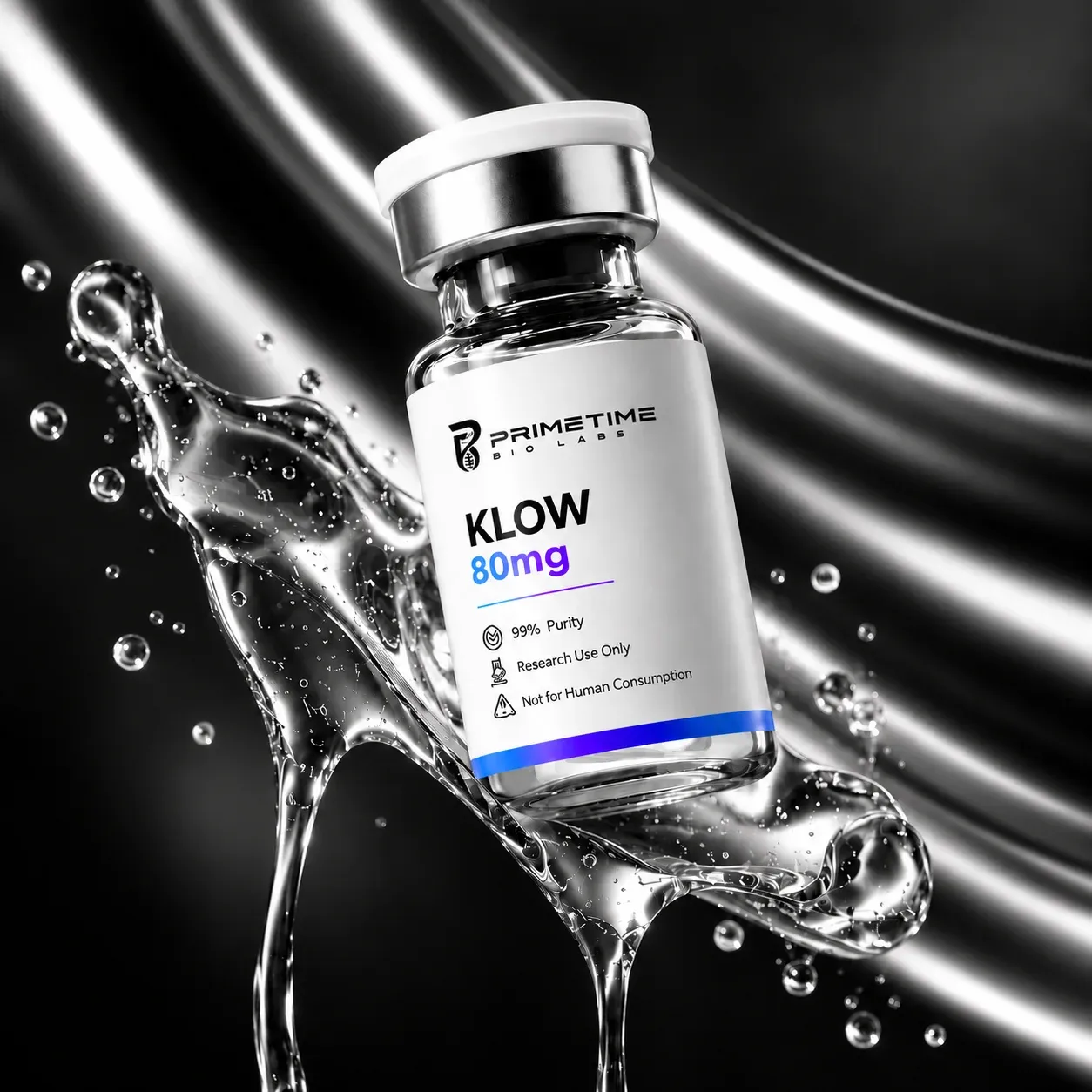
- Product KLOW · Components disclosed GHK-Cu, BPC-157, TB-500, KPV · Labeled total 80 mg · Price on 18 Oct 2026 $89.99 · Per-component split not published · Page KLOW product page
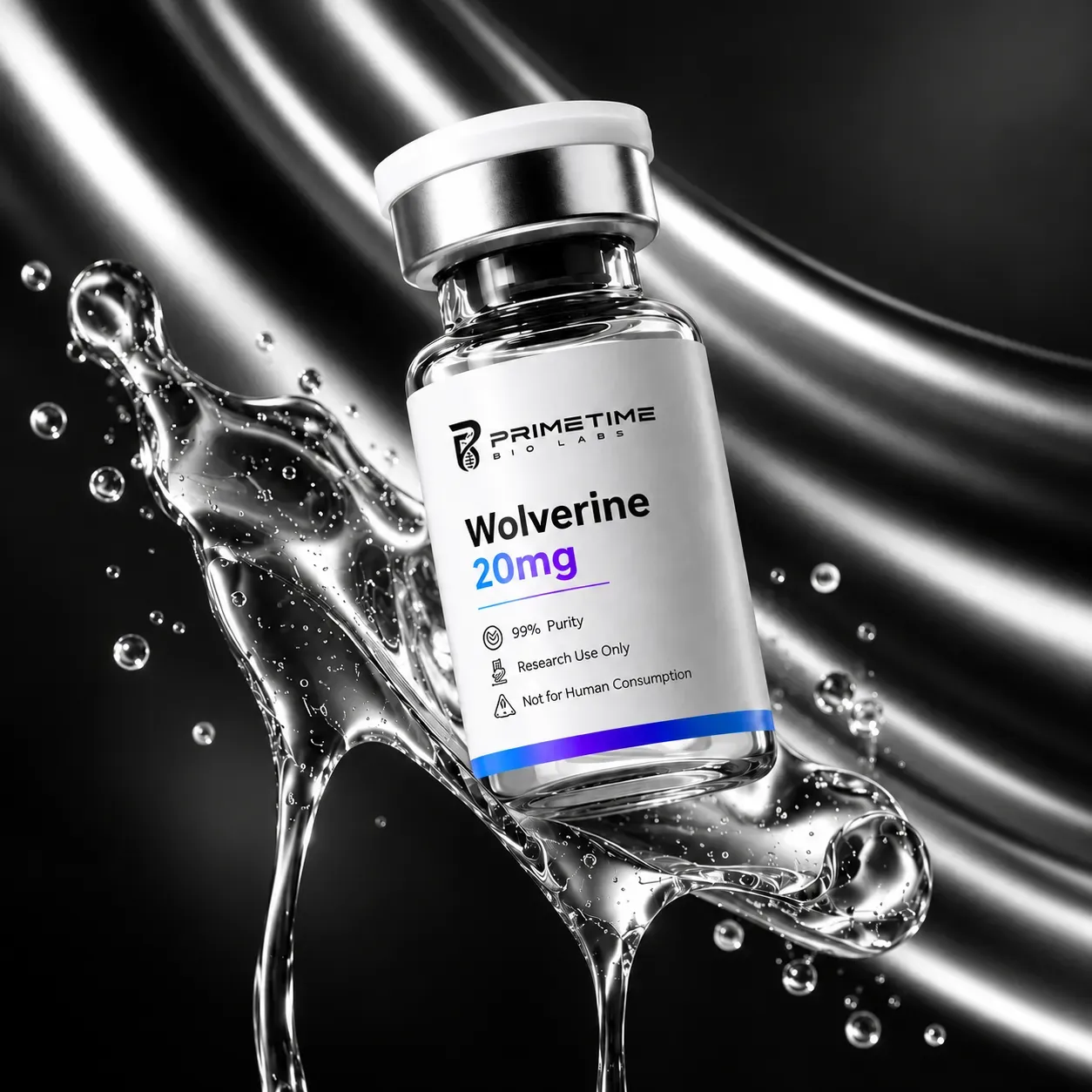
- Product Wolverine · Components disclosed BPC-157, TB-500 · Labeled total 20 mg · Price on 18 Oct 2026 $84.99 · Per-component split not published · Page Wolverine product page
KLOW is the same three components with KPV added. The evidence comparison between the two blends, and what KPV does or does not add, is covered in the KLOW research review. Wolverine is the two repair components without the copper peptide, and it is covered in the Wolverine research review. Neither comparison is repeated in this article.
Price per labeled milligram, checked 18 October 2026
- GLOW — Price: $79.99 — Labeled total mass: 70 mg — Price per labeled mg: $1.14
- KLOW — Price: $89.99 — Labeled total mass: 80 mg — Price per labeled mg: $1.12
- Wolverine — Price: $84.99 — Labeled total mass: 20 mg — Price per labeled mg: $4.25
This arithmetic divides the vial price by the total labeled mass. It is not a per-component cost, because no per-component amounts are published for any of the three. It does not measure potency, quality or value, and it does not compare like with like, because the products contain different components in different numbers.
What a certificate can confirm when three peptides share one vial
A certificate of analysis is a test record. It can support only what it actually measured, and a blend raises questions a single-peptide certificate never has to answer.
What a certificate can and cannot settle for a blend
- Field identity · What it can support that a named compound was detected · What it cannot prove that all three components are present, unless each is named and tested separately · Batch-specific yes
- Field purity, as a single percentage · What it can support how much of the measured material was the target · What it cannot prove how the mass divides between three components, because one figure describes one measurement · Batch-specific yes
- Field quantity or content · What it can support an amount, where an amount was measured · What it cannot prove a per-component split, unless the certificate reports each component separately · Batch-specific yes
- Field batch or lot number · What it can support that the document belongs to a specific production run · What it cannot prove anything about a different lot · Batch-specific yes
- Field method · What it can support that a stated technique was used · What it cannot prove that the technique was suitable for separating three peptides in one sample · Batch-specific no
- Field anything not on the document · What it can support nothing · What it cannot prove sterility, endotoxin levels or stability, unless those tests are named and reported · Batch-specific not applicable
The key point follows from the second and third rows. A certificate reporting one purity figure for a three-component vial cannot confirm the ratio, because a single number cannot describe three quantities. Only a certificate that names and measures each component separately could do that.
The GLOW product page states that its purity figure applies to one batch, tested on one date. It also states that testing shows chemical composition and cleanliness, not biological activity, safety or effectiveness. For how the standard fields work on a single-peptide certificate, see the guide to reading a peptide certificate of analysis.
One further detail is worth noticing here. GLOW and KLOW currently display the same batch number and the same analysis date, for two products with different component counts and different total masses.
Why single-component stability data does not reach a three-peptide vial
Storage advice for research peptides is often presented as settled. For this blend, very little is.
No published stability study was identified for GHK-Cu, BPC-157 or TB-500 as individual research materials. If no component has its own validated window, a vial holding all three cannot inherit a combined one. Three components means three degradation profiles, and no study has measured them together in one container.
The GLOW product page gives no storage temperature, no shelf life and no reconstituted hold time. It states that the vial is sealed and light-protected for shipping and storage. Neither its quality section nor its compliance section mentions stability testing.
Why windows quoted for one product do not transfer to another is explained in the guide to storing peptides without stability data. That argument is not repeated here. The blend-specific point here is a narrower one. A number borrowed from a different formulation is not evidence about this one, and three unmeasured components do not become measured by sharing a vial.
Why an undisclosed split rules out any protocol
This article gives no dosing, no protocol, no cycle and no reconstitution method. That omission is not a formality.
Anything operational would have to begin from the amount of each component present. That amount is not published anywhere. Building a procedure on an unpublished number would mean inventing the number first, and every figure in circulation contradicts at least one other figure.
GLOW is sold for laboratory research use only. It is not approved for use in people, and nothing here should be read as guidance for such use. This article evaluates published product information and published evidence. Where neither exists, it says so.